


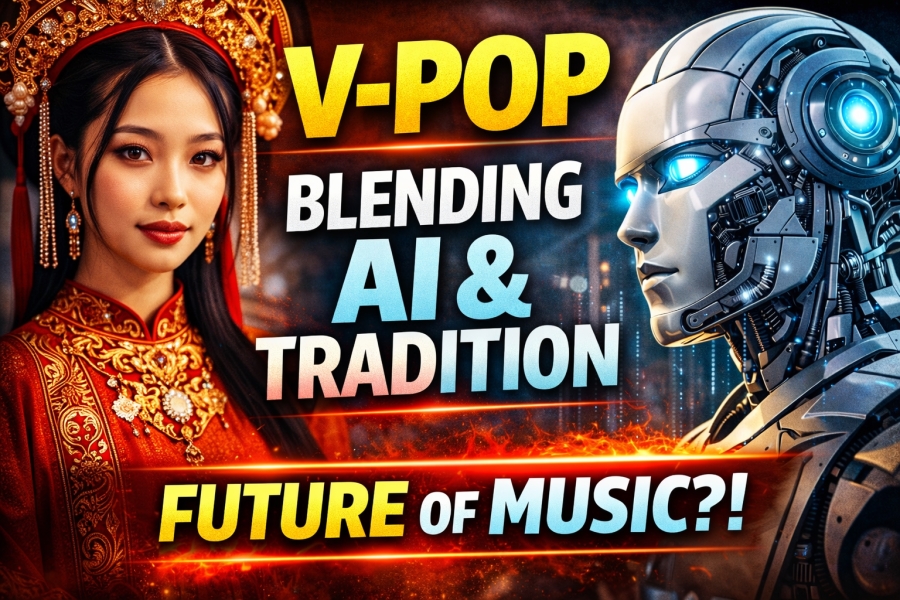
How V-Pop Is Blending AI and Tradition to Shape the Future of Music
Vietnam’s pop music scene, known as V-Pop, is quietly redefining the global music landscape by blending artificial intelligence with deep cultural tradition. While many markets rush toward fully AI-generated music, Vietnam is taking a different path — one that respects heritage, identity, and human creativity. From AI-assisted production and data-driven fan engagement to visually rich storytelling rooted in folklore, V-Pop is proving that innovation does not require cultural sacrifice. In 2026, this balance between cutting-edge technology and tradition may position Vietnam as one of the most forward-thinking music markets in the world.
In the global conversation around music and technology, most attention is focused on Western markets — the U.S., Europe, and South Korea. But quietly and confidently, Vietnam’s pop music scene (V-Pop) is undergoing a profound transformation of its own. One that doesn’t simply adopt artificial intelligence blindly, nor reject tradition outright — but instead fuses AI innovation with deep cultural roots.
V-Pop’s evolution represents a powerful case study in how emerging music markets can modernize without losing identity. In 2026, Vietnam stands at a fascinating crossroads: embracing AI-driven production, analytics, and marketing tools, while still grounding its sound, storytelling, and aesthetics in centuries-old musical traditions.
This balance — between the future and the past — may be one of the most important lessons for the global music industry.
The Rise of V-Pop: From Local Sound to Global Movement
Vietnamese pop music has existed for decades, but its modern explosion began in the early 2010s. As internet access expanded and streaming platforms became dominant, a new generation of Vietnamese artists emerged — fluent in global pop structures yet deeply influenced by local culture.
Artists such as Sơn Tùng M-TP, Mỹ Tâm, Suboi, MIN, and Hoàng Thùy Linh helped redefine what Vietnamese pop could be: polished, cinematic, culturally confident, and commercially viable.
Unlike many Western pop scenes, V-Pop has always carried a strong narrative and visual identity. Music videos often incorporate traditional clothing, folklore, historical imagery, and symbolic storytelling — elements that continue to define the genre today.
Now, AI is entering this ecosystem — not as a replacement for creativity, but as a multiplier.
How AI Is Entering the V-Pop Ecosystem
Artificial intelligence is influencing V-Pop across multiple layers of the music pipeline:
🎧 1. Music Production & Composition
AI tools are increasingly used to:
-
Assist with melody generation
-
Suggest chord progressions
-
Analyze hit song structures
-
Speed up demo creation
However, unlike fully AI-generated tracks seen elsewhere, Vietnamese producers still lead the creative direction. AI acts as a collaborator, not a composer. Traditional instruments like the đàn tranh, đàn bầu, and sáo trúc are still recorded by human musicians, then enhanced using modern production techniques.
The result? Music that sounds modern yet unmistakably Vietnamese.
🎼 2. Preserving Traditional Sounds Through AI
One of the most interesting developments in Vietnam is the use of AI to preserve traditional music, not erase it.
Researchers and producers are:
-
Digitizing traditional instruments
-
Training AI models on historical folk melodies
-
Using AI to restore old recordings
-
Creating virtual instruments that replicate traditional timbres
Rather than replacing folk music, AI is being used to archive and protect it — ensuring cultural continuity in a digital age.
This approach contrasts sharply with fears elsewhere that AI will homogenize global music.
AI-Powered Visual Storytelling in V-Pop
V-Pop is as visual as it is sonic. Music videos are treated as cinematic experiences, often rooted in mythology, spirituality, and national history.
AI now plays a growing role in:
-
Visual effects
-
Scene generation
-
Animation
-
Color grading
-
Motion tracking
Yet the themes remain deeply traditional.
For example:
-
Ancient legends are reimagined with futuristic visuals
-
Traditional costumes appear in AI-enhanced dreamscapes
-
Folklore narratives are layered with modern symbolism
This creates a powerful contrast: cutting-edge visuals telling ancient stories.
Data, AI, and Fan Engagement in Vietnam
Vietnam’s young, mobile-first population has made it fertile ground for data-driven music strategies.
AI is increasingly used to:
-
Analyze listener behavior
-
Predict viral potential
-
Optimize release timing
-
Customize fan engagement
-
Localize marketing campaigns
Vietnamese labels and independent artists alike are leveraging AI analytics to understand:
-
Which regions respond best to certain sounds
-
How visuals affect engagement
-
What lyrical themes resonate most with Gen Z
Still, unlike hyper-commercial Western models, V-Pop often prioritizes community loyalty over algorithmic domination.
Fans don’t just stream — they participate, remix, comment, and build narratives around artists.
Tradition as a Creative Anchor, Not a Limitation
One of the most striking aspects of V-Pop is how tradition is treated as a strength, not an obstacle.
Themes commonly found in V-Pop include:
-
Family and ancestry
-
Spirituality and fate
-
National identity
-
Feminine and masculine archetypes
-
Rural vs urban life
AI does not dilute these themes — instead, it helps amplify them for modern audiences.
This stands in contrast to many global pop markets where AI trends push toward sameness.
Vietnam proves that authentic cultural storytelling still wins.
The Ethical Line: AI as Tool, Not Identity
Vietnamese artists and industry leaders are increasingly vocal about ethical AI use.
There is a growing consensus around:
-
Rejecting AI voice cloning without consent
-
Avoiding full AI-generated artists
-
Maintaining transparency around AI-assisted creation
-
Protecting artist identity and originality
This mirrors broader global debates — but Vietnam’s response has been notably measured and intentional.
Rather than chasing novelty, the focus remains on human expression.
How V-Pop Differs from K-Pop and Western AI Adoption
While V-Pop is often compared to K-Pop, their approaches to AI differ significantly.
| Aspect | V-Pop | K-Pop / Western Pop |
|---|---|---|
| AI Role | Supportive, assistive | Aggressive, scalable |
| Tradition | Central to identity | Often secondary |
| Artist Image | Human-centric | Increasingly virtual |
| Cultural Roots | Strongly emphasized | Sometimes abstracted |
V-Pop’s strategy is less about global domination and more about cultural longevity.
Why V-Pop’s Approach Matters Globally
Vietnam’s blend of AI and tradition offers a powerful alternative vision for the future of music:
-
Technology doesn’t have to erase culture
-
Innovation doesn’t require losing identity
-
AI can preserve heritage, not replace it
-
Global relevance can coexist with local roots
As AI continues to flood the global music market with synthetic content, V-Pop shows another path — one rooted in intention, respect, and balance.
What the Future Holds for V-Pop
Looking ahead, V-Pop is likely to:
-
Expand globally through digital platforms
-
Collaborate with other Asian and global artists
-
Use AI more deeply in live performances and visuals
-
Continue digitizing cultural heritage
-
Inspire other emerging markets
Vietnam may not be the loudest voice in the AI music debate — but it may be one of the wisest.
Conclusion: A Model for the Future of Music
In a world racing toward automation, Vietnam’s pop music scene reminds us that technology is most powerful when guided by human values.
V-Pop’s blend of AI and tradition isn’t about nostalgia or resistance. It’s about evolution with memory — progress that honors where it came from.
As the global music industry grapples with questions of authenticity, identity, and the role of AI, Vietnam offers a compelling answer:
The future of music doesn’t belong to machines or humans alone — it belongs to cultures that know how to balance both.
And that, brother, is why V-Pop’s story matters far beyond Vietnam 🌏🎶
