


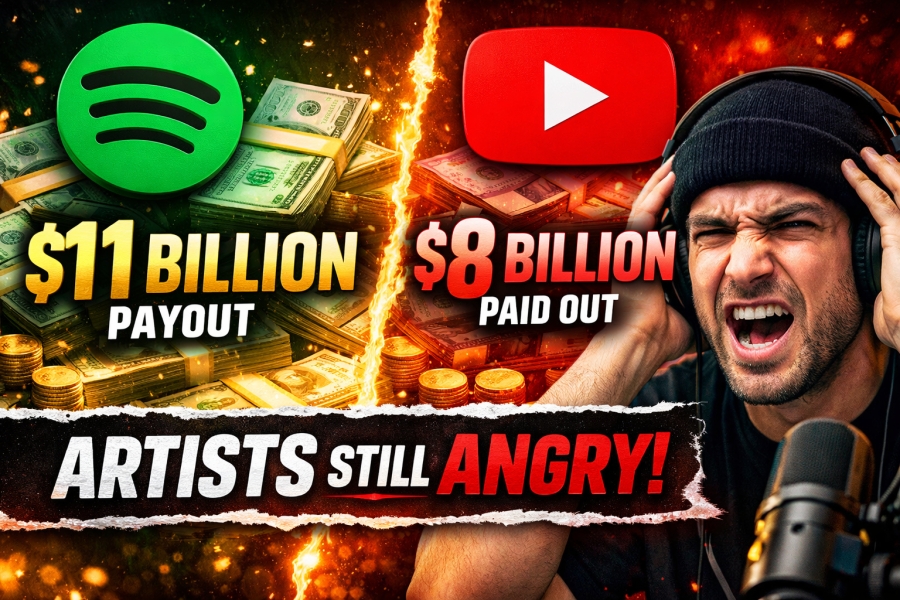
Streaming Money Is Exploding (But Still Controversial)
The Truth Behind Spotify’s $11 Billion and YouTube’s $8 Billion Music Payout Boom
The global music industry is experiencing one of the most dramatic financial transformations in its history. After years of decline caused by piracy and collapsing physical sales, streaming platforms have not only revived the industry—they’ve turned it into a multi-billion-dollar powerhouse.
At the center of this revolution are two giants: Spotify and YouTube.
In 2025 alone:
-
Spotify paid over $11 billion to the music industry
-
YouTube paid over $8 billion in a single year
These numbers are staggering. But here’s the catch:
Despite record-breaking payouts, artists are still unhappy.
So what’s really going on?
Let’s break it down.
🎧 The Streaming Boom: More Money Than Ever Before
The modern music economy is powered by streaming, and it’s growing fast.
According to Spotify’s latest reports, the platform paid out more than $11 billion in 2025, marking the largest annual payout in music history.
At the same time, YouTube revealed it paid more than $8 billion to the music industry between 2024 and 2025, highlighting its increasing role in music monetization.
This isn’t just incremental growth—it’s explosive.
Streaming now accounts for the majority of global music revenue, with billions of users worldwide contributing through subscriptions and ad-supported listening.
Even more impressive:
-
Spotify alone contributes roughly 30% of global recorded music revenue
-
Around 70% of its revenue is paid back to the industry
👉 In simple terms:
The more streaming grows, the more money flows into music.
📈 A Rising Tide… But Who Benefits?
At first glance, these numbers suggest a golden era for artists. And in some ways, that’s true.
Spotify reports:
-
Over 13,800 artists now earn $100,000+ per year from the platform alone
-
Around 1,500 artists generate over $1 million annually
-
Even smaller artists are earning more than ever before compared to a decade ago
There’s also been a massive rise in independent artists:
-
Roughly half of Spotify’s payouts go to indie artists and labels
This signals a huge shift:
👉 You no longer need a major label to make money in music.
Streaming has:
-
Democratized distribution
-
Opened global audiences
-
Created new income opportunities
But here’s where things get complicated…
⚠️ The Big Controversy: Artists Still Feel Underpaid
Despite billions flowing into the industry, many artists argue they’re not seeing their fair share.
The core issue lies in how streaming payments actually work.
Unlike traditional sales (where an artist earns money per album or download), streaming platforms use a pro-rata system:
-
All revenue is pooled together
-
Artists are paid based on their share of total streams
This means:
👉 Your income depends on your percentage of total listens—not just your fans.
Spotify itself confirms it doesn’t pay artists directly. Instead, money goes to rights holders (labels, publishers, distributors), who then split it further.
💡 Why This Causes Problems
1. Superstars Take a Huge Share
Because payouts are based on total streams:
-
Top artists dominate revenue
-
Smaller artists get a much smaller slice
Critics argue this creates a system where:
👉 The rich get richer
2. Millions of Streams = Modest Income
Even with growth, per-stream payouts are still low.
Artists often need:
-
Hundreds of thousands
-
Or even millions of streams
…to generate meaningful income.
3. Labels Take a Cut
If you’re signed:
-
Labels, publishers, and distributors all take percentages
-
Artists may receive only a fraction of total earnings
4. Streaming Replaced Higher-Paying Formats
In the past:
-
CD sales = higher margins
-
Downloads = direct purchases
Now:
-
Streaming pays fractions of a cent per play
🎤 The Artist Backlash Is Growing
This tension has led to increasing criticism from musicians worldwide.
Many argue that:
-
Streaming platforms are profitable
-
But artists struggle to make a living
Some campaigns and proposals include:
-
A “penny per stream” model
-
User-centric payment systems (where your subscription only pays artists you listen to)
Critics say the current system is fundamentally flawed because:
👉 It prioritizes scale over loyalty
🔄 The Industry’s Defense: Streaming Saved Music
Streaming companies push back strongly against criticism.
Their argument is simple:
👉 Without streaming, the music industry might have collapsed.
In the early 2000s:
-
Piracy was rampant
-
Revenue was shrinking
-
Artists were losing income
Streaming reversed that trend by:
-
Making music accessible
-
Encouraging paid consumption
-
Reducing illegal downloads
Today:
-
The industry is growing again
-
More artists are earning than ever before
Spotify claims this is a more sustainable, long-term ecosystem.
🌍 Global Growth Is Changing Everything
One of the biggest impacts of streaming is global reach.
Artists now earn:
-
More than 50% of their royalties from international listeners
This means:
-
A track made in Turkey can blow up in Brazil
-
A UK Garage song can trend in Japan
Streaming has turned music into a truly borderless industry.
🚀 Independent Artists Are Winning (Sort Of)
Streaming has empowered independent musicians in ways never seen before.
Benefits include:
-
Direct distribution (no label needed)
-
Global exposure
-
Data-driven audience insights
Platforms like:
-
DistroKid
-
TuneCore
-
CD Baby
…allow artists to upload music directly to streaming services.
However, independence comes with challenges:
-
Marketing is harder
-
Competition is massive (100,000+ songs uploaded daily)
-
Visibility is limited without algorithm support
👉 So while access is easier, success is still difficult.
🤖 New Problem: AI and Streaming Fraud
Another layer of controversy is emerging in 2026:
-
AI-generated music
-
Fake streams and bot activity
Streaming platforms are now:
-
Cracking down on “fake plays.”
-
Filtering low-quality or spam content
Why?
Because fake streams:
-
Drain revenue from real artists
-
Manipulate charts and payouts
This is becoming a major battleground for the future of streaming.
💸 Where the Money Really Goes
Let’s break down a typical streaming dollar:
-
~30% → Platform (Spotify, YouTube, etc.)
-
~70% → Rights holders
-
Labels
-
Publishers
-
Distributors
-
Artists
-
From there:
-
Artists receive a percentage depending on contracts
👉 This layered system is why payouts feel smaller than headlines suggest.
🔮 The Future of Streaming Payments
The current model isn’t set in stone.
Here are the biggest potential changes coming:
1. User-Centric Payments
Instead of pooling all revenue:
-
Your subscription would only pay artists you listen to
2. Higher Subscription Prices
Streaming platforms are already increasing prices to:
-
Boost payouts
-
Improve profitability
3. AI Regulation
Expect:
-
AI labeling requirements
-
Stricter monetization rules
4. More Transparency
Platforms like Spotify are publishing more data to:
-
Address criticism
-
Show how money flows
⚖️ So… Is Streaming Good or Bad?
The answer is: both.
✅ The Good:
-
Record-breaking payouts
-
Global reach for artists
-
Independent music growth
-
Industry revival
❌ The Bad:
-
Low per-stream earnings
-
Unequal distribution
-
Complex royalty systems
-
Ongoing artist dissatisfaction
🎯 Final Thoughts: A Billion-Dollar Paradox
The modern music industry is built on a paradox:
👉 There has never been more money in music
👉 But it’s never been harder for most artists to earn a living
Spotify’s $11 billion and YouTube’s $8 billion payouts prove one thing clearly:
Streaming is not the problem—distribution is.
As the industry evolves, the biggest question isn’t whether streaming will continue to grow…
It’s whether artists will finally get a system that feels fair.
