


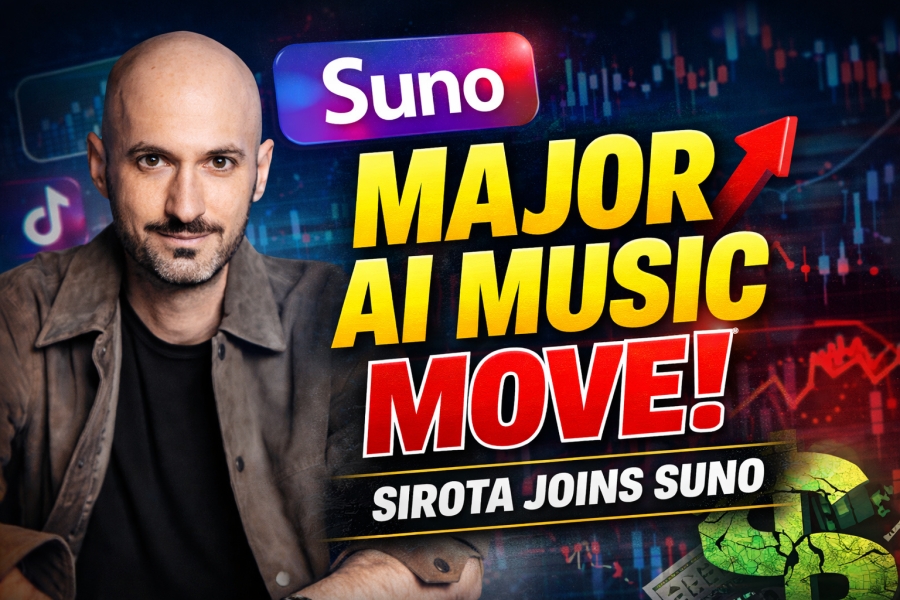
Suno Hires Former Merlin CEO Jeremy Sirota as Chief Commercial Officer: What This Means for the Future of AI Music
The artificial intelligence music race just intensified.
Suno, one of the fastest-growing AI music generation platforms, has officially hired former Merlin CEO Jeremy Sirota as its new Chief Commercial Officer (CCO). The move signals a major strategic shift — and potentially a new chapter in the evolving relationship between AI companies and the traditional music industry.
Sirota will lead Suno’s commercial strategy, music industry relationships, platform partnerships, and enterprise solutions. For an AI company currently navigating legal scrutiny, licensing debates, and industry skepticism, this appointment is far more than a routine executive hire.
It is a statement.
In this article, we break down what this hire means for Suno, the broader AI music landscape, independent artists, record labels, and the future of music commercialization.
Who Is Jeremy Sirota?
Jeremy Sirota is best known for serving as CEO of Merlin, the global digital rights agency representing tens of thousands of independent labels and distributors worldwide. Merlin negotiates licensing deals with major digital service providers like Spotify, Apple Music, YouTube, and TikTok on behalf of independent rights holders.
Before Merlin, Sirota held leadership positions at Warner Music Group and was deeply involved in digital licensing strategy and global music partnerships.
In short:
He understands music rights.
He understands streaming economics.
He understands how to negotiate with tech platforms.
That experience makes him a powerful addition to Suno — especially at a time when AI music companies are facing increasing legal and commercial pressure.
Why Suno’s Executive Move Is So Significant
AI music platforms like Suno have grown rapidly by allowing users to generate full songs using text prompts. These tools can create vocals, lyrics, instrumentation, and production styles in seconds.
However, their rapid rise has triggered serious questions:
-
Were training datasets properly licensed?
-
Are AI-generated songs infringing on copyrighted works?
-
How will artists and labels be compensated?
-
Can AI music coexist with traditional rights frameworks?
By hiring a seasoned executive with deep roots in the music licensing ecosystem, Suno appears to be signaling its intention to move toward structured commercial partnerships rather than remaining in a purely disruptive tech lane.
This isn’t just about growth.
It’s about legitimacy.
The AI Music Industry at a Crossroads
The broader AI music industry is currently experiencing a period of tension and transformation.
Legal Battles and Licensing Scrutiny
Several AI music companies are facing lawsuits from major record labels, who allege that copyrighted recordings were used to train generative models without authorization. These lawsuits could set precedent for how AI training data is regulated moving forward.
The music industry has historically resisted disruptive technologies before eventually integrating them (Napster, streaming, YouTube). But AI presents a new kind of challenge — one that involves not just distribution, but creation itself.
Bringing someone like Sirota into Suno’s leadership suggests the company understands the importance of negotiating with rights holders rather than ignoring them.
Suno’s Strategic Shift Toward Enterprise and Partnerships
According to the announcement, Sirota will oversee:
-
Commercial strategy
-
Music industry relationships
-
Platform partnerships
-
Enterprise solutions
This indicates Suno may be moving beyond consumer experimentation toward structured business-to-business models.
What Could This Look Like?
Potential developments could include:
-
Licensing agreements with independent labels
-
Revenue-sharing frameworks for AI-generated works
-
White-label enterprise AI music tools
-
Partnerships with streaming platforms
-
AI-assisted production tools for professional creators
Instead of positioning itself as a replacement for artists, Suno may be aiming to become a licensed technology partner within the music ecosystem.
That shift could significantly change how AI music platforms are perceived.
What This Means for Independent Artists
Independent artists are often the first to feel both the opportunities and risks of technological disruption.
On one hand, AI tools can:
-
Speed up production workflows
-
Help with songwriting inspiration
-
Reduce costs
-
Democratize access to music creation
On the other hand, concerns remain about:
-
Market oversaturation
-
Dilution of artistic value
-
Algorithmic competition
-
Copyright ambiguity
If Suno successfully builds structured agreements with independent rights holders — something Sirota is uniquely positioned to facilitate — it could open new monetization pathways rather than simply adding noise to the system.
For indie artists, the key question is this:
Will AI become a collaborator — or a competitor?
AI Music Commercialization: The Bigger Picture
The hiring of a Chief Commercial Officer with deep licensing expertise highlights a broader trend: AI music companies are transitioning from startup experimentation to revenue-focused, compliance-driven operations.
This phase typically includes:
-
Formalized licensing negotiations
-
Regulatory navigation
-
Investor accountability
-
Corporate governance expansion
As AI music matures, the companies that survive will likely be those that align with rights frameworks rather than fight against them.
Suno’s executive hire suggests it wants to be one of those companies.
The Power of Industry Relationships
One of Sirota’s strongest assets is his extensive network within the global music industry.
At Merlin, he represented independent labels across dozens of territories, negotiating with digital giants while advocating for fair economics for indies. That background gives him credibility — something AI startups often lack when entering rights conversations.
This credibility could help:
-
Reduce hostility between AI platforms and labels
-
Open negotiation channels
-
Establish pilot licensing programs
-
Explore revenue-sharing experiments
In a time when tensions between tech and music are high, relationships matter.
Will This Ease Industry Tensions?
The music industry’s reaction to generative AI has been cautious at best and adversarial at worst.
However, history shows that confrontation often transitions into collaboration once economic models are clarified.
Consider:
-
Streaming was once seen as the enemy of music.
-
YouTube faced massive licensing disputes in its early years.
-
Social platforms were accused of undervaluing content creators.
Today, all three are deeply embedded in the industry’s revenue ecosystem.
Suno’s move could signal the beginning of a similar trajectory for AI music — from disruption to integration.
The Commercial Future of AI Music
Looking ahead, several scenarios could emerge:
1. Licensed AI Training Models
AI platforms may pay rights holders to train on licensed catalogs, similar to how streaming services pay royalties.
2. Revenue-Sharing AI Outputs
Artists and rights holders could receive compensation when AI-generated music is influenced by licensed material.
3. Hybrid Human-AI Workflows
Professional producers may integrate AI tools into traditional production pipelines, increasing efficiency rather than replacing creativity.
4. New Business Categories
Entirely new licensing categories may be developed for AI-generated content.
If Suno successfully builds these frameworks, its commercial expansion could reshape how the industry interacts with AI.
Why This Move Matters Beyond Suno
Suno’s appointment of Jeremy Sirota is not just a company-specific update. It reflects a broader evolution across the AI creative sector.
Key signals include:
-
AI companies recognize the need for industry cooperation
-
Legal compliance is becoming central to growth
-
Commercial strategy now outweighs pure technical novelty
-
Investor confidence may depend on licensing stability
This is a maturation moment for AI music companies.
And executive hires like this often precede significant partnership announcements.
Risk Factors Still Remain
Despite this strategic hire, challenges persist:
-
Ongoing litigation involving AI training data
-
Regulatory uncertainty around generative models
-
Public perception concerns
-
Artist backlash
Even with strong leadership, Suno will need to demonstrate transparency, fairness, and ethical standards to earn trust.
Hiring a respected industry executive is a strong step — but execution will determine long-term success.
Final Thoughts: A Defining Moment for AI and Music
Suno's hiring of former Merlin CEO Jeremy Sirota as Chief Commercial Officer may mark a turning point in the AI music conversation.
Rather than positioning itself as an outsider disrupting the industry, Suno appears to be preparing to engage directly with rights holders, platforms, and enterprise partners.
For independent artists, labels, and tech observers, this move signals that AI music is entering its next phase — one defined not just by innovation, but by negotiation.
The future of music creation will likely include AI.
The real question is whether it will be collaborative, licensed, and sustainable.
With Jeremy Sirota now steering Suno’s commercial strategy, the company is betting that alignment — not opposition — is the path forward.
And the entire music industry will be watching closely.
