


Kaizen DSP Releases Choroboros: A Powerful FREE Multi-Engine Chorus Plugin (Open Beta)
In the world of music production, chorus effects remain one of the most essential tools for adding width, depth, and movement to a sound. From lush vocal doubling to swirling synth textures, chorus plugins are a staple in almost every producer’s workflow. Now, the Canadian audio software developer Kaizen DSP has introduced a new entry into the modulation space: Choroboros, a free multi-engine chorus plugin currently available in open beta for macOS and Windows.
Unlike many traditional chorus plugins that offer just a single algorithm or basic controls, Choroboros stands out with a multi-engine architecture, allowing producers to switch between several modulation styles ranging from classic analog chorus to experimental spatial effects. The plugin is currently offered free during its public beta period, giving producers and sound designers the opportunity to explore its capabilities before the official commercial release planned after the beta phase.
In this article, we’ll explore what Choroboros is, what makes it unique, its key features, and why this free plugin is already attracting attention in the audio production community.
What Is Choroboros?
Choroboros is a multi-engine chorus effect plugin designed to provide producers with deep control over modulation and stereo movement. Developed by Kaizen DSP, the plugin combines five different chorus engines and ten DSP algorithms inside a streamlined interface.
The goal of the plugin is simple: instead of forcing producers to use multiple chorus plugins to achieve different styles, Choroboros provides multiple sonic “colors” within one tool. Each engine is designed with a specific tonal character and processing approach, allowing users to quickly move from subtle stereo widening to rich analog modulation or experimental spatial effects.
The plugin is available in VST3 and AU formats for Windows and macOS, with support for modern sample rates up to 192 kHz and zero reported latency, making it suitable for both studio production and real-time processing.
Why Chorus Plugins Still Matter
Before diving deeper into Choroboros, it’s worth understanding why chorus effects remain so widely used in music production.
A chorus effect works by duplicating a signal and slightly modulating its pitch and timing, creating the illusion of multiple instruments or voices playing together. This technique adds movement and thickness to sounds without drastically altering their core tone.
Common uses include:
-
Thickening lead vocals
-
Adding width to synth pads
-
Creating movement in guitars
-
Enhancing bass textures
-
Designing atmospheric ambient soundscapes
Because of this versatility, modern producers often rely on chorus effects to give their tracks more life and dimension.
Choroboros builds on this tradition but takes the concept further by offering multiple chorus models in a single plugin.
The Five Chorus Engines
The defining feature of Choroboros is its five unique chorus engines, each designed with a different modulation style and sonic character.
Each engine also offers Normal and HQ modes, giving users a total of ten DSP algorithms to explore.
Let’s break them down.
1. Green Engine – Classic Chorus
The Green engine focuses on a traditional, musical chorus sound inspired by classic digital modulation effects.
It uses Lagrange interpolation algorithms that prioritize smooth pitch modulation while maintaining low CPU usage. The Normal mode uses a third-order interpolation, while the HQ mode increases fidelity with a fifth-order interpolation for more accurate harmonic behavior.
This engine is perfect for:
-
Guitar chorus
-
Vintage synth textures
-
Subtle vocal widening
-
Classic 80s-style modulation
The Green engine offers a familiar chorus sound that fits easily into most mixes.
2. Blue Engine – Modern Transparent Modulation
The Blue engine focuses on clean, modern chorus effects with precise stereo imaging.
Instead of emphasizing color or analog warmth, this engine uses cubic interpolation and Thiran allpass filters to maintain transparency and phase accuracy.
This makes it ideal for:
-
Modern electronic music
-
Clean vocal widening
-
Ambient sound design
-
Subtle stereo enhancement
If you want a chorus effect that enhances width without sounding “effected,” the Blue engine is a great choice.
3. Red Engine – Vintage Analog Emulation
The Red engine is designed for producers who love the warmth and character of classic analog gear.
In Normal mode, it uses a bucket-brigade device (BBD) filtering, which emulates the circuitry used in many vintage chorus pedals. In HQ mode, it switches to a tape-style algorithm that simulates wow, flutter, and tape saturation.
This engine excels at:
-
Vintage synth sounds
-
Retro chorus guitar tones
-
Lo-fi textures
-
Tape-style modulation effects
For producers working in genres like synthwave, house, or indie electronic, the Red engine offers plenty of analog-inspired character.
4. Purple Engine – Experimental Spatial Effects
The Purple engine is where Choroboros starts to get experimental.
Instead of traditional chorus modulation, this engine uses phase-warped processing and 2D orbital modulation, moving the signal across a virtual spatial plane rather than a simple modulation path.
The result can produce unusual stereo motion and evolving textures.
Sound designers may find this engine particularly useful for:
-
Experimental electronic music
-
Cinematic sound design
-
Ambient pads
-
Complex spatial modulation
This is one of the more unique aspects of Choroboros compared to typical chorus plugins.
5. Black Engine – Efficient Ensemble Processing
The Black engine is designed for efficient, low-CPU chorus processing.
Its Normal mode uses linear interpolation, creating a transparent modulation effect without adding significant coloration. In HQ mode, it expands into a multi-voice ensemble algorithm, which simulates multiple voices layered together.
This engine is perfect for:
-
Thick synth layers
-
Bass chorus
-
Wide pad stacks
-
Efficient CPU usage in large projects
Simple Yet Powerful Controls
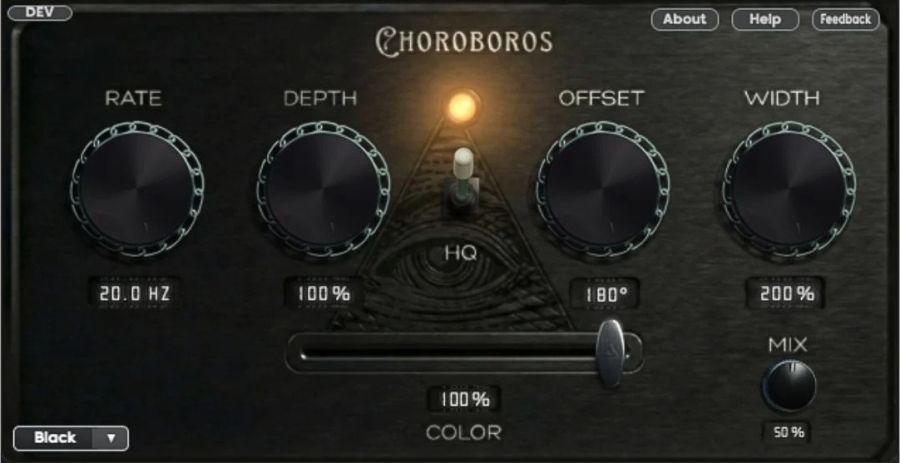
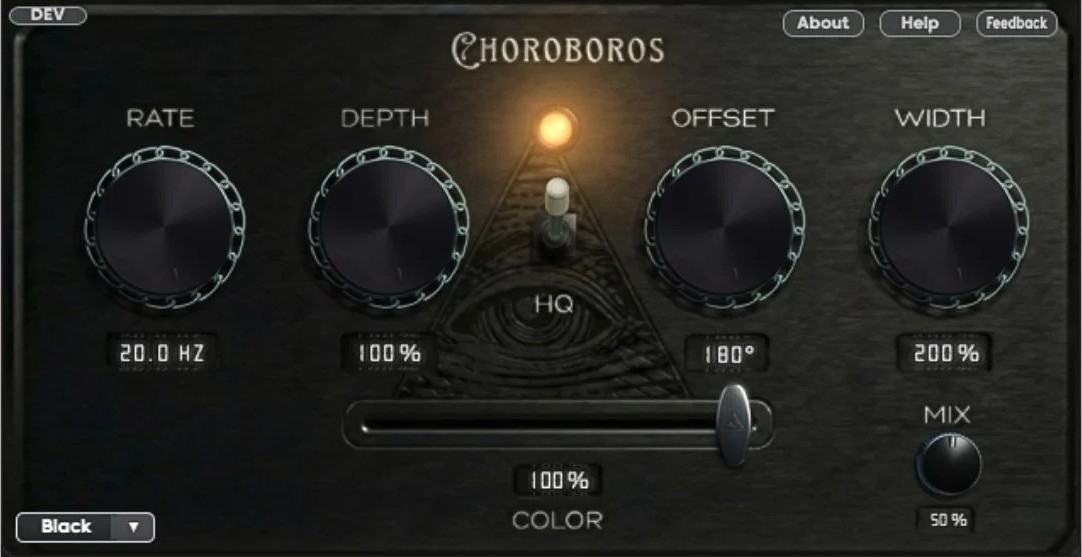
Despite its complex internal algorithms, Choroboros uses a minimal control layout, making it easy to use.
The plugin features six main parameters:
-
Rate – Controls modulation speed
-
Depth – Determines the intensity of pitch modulation
-
Offset – Adjusts LFO phase relationship
-
Width – Controls stereo spread
-
Color – Alters tonal character depending on the engine
-
Mix – Balances dry and wet signals
These controls allow producers to shape the chorus effect quickly without navigating complicated menus.
Tempo Sync and Workflow Enhancements
Choroboros includes several workflow-friendly features designed to make the plugin easier to use during production.
One of the most useful features is tempo synchronization. Users can right-click the Rate control to sync the modulation speed to their DAW’s BPM, with options for straight, triplet, dotted, and swing timing divisions.
Other workflow features include:
-
Engine memory – Each engine remembers its own settings
-
Direct value input – Double-click parameters to enter exact values
-
Per-engine visual skins – Unique interface design for each engine
-
Integrated feedback system – Send usage feedback directly from the plugin
These features make switching between modulation styles fast and intuitive.
A Unique Built-In Developer Panel
One feature that makes Choroboros stand out from many other plugins is its built-in developer panel.
This panel exposes the plugin’s internal DSP behavior in real time, allowing users to see how the algorithms are processing the audio signal.
The developer panel includes tools such as:
-
Real-time signal flow visualization
-
Audio thread timing diagnostics
-
Frequency response analysis
-
Engine-specific tone curves
-
Parameter mapping tools
For producers and audio developers interested in the technical side of DSP, this panel offers a rare level of transparency.
Open Beta and Future Plans
Currently, Choroboros is available as a free open beta, with the source code released under the GPLv3 license. This means developers and enthusiasts can explore the plugin’s internal algorithms during the beta period.
However, Kaizen DSP has stated that the final version (v1.0) will eventually become a commercial closed-source plugin, while the beta codebase will remain publicly available.
The beta phase is expected to continue until May 1, 2026, giving producers plenty of time to experiment with the plugin and provide feedback to the developers.
System Compatibility
Choroboros supports modern production environments with the following specifications:
-
Formats: VST3 and AU
-
Platforms: Windows and macOS
-
Sample rates: 44.1 kHz to 192 kHz
-
Bit depth: 32-bit floating point
-
Latency: 0 samples reported
A Pro Tools AAX version is currently under development, which will expand compatibility further once released.
Why Choroboros Is Worth Trying
For a free plugin, Choroboros offers a surprisingly deep feature set.
Here are a few reasons producers may want to add it to their toolkit:
1. Multiple chorus styles in one plugin
Instead of using several chorus plugins, you get five different modulation engines in one tool.
2. High-quality DSP algorithms
The plugin offers ten algorithms designed for both classic and modern chorus effects.
3. Advanced developer diagnostics
The integrated dev panel provides insight into how the plugin processes audio.
4. Modern workflow features
Tempo sync, parameter memory, and direct value entry improve usability.
5. Completely free during beta
Producers can download and use the plugin at no cost during the beta period.
Final Thoughts
The release of Choroboros by Kaizen DSP highlights how innovative free plugins can still be in today’s audio production landscape. With its multi-engine architecture, experimental modulation options, and transparent DSP design, Choroboros offers far more flexibility than many traditional chorus effects.
While the plugin is still in open beta, it already demonstrates strong potential as a powerful modulation tool for producers, sound designers, and mixing engineers.
If you’re looking for a versatile chorus plugin that goes beyond simple stereo widening, Choroboros is definitely worth exploring. Its combination of classic analog tones, modern digital precision, and experimental spatial effects makes it one of the more interesting new releases in the world of audio plugins.
And since the beta version is currently free, there’s no better time to give it a try.
