


🎵 Introduction: The Streaming Era Is Dominating Music
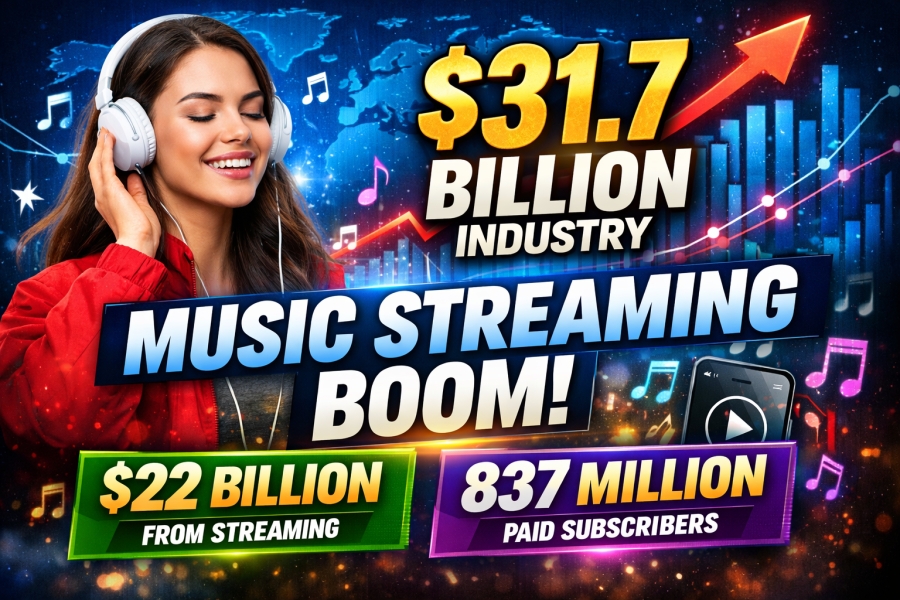
The global music industry is not just growing—it’s exploding at an unprecedented scale. In 2025, total revenues reached an incredible $31.7 billion, marking another record-breaking year for the business of music. At the center of this growth is one unstoppable force: music streaming.
Streaming alone generated over $22 billion, accounting for roughly 70% of the entire industry’s revenue. Even more impressive, the number of paid streaming subscribers worldwide has climbed to 837 million users—a figure that continues to rise rapidly.
This isn’t just growth. This is a complete transformation of how music is created, distributed, and monetized.
📈 The Numbers Behind the Boom
Let’s break down the key figures driving headlines across the music world:
-
$31.7 billion – Total global music industry revenue (2025)
-
$22+ billion – Revenue from streaming services
-
70% – Percentage of total revenue from streaming
-
837 million – Paid streaming subscribers worldwide
These numbers confirm one thing: streaming is no longer the future—it is the present.
Over the past decade, the industry has undergone a massive shift away from physical sales and downloads toward subscription-based and ad-supported streaming platforms. What started as a convenience has now become the dominant economic engine of music.
🌍 Why Music Streaming Keeps Growing
1. Global Accessibility
One of the biggest drivers of streaming growth is accessibility. Today, anyone with a smartphone and internet connection can instantly access millions of songs.
Emerging markets in regions like Asia, Africa, and South America are playing a massive role in this expansion. As internet infrastructure improves, millions of new users are entering the streaming ecosystem every year.
2. Affordable Subscription Models
Streaming platforms have mastered pricing strategies. With:
-
Student discounts
-
Family plans
-
Regional pricing
Music has become more affordable than ever. This has significantly reduced piracy and encouraged legal consumption.
3. Personalized User Experience
Advanced algorithms and AI-driven recommendations have transformed how people discover music. Users no longer need to search—music finds them.
Playlists, daily mixes, and curated suggestions keep listeners engaged for longer periods, increasing both user retention and revenue.
4. Mobile-First Consumption
Streaming fits perfectly into modern lifestyles. Whether commuting, working out, or relaxing, users can listen anytime, anywhere.
This “always-on” accessibility has made music a constant companion in daily life.
💰 Where the Money Is Coming From
Streaming revenue is divided into two main categories:
🔹 Subscription-Based Streaming
Paid subscriptions are the largest revenue driver. With 837 million subscribers globally, monthly fees generate consistent and predictable income for platforms and rights holders.
🔹 Ad-Supported Streaming
Free tiers supported by ads also contribute billions. These platforms act as entry points, eventually converting users into paid subscribers.
🎤 What This Means for Artists
While the industry is making more money than ever, the impact on artists is complex.
✅ Opportunities
-
Global reach: Artists can reach international audiences instantly
-
Low barriers to entry: No need for physical distribution
-
Data insights: Artists can analyze listener behavior
⚠️ Challenges
-
Low per-stream payouts: Revenue is spread thin across millions of artists
-
High competition: Over 100,000 tracks are uploaded daily
-
Algorithm dependency: Success often depends on playlist placement
For independent artists, streaming is both a blessing and a challenge. It provides access—but not guaranteed income.
🔥 The Rise of Independent Artists
One of the most important trends in the streaming era is the rise of independent musicians.
Artists no longer need major labels to distribute their music globally. Platforms and digital distributors have made it possible to:
-
Release music instantly
-
Build fanbases organically
-
Monetize content directly
However, standing out in a saturated market requires strong branding, marketing, and consistency.
🎧 The Role of Playlists and Algorithms
Playlists have become the new radio.
Being featured on major playlists can:
-
Generate millions of streams
-
Launch careers overnight
-
Increase visibility globally
Algorithms also play a huge role by:
-
Recommending songs based on user behavior
-
Boosting tracks with high engagement
-
Creating viral moments
This shift has fundamentally changed how hits are made.
🌐 Streaming and Globalization of Music
Streaming has removed geographical barriers.
Today:
-
Latin music dominates global charts
-
K-pop continues to expand worldwide
-
African genres like Afrobeats are gaining massive traction
Listeners are more open than ever to music from different cultures, languages, and styles.
This global exchange is shaping a more diverse and interconnected music industry.
📊 Is This Growth Sustainable?
While the numbers are impressive, questions remain about long-term sustainability.
Key Concerns:
1. Artist Compensation
Many artists argue that streaming payouts are too low. This has led to ongoing debates about fair distribution of revenue.
2. Streaming Fraud
Artificial streams generated by bots are becoming a growing issue, costing the industry billions.
3. Market Saturation
With millions of songs available, discoverability is becoming increasingly difficult.
🚀 Future Trends in Music Streaming
The streaming boom is far from over. Here are the trends shaping the next phase:
🎯 1. AI Integration
AI will play a bigger role in:
-
Music recommendations
-
Content creation
-
Listener personalization
🎯 2. Higher Subscription Prices
As platforms mature, price increases are expected to boost revenue further.
🎯 3. Exclusive Content
Platforms may invest more in:
-
Exclusive releases
-
Artist partnerships
-
Premium experiences
🎯 4. Immersive Audio
Technologies like spatial audio and high-resolution streaming are becoming more popular.
🎯 5. Direct-to-Fan Monetization
Artists are exploring new ways to earn, including:
-
Fan subscriptions
-
Exclusive content
-
Merch integrations
🎵 The Return of Physical Formats (Yes, Really)
Despite streaming dominance, physical formats—especially vinyl—are making a surprising comeback.
Vinyl sales have been growing for nearly two decades, driven by:
-
Collectors
-
Audiophiles
-
Nostalgia
This shows that while streaming is king, physical music still has emotional and cultural value.
⚡ Key Takeaways
-
The global music industry reached $31.7 billion in 2025
-
Streaming accounts for over 70% of total revenue
-
There are 837 million paid subscribers worldwide
-
Streaming continues to reshape how music is consumed and monetized
-
Opportunities for artists are growing—but so are challenges
🎯 Final Thoughts
Music streaming is not just a trend—it’s the foundation of the modern music industry.
With billions in revenue, hundreds of millions of subscribers, and continuous technological innovation, streaming has redefined what it means to be a musician, a fan, and a business in the digital age.
However, the industry is still evolving. Issues like fair pay, discoverability, and sustainability will shape the next chapter of this growth story.
One thing is certain:
Music streaming isn’t slowing down anytime soon. It’s only getting bigger.
