


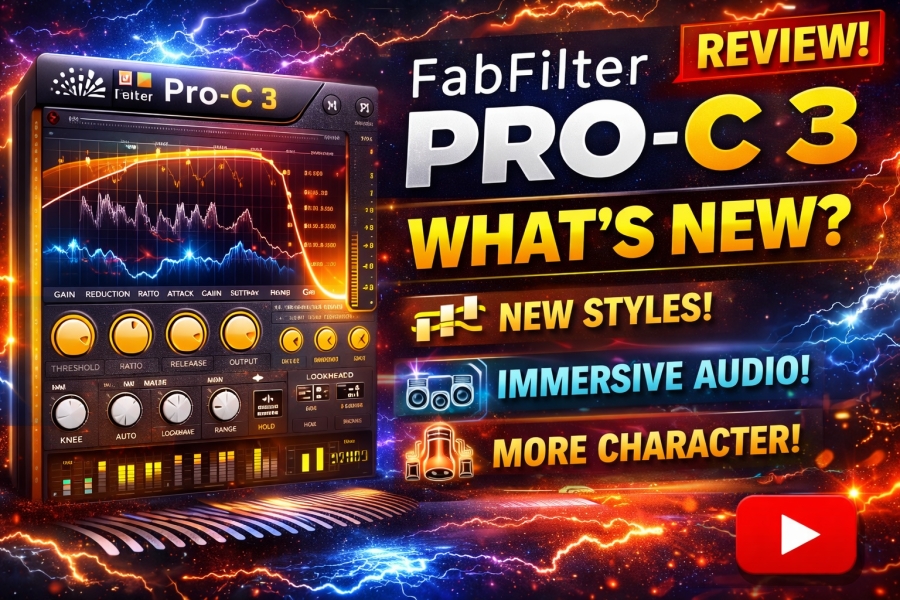
Pro-C 3: FabFilter Upgrades Its Hugely Popular Flagship Compressor Plugin – Here’s What’s New
FabFilter has officially raised the bar once again with the release of Pro-C 3, the next evolution of its hugely popular flagship compressor plugin. Already regarded as one of the most transparent, flexible, and intuitive compressors in modern music production, Pro-C has long been a staple in professional studios, bedroom setups, and post-production environments alike.
With six brand-new compression styles, fully immersive audio support, and a serious dose of character and creative flexibility, Pro-C 3 is not just an incremental update — it’s a significant leap forward. Whether you’re mixing music, mastering tracks, or working in film, TV, or game audio, this new version is designed to meet the demands of today’s producers and engineers.
In this in-depth guide, we break down everything that’s new in FabFilter Pro-C 3, what’s improved, and why this update matters.
What Is FabFilter Pro-C 3?
FabFilter Pro-C 3 is a professional dynamic range compressor plugin designed for mixing, mastering, sound design, and immersive audio workflows. It builds on the legacy of Pro-C 2, which was already considered one of the most transparent and user-friendly compressors on the market.
Known for its clean sound, detailed visual feedback, and intelligent controls, Pro-C has always balanced precision and musicality. With Pro-C 3, FabFilter expands that vision further by introducing more sonic character, modern surround and immersive audio support, and deeper control over dynamics — all while maintaining the company’s signature sleek interface.
What’s New in Pro-C 3? A Big Step Forward
FabFilter hasn’t just refreshed the UI and added a couple of presets. Pro-C 3 introduces major new functionality that directly responds to how modern producers work today.
Key Highlights at a Glance
-
Six brand-new compression styles
-
Fully immersive audio support (Dolby Atmos & surround formats)
-
Enhanced character and saturation options
-
Improved attack and release behavior
-
Smarter visual feedback and metering
-
Workflow refinements for faster mixing
Let’s dive into each of these upgrades in detail.
Six New Compression Styles for Maximum Versatility
One of the most headline-grabbing upgrades in Pro-C 3 is the introduction of six new compression styles, dramatically expanding the plugin’s sonic palette.
While previous versions focused heavily on transparency and clean control, Pro-C 3 leans more confidently into characterful compression, giving producers more tonal options without needing additional plugins.
Why Compression Styles Matter
Different compression styles react uniquely to transients, sustain, and dynamics. By expanding the number of styles available, FabFilter allows users to tailor compression behavior precisely to the material — whether it’s drums, vocals, bass, synths, or full mixes.
These new styles range from:
-
Ultra-transparent and surgical
-
Punchy and aggressive
-
Warm, musical, and character-driven
This means Pro-C 3 can now comfortably cover tasks that once required multiple compressors — from clean leveling to creative tone shaping.
Fully Immersive Audio Support: Built for the Future
One of the most important technical upgrades in FabFilter Pro-C 3 is its full immersive audio functionality.
Native Support for Modern Formats
Pro-C 3 now supports:
-
Dolby Atmos
-
Surround formats up to 9.1.6
-
Complex multichannel workflows
This makes it an excellent choice for film scoring, post-production, game audio, and immersive music mixing, where consistency and precision across channels are critical.
Channel Linking & Precision Control
FabFilter has refined channel linking options, allowing you to:
-
Compress channels independently
-
Link dynamics across surround beds
-
Maintain spatial integrity in immersive mixes
For engineers working in immersive environments, this update alone makes Pro-C 3 a must-have.
More Character Without Sacrificing Clarity
FabFilter plugins are famous for their clean sound — but Pro-C 3 adds a tasteful dose of character without compromising transparency.
Enhanced Compression Behavior
Pro-C 3 introduces:
-
More musical attack and release curves
-
Improved transient handling
-
Smoother gain reduction at higher ratios
This results in compression that feels alive and responsive, especially on drums, vocals, and buses.
Subtle Saturation & Harmonic Color
While Pro-C 3 is not a saturation plugin, the new compression styles introduce natural harmonic density that adds body and presence — particularly useful when working on vocals or analog-inspired mixes.
Visual Feedback: Still the Best in the Game
FabFilter has always excelled in visual clarity, and Pro-C 3 continues that tradition with subtle but meaningful refinements.
Improved Gain Reduction Display
The gain reduction meter is now even clearer, helping you:
-
See exactly how compression affects transients
-
Identify over-compression quickly
-
Dial in settings faster with confidence
Intuitive Interface Enhancements
Everything remains exactly where experienced users expect it to be — but smoother, faster, and more refined. FabFilter has mastered the art of improving workflows without breaking muscle memory.
Advanced Sidechain & Detection Options
Pro-C 3 retains FabFilter’s powerful sidechain and detection features while refining their responsiveness.
Sidechain EQ & Filtering
You can still shape the detector signal using:
-
High-pass and low-pass filtering
-
External sidechain input
-
Frequency-focused compression
This makes Pro-C 3 ideal for:
-
Vocal clarity
-
Bass-kick separation
-
Dynamic resonance control
Perfect for Mixing, Mastering, and Beyond
One of the biggest strengths of FabFilter Pro-C 3 is its versatility.
For Mixing Engineers
-
Control vocals with precision
-
Add punch to drums
-
Glue buses together naturally
For Mastering Engineers
-
Transparent dynamic control
-
Minimal phase distortion
-
Precise stereo and multichannel handling
For Sound Designers & Post-Production
-
Shape dynamics creatively
-
Maintain clarity in complex sessions
-
Work seamlessly in surround and immersive formats
Few compressors can move so effortlessly between these roles.
Pro-C 3 vs Pro-C 2: Is the Upgrade Worth It?
If you’re currently using Pro-C 2, the question is obvious: should you upgrade?
Reasons to Upgrade to Pro-C 3
-
You want more character and tonal options
-
You work in surround or immersive audio
-
You need more modern compression behavior
-
You want future-proof compatibility
If you rely on Pro-C daily, Pro-C 3 feels less like an optional update and more like a natural next step.
Performance & Compatibility
FabFilter Pro-C 3 is optimized for modern systems and offers excellent performance even in large sessions.
Supported Formats
-
VST3
-
AU
-
AAX
Supported Platforms
-
macOS (Apple Silicon & Intel)
-
Windows
It integrates seamlessly with all major DAWs, including Ableton Live, Logic Pro, Pro Tools, Cubase, Studio One, FL Studio, and more.
Final Thoughts: A New Benchmark for Compression
FabFilter Pro-C 3 is not just an update — it’s a statement. By combining six new compression styles, immersive audio support, and refined sonic character, FabFilter has once again set a new benchmark for what a modern compressor plugin should be.
Whether you’re a producer, mix engineer, mastering engineer, or post-production professional, Pro-C 3 delivers:
-
Surgical precision
-
Musical flexibility
-
Future-ready workflows
In a crowded plugin market, Pro-C 3 stands out as a tool that balances technical excellence with creative freedom — and that’s exactly why FabFilter remains at the top of the game.
