


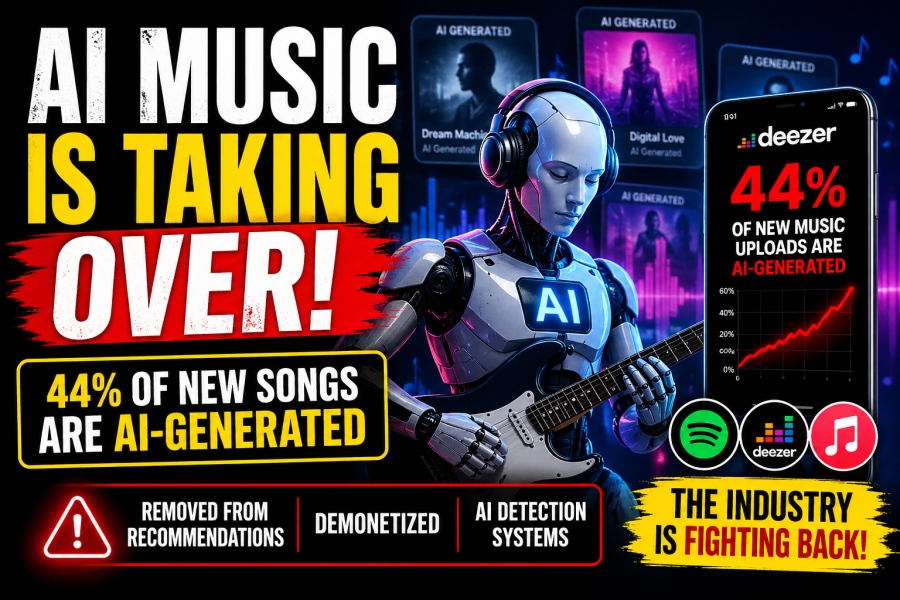
AI Music Is Flooding the Industry in 2026: What It Means for Artists, Streaming Platforms, and the Future of Music
The music industry is facing one of the biggest disruptions in its history — and it’s happening faster than anyone expected.
Artificial intelligence is no longer just a creative tool. It has become a mass production engine, generating music at a scale that is overwhelming streaming platforms and reshaping the entire ecosystem.
Recent reports from platforms like Deezer reveal a shocking reality:
- Nearly 44% of all new music uploads are now AI-generated
- Around 75,000 AI tracks are uploaded every single day
- That equals over 2 million AI songs per month
This is not a trend. This is a takeover.
In this article, we’ll break down what’s happening, why it matters, and how it could completely change the future of music.
The Rise of AI Music: From Tool to Mass Production
Just a few years ago, AI music tools were seen as experimental.
Platforms like:
- Suno
- Udio
allowed users to create songs using simple text prompts. What once took hours in a studio could now be done in seconds.
At first, this was exciting.
Producers used AI to:
- Generate ideas
- Speed up workflows
- Experiment with new sounds
But things escalated quickly.
AI tools improved at an exponential rate, and suddenly:
👉 Anyone could generate thousands of songs in a day.
This is where the problem began.
Why 44% AI Music Is a Massive Problem
At first glance, AI-generated music might not seem like a big issue.
But when nearly half of all new uploads are AI-created, the entire system starts to break down.
1. Oversaturation of Platforms
Streaming platforms are designed to help users discover music.
But when millions of AI songs are uploaded every month:
- Discovery becomes harder
- Quality gets diluted
- Algorithms struggle to filter content
This leads to a flooded ecosystem where genuine artists get lost.
2. Decline in Artist Visibility
For independent artists, visibility is everything.
But with AI generating thousands of tracks daily:
- Competition becomes unrealistic
- Organic growth becomes harder
- Smaller artists are pushed out
In simple terms:
👉 AI is not just competing with artists — it’s overwhelming them.
3. Fake Streams and Manipulation
AI music is often linked to streaming fraud.
Because AI can generate music cheaply and quickly, bad actors can:
- Upload massive catalogs
- Use bots to generate streams
- Collect royalties at scale
This creates a system where:
👉 Quantity beats quality.
How Streaming Platforms Are Fighting Back
Platforms like Deezer, Spotify, and Apple Music are now taking aggressive action.
This is one of the biggest shifts in the industry right now.
Removing AI Music From Recommendations
One of the first major steps is limiting exposure.
Platforms are:
- Removing AI tracks from algorithmic recommendations
- Preventing them from appearing in curated playlists
- Reducing their visibility across the platform
This is critical because:
👉 Recommendations are the main driver of streams.
Without algorithm support, AI music loses much of its impact.
Demonetizing AI-Generated Content
Another major move is cutting off revenue.
Some platforms are:
- Refusing to pay royalties on AI-generated tracks
- Flagging suspicious uploads
- Blocking monetization entirely
This directly targets the financial incentive behind AI spam.
If AI music can’t generate revenue:
👉 The motivation to flood platforms decreases.
Building AI Detection Systems
Perhaps the most important response is technology itself.
Streaming platforms are investing heavily in:
- AI detection algorithms
- Audio fingerprinting
- Metadata analysis
These systems are designed to:
- Identify AI-generated tracks
- Detect mass-upload patterns
- Flag fraudulent behavior
This creates a technological arms race:
👉 AI vs AI.
The Algorithm Problem: Why AI Breaks Music Discovery
Streaming platforms rely on algorithms to recommend music.
These systems analyze:
- Listening behavior
- Engagement rates
- Popularity trends
But AI music disrupts this system.
When thousands of similar tracks are uploaded:
- Algorithms receive distorted signals
- Engagement metrics become unreliable
- Recommendations lose accuracy
This leads to a worse experience for listeners.
The Listener Experience Is Changing
For everyday users, the rise of AI music is already noticeable.
Listeners may experience:
- Lower-quality recommendations
- Repetitive or generic tracks
- Difficulty discovering authentic artists
In some cases, users don’t even realize they are listening to AI-generated music.
This raises a major concern:
👉 If listeners can’t tell the difference, does authenticity still matter?
The Rise of AI Artists
Perhaps the most controversial development is the emergence of AI artists.
These are:
- Fully AI-generated personas
- With AI-generated voices
- Releasing AI-generated music
Some of these artists are already:
- Gaining streams
- Building audiences
- Appearing on charts
This blurs the line between:
- Human creativity
- Machine-generated content
What This Means for Real Artists
For human artists, this shift is both a threat and an opportunity.
The Threat:
- Increased competition
- Reduced visibility
- Pressure to produce more content
The Opportunity:
- Use AI as a tool
- Focus on authenticity
- Build stronger fan connections
Artists who adapt may thrive.
Those who don’t may struggle.
The Industry Is Entering a New Phase
The music industry has gone through many transformations:
- Vinyl → CD
- CD → Digital downloads
- Downloads → Streaming
Now, we are entering the next phase:
👉 Streaming → AI-driven ecosystems
This shift is happening faster than any previous transition.
Regulation May Be the Next Step
As AI music continues to grow, regulation is becoming inevitable.
Governments and industry bodies may introduce:
- AI labeling requirements
- Copyright protections
- Royalty frameworks for AI content
This could help restore balance in the industry.
The Future of Music in an AI World
Looking ahead, several outcomes are possible:
1. Controlled AI Integration
AI becomes a tool, not a replacement.
2. Verified Artist Systems
Platforms prioritize verified human creators.
3. New Revenue Models
Streaming evolves to support both human and AI content.
4. Increased Transparency
Listeners know exactly what they are hearing.
The Bigger Picture: A Turning Point
The rise of AI music is not just a technological shift.
It is a cultural shift.
It challenges:
- What it means to be an artist
- How music is valued
- How creativity is defined
This is why the current moment is so important.
Final Thoughts: AI Is Here to Stay — But the Industry Must Adapt
AI music is not going away.
It will continue to grow, evolve, and integrate into the music industry.
But the current situation — where nearly half of all uploads are AI-generated — is not sustainable.
Streaming platforms, artists, and listeners must adapt.
Because right now, one thing is clear:
👉 AI is no longer just part of the music industry.
👉 It is reshaping it entirely.
