


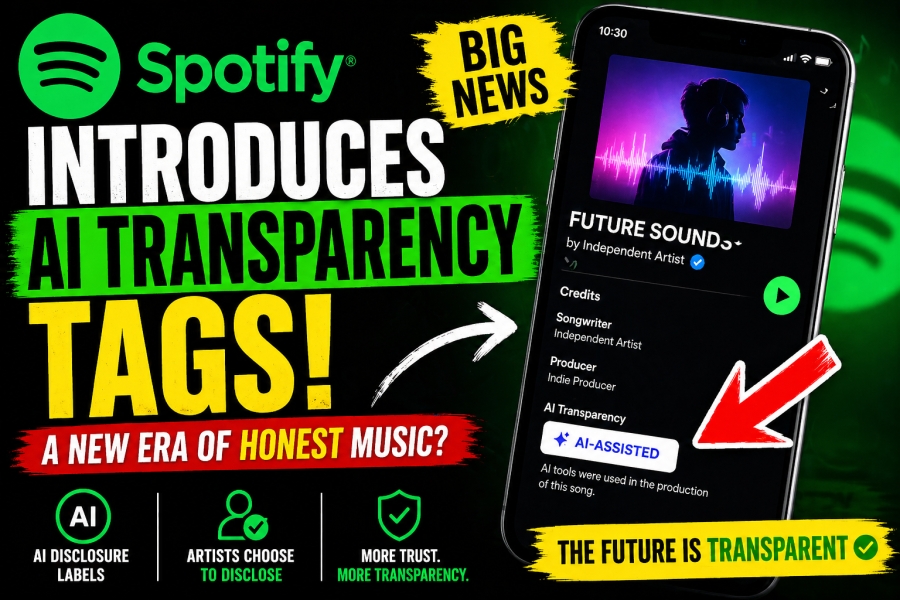
Spotify Introduces AI Transparency Tags: A Major Shift Toward Trust in the Music Industry
The music industry is entering a new era — one defined not just by sound, but by transparency.
As artificial intelligence continues to reshape how music is created, distributed, and consumed, streaming platforms are under increasing pressure to clarify what listeners are actually hearing. Now, Spotify is taking a major step forward by testing AI transparency tags — a feature that could fundamentally change how music is labeled and understood in 2026 and beyond.
This move signals something much bigger than a simple update.
👉 It marks the beginning of a new standard: AI disclosure in music.
In this article, we break down what Spotify’s AI transparency tags are, how they work, and why this could be one of the most important developments in the modern music industry.
What Are Spotify’s AI Transparency Tags?
Spotify’s new AI transparency tags are designed to give listeners more information about how a song was created.
Under this system:
- Songs may include AI disclosure labels within the credits section
- Artists and labels can choose whether to indicate AI involvement
- The feature is currently being tested before a wider rollout
These tags aim to inform listeners if artificial intelligence played a role in:
- Songwriting
- Production
- Vocal generation
- Composition
This means that for the first time, users could clearly see whether a track was:
👉 Fully human-made, partially AI-assisted, or heavily AI-generated.
Why Spotify Is Introducing AI Labels Now
The timing of this feature is no coincidence.
The music industry is currently facing an unprecedented surge in AI-generated content. Reports from platforms like Deezer show that nearly 44% of new music uploads are now AI-generated, with tens of thousands of AI tracks being uploaded daily.
This explosion has created several major challenges:
- Difficulty distinguishing real artists from AI creations
- Increased risk of fraud and fake streaming
- Growing concerns about authenticity
Spotify’s AI transparency tags are a direct response to these issues.
👉 The goal is simple: bring clarity to a rapidly evolving landscape.
The Push Toward Transparency in Music
Transparency has become one of the most important topics in the music industry.
In the past, streaming platforms focused on:
- Convenience
- Personalization
- Accessibility
But in 2026, the focus is shifting toward:
- Authenticity
- Accountability
- Creator recognition
Spotify’s new feature aligns with this shift.
By introducing AI labels, Spotify is:
- Acknowledging the rise of AI music
- Addressing listener concerns
- Creating a more transparent ecosystem
This is not just about technology — it’s about trust.
How AI Transparency Tags Could Work in Practice
While Spotify is still testing the feature, we can expect AI tags to appear similarly to existing song credits.
For example, when viewing a track, users may see:
- Songwriters
- Producers
- Engineers
- AI involvement (if disclosed)
This could include labels such as:
- “AI-assisted production”
- “AI-generated vocals”
- “AI-composed elements”
The exact format may evolve, but the concept remains clear:
👉 Give listeners insight into how the music was created.
Why This Is a Big Deal for Listeners
For the average listener, this feature introduces a new layer of awareness.
Until now, most users had no way of knowing:
- Whether a song was created by a human
- Whether AI played a role in production
- Whether vocals were synthetic
AI transparency tags change that.
Key benefits for listeners:
- More informed listening choices
- Greater trust in the platform
- Better understanding of music creation
However, it also raises an interesting question:
👉 Will listeners care if music is AI-generated?
The answer may shape the future of the industry.
What This Means for Artists and Producers
For artists, producers, and creators, this feature has significant implications.
1. Increased Accountability
Artists may feel pressure to disclose AI usage honestly.
Transparency could become part of their brand identity.
2. Creative Freedom vs Perception
Some artists use AI as a tool:
- For sound design
- For idea generation
- For efficiency
But public disclosure may influence how their work is perceived.
👉 Will AI-assisted music be seen as less authentic?
3. Competitive Advantage
Artists who emphasize “human-made” music may gain an advantage.
Authenticity could become a selling point in a saturated market.
The Debate: Should AI Disclosure Be Mandatory?
One of the biggest questions surrounding Spotify’s new feature is whether AI labeling should be optional or required.
Currently, the system allows:
👉 Artists to choose whether to disclose AI usage.
This has sparked debate across the industry.
Arguments for optional disclosure:
- Protects artistic freedom
- Encourages experimentation
- Avoids over-regulation
Arguments for mandatory disclosure:
- Ensures transparency
- Prevents misleading content
- Builds trust with listeners
This debate is far from over, and it could shape future regulations.
The Role of Labels and Distributors
It’s important to note that AI disclosure may not always be controlled by artists alone.
Labels and distributors play a major role in:
- Uploading music
- Managing metadata
- Setting release standards
This means:
👉 AI transparency could eventually become a label-level requirement.
If major labels adopt strict policies, it could accelerate industry-wide standardization.
AI Transparency vs AI Detection
Spotify’s approach focuses on disclosure, not just detection.
This is different from platforms that rely on:
- AI detection systems
- Automated filtering
- Content removal
Transparency tags are more about:
👉 Informing users, rather than policing content.
However, the two systems may eventually work together:
- Detection identifies AI content
- Labels communicate it to users
How This Impacts the Future of Music Discovery
Music discovery is one of Spotify’s core features.
With AI transparency tags, discovery could evolve in new ways.
For example:
- Users may filter songs based on AI involvement
- Playlists may highlight human-created music
- Algorithms may prioritize transparency
This introduces a new dimension to music exploration.
Could AI Labels Affect Streaming Numbers?
One of the biggest unknowns is how AI tags will impact streaming performance.
Possible outcomes include:
1. Reduced Streams for AI Music
Some listeners may avoid AI-labeled tracks.
2. Increased Curiosity
Others may be more interested in AI-generated music.
3. No Significant Change
Many listeners may not care at all.
The reality is:
👉 Listener behavior will determine the success of this feature.
A Step Toward Industry Standardization
Spotify’s move could set a precedent for the entire industry.
Other platforms like:
- Apple Music
- YouTube Music
may follow with similar features.
This could lead to:
- Universal AI labeling standards
- Consistent disclosure across platforms
- Greater transparency industry-wide
In many ways, this is the beginning of a new standard.
The Bigger Picture: AI Control Era
Spotify’s AI transparency tags are part of a broader trend.
The music industry is shifting from:
- AI experimentation
To:
- AI regulation and control
This includes:
- AI detection systems
- Monetization restrictions
- Legal frameworks
Transparency is just one piece of the puzzle — but it’s a critical one.
Challenges and Limitations
While the feature is promising, it is not without challenges.
1. Reliance on Self-Disclosure
Artists may choose not to disclose AI usage.
2. Lack of Clear Definitions
What counts as “AI-generated” vs “AI-assisted”?
3. Enforcement Issues
Without strict rules, the system may be inconsistent.
These challenges highlight the need for:
👉 Clear guidelines and industry cooperation.
Final Thoughts: A Turning Point for Music Transparency
Spotify’s introduction of AI transparency tags is more than just a feature update.
It represents a shift in how music is understood and valued.
For the first time, listeners may gain real insight into:
- Who created a song
- How it was created
- Whether AI played a role
In a world where AI is rapidly changing creativity, this level of transparency is essential.
👉 It restores trust.
👉 It empowers listeners.
👉 It reshapes the industry.
As AI continues to evolve, one thing is clear:
The future of music will not just be about what we hear —
but about how it was made.
