


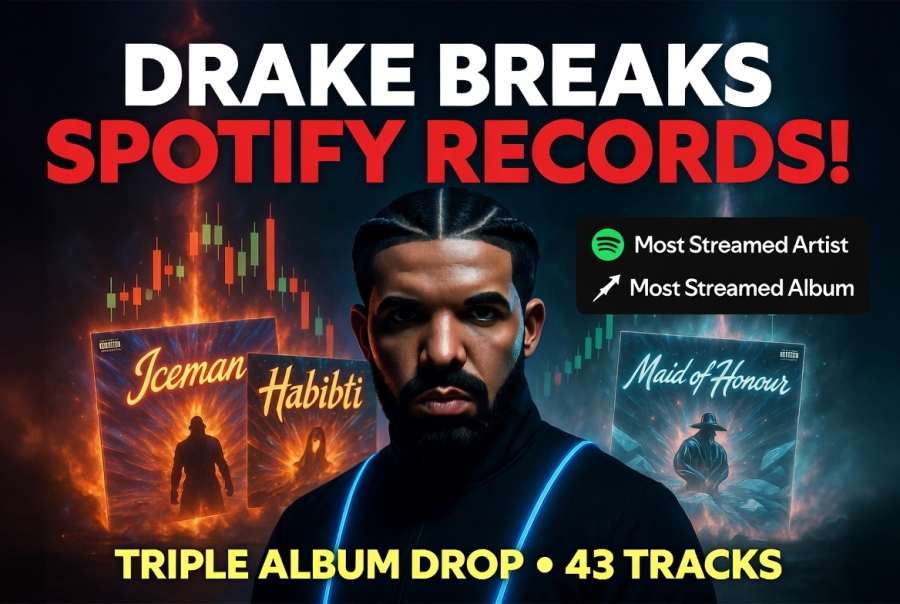
Drake Breaks Spotify Records With Surprise Triple Album Drop: Iceman, Habibti, and Maid of Honour Shake the Music Industry
The music industry woke up to absolute chaos when Drake unexpectedly released not one, not two, but three full-length albums at the exact same time. The surprise project rollout included Iceman, Habibti, and Maid of Honour, totaling a massive 43 tracks and instantly becoming one of the biggest moments in streaming history.
Within hours, streaming platforms exploded with activity. Social media feeds became flooded with reactions, debates, memes, reviews, and fan theories as listeners attempted to process the scale of the release. According to reports from Spotify, Drake officially became the most-streamed artist in a single day for 2026, while Iceman reportedly achieved the biggest single-day album streaming debut of the year.
The triple album drop immediately became more than just a music release. It evolved into a cultural event that once again demonstrated Drake’s unmatched ability to dominate attention, shape online conversations, and control the direction of the modern music industry.
The Surprise Release That Nobody Saw Coming
In an era where artists typically spend months promoting albums through teaser campaigns, interviews, singles, trailers, and social media marketing, Drake chose complete unpredictability.
Fans woke up to discover three separate projects uploaded simultaneously across streaming services. No long rollout. No warning. No major press campaign beforehand. Just instant impact.
The albums each carried their own distinct identity:
- Iceman leaned heavily into cold, atmospheric production and introspective themes.
- Habibti explored international sounds, melodic experimentation, and global influences.
- Maid of Honour delivered emotional storytelling mixed with luxury rap aesthetics and relationship-driven themes.
Together, the projects showcased Drake’s versatility across multiple styles while also giving fans enough material to dissect for weeks or even months.
The decision to release 43 tracks at once may seem excessive to some critics, but from a streaming perspective, it was a calculated masterclass. Modern streaming algorithms reward volume, replayability, and constant engagement. By flooding platforms with content, Drake essentially ensured that listeners would remain inside his ecosystem for hours.
Spotify Records Shattered Overnight
The numbers were immediate and historic.
Spotify confirmed Drake became the platform’s most-streamed artist in a single day for 2026, a title that further strengthens his already legendary streaming dominance. Meanwhile, Iceman reportedly became Spotify’s most-streamed album in a single day this year.
These achievements are significant because streaming records have become one of the music industry’s most important measurements of cultural influence. Album sales no longer tell the entire story. Today, streaming activity reflects real-time audience behavior, online conversation, playlist placement, and global engagement.
Drake has consistently mastered this environment better than almost any artist in history.
For over a decade, he has adapted perfectly to the streaming era by creating music designed for replay value, social media virality, emotional connection, and playlist longevity. Whether critics love or hate his approach, the numbers repeatedly prove his dominance.
The triple album strategy amplified that power even further.
Listeners immediately began building playlists, ranking favorite songs, debating the best album, sharing lyrics online, and generating millions of posts across platforms like TikTok, X, Instagram, Reddit, and YouTube. Every reaction fueled additional streams.
Social Media Explodes With Debate
As expected, the internet instantly divided into multiple camps.
Some fans called the triple release one of the greatest surprise drops in modern music history. Others argued that 43 tracks was overwhelming and unnecessary. Critics questioned whether all the material was truly essential, while supporters praised Drake for delivering an enormous amount of content directly to fans without traditional industry gatekeeping.
This debate itself became part of the marketing.
Controversy and conversation now drive visibility in the streaming era. Every argument online creates more clicks, more streams, and more attention. Drake understands this better than most artists alive.
Within hours of release:
- “Iceman” trended worldwide.
- Fans began ranking the three albums against each other.
- Reaction channels flooded YouTube.
- TikTok edits featuring unreleased snippets went viral.
- Hip-hop communities started analyzing possible subliminal disses and hidden messages.
- Memes comparing listeners trying to finish all 43 tracks dominated social media.
The release became unavoidable online.
Drake’s Streaming Era Dominance Continues
Drake’s success is not accidental. He has spent years perfecting the formula for streaming-era superstardom.
Unlike artists who focus solely on traditional album craftsmanship, Drake understands the psychology behind modern listening habits. His music often blends catchy hooks, emotional vulnerability, quotable lyrics, and highly replayable production designed to thrive on streaming services.
He also releases music at a pace that keeps audiences constantly engaged.
This latest triple album move reflects how the music business has changed. In previous decades, releasing three albums simultaneously would have been considered commercially risky. Physical distribution costs, retail limitations, and radio promotion would have made the strategy almost impossible.
Streaming changed everything.
Now artists can upload massive amounts of music instantly to global audiences without worrying about shelf space or manufacturing. Success is measured through engagement and attention rather than physical inventory.
Drake has become one of the greatest examples of how to dominate this system.
The Business Strategy Behind 43 Tracks
Many people initially questioned why Drake would release such a huge amount of music all at once. However, from a business perspective, the move makes perfect sense.
Streaming platforms reward:
- Longer listening sessions
- Repeat plays
- Playlist additions
- Viral moments
- Continuous audience engagement
Forty-three tracks dramatically increase the chances of multiple songs becoming hits simultaneously. Instead of betting everything on one lead single, Drake essentially flooded the market with options.
Different audiences can connect with different songs:
- Club listeners gravitate toward aggressive records.
- Emotional fans replay introspective tracks.
- International audiences embrace melodic crossover moments.
- TikTok users discover short viral snippets.
This creates a streaming ecosystem where the albums continuously feed themselves.
Even listeners criticizing the project contribute to its success because controversy generates curiosity.
Iceman Emerges as the Biggest Winner
While all three albums performed strongly, Iceman quickly emerged as the standout commercial force.
The project’s darker tone, cinematic production, and emotionally cold atmosphere resonated heavily with listeners. Fans immediately highlighted several tracks as instant classics, while online communities praised the project’s consistency and replay value.
Many listeners described Iceman as Drake returning to a colder, more focused sound reminiscent of some of his earlier eras.
Its streaming success reflects how audiences continue gravitating toward emotionally immersive albums that create a distinct mood and identity.
The title itself — Iceman — became symbolic online, representing Drake’s calm, calculated dominance over the streaming landscape.
The Evolution of Surprise Album Culture
Drake’s triple release also reflects the growing power of surprise drops in the modern music industry.
Over the past decade, major artists have increasingly abandoned long promotional cycles in favor of sudden releases designed to maximize shock value and online momentum.
Surprise drops work because they create urgency.
Fans immediately rush to streaming platforms to avoid spoilers, participate in online conversations, and experience the moment collectively in real time. This creates massive spikes in engagement that traditional rollouts often struggle to achieve.
For Drake, surprise releases are especially effective because he already possesses one of the largest and most loyal fanbases in the world. He does not necessarily need months of marketing buildup. His name alone generates global attention.
By releasing three albums simultaneously, he transformed a standard album release into a historic entertainment event.
Critics vs Fans: The Ongoing Debate
As always, Drake’s success has reignited debates about artistry versus commercial dominance.
Some critics argue that modern streaming culture encourages quantity over quality, rewarding artists for releasing massive amounts of content rather than carefully curated albums. Others believe Drake’s ability to consistently create music that connects with millions of listeners is itself a form of artistic genius.
Supporters argue that:
- Drake understands modern culture better than anyone.
- He delivers exactly what audiences want.
- His versatility allows him to dominate multiple genres simultaneously.
- His influence on streaming culture is undeniable.
Critics argue that:
- The projects are too long.
- Some songs feel unnecessary.
- Streaming incentives encourage bloated tracklists.
- Quantity sometimes overshadows depth.
Regardless of opinion, one reality remains undeniable: everyone is talking about Drake.
And in today’s music industry, attention is power.
What This Means for the Future of Music
Drake’s triple album success may influence how major artists approach releases moving forward.
Labels and artists closely monitor streaming data, engagement metrics, and audience behavior. If massive surprise releases continue generating historic numbers, more artists may experiment with unconventional rollout strategies.
We are entering an era where:
- Albums become streaming events.
- Social media reactions are part of the product itself.
- Viral moments matter as much as radio play.
- Volume can outperform traditional structure.
- Streaming algorithms shape creative decisions.
Drake is not simply participating in this evolution. He is helping define it.
The success of Iceman, Habibti, and Maid of Honour proves that the relationship between music, streaming, and internet culture is now more interconnected than ever before.
Final Thoughts
Drake’s surprise triple album release will likely be remembered as one of the defining music moments of 2026.
By dropping 43 tracks simultaneously across Iceman, Habibti, and Maid of Honour, he once again demonstrated his unmatched ability to dominate streaming platforms, capture internet attention, and shape global music conversations overnight.
Whether fans view the release as genius, excessive, innovative, or controversial, its impact is impossible to ignore.
Spotify records were shattered. Social media exploded. The music industry stopped everything to pay attention.
And once again, Drake proved that when it comes to the streaming era, few artists understand the game better than he does.
