


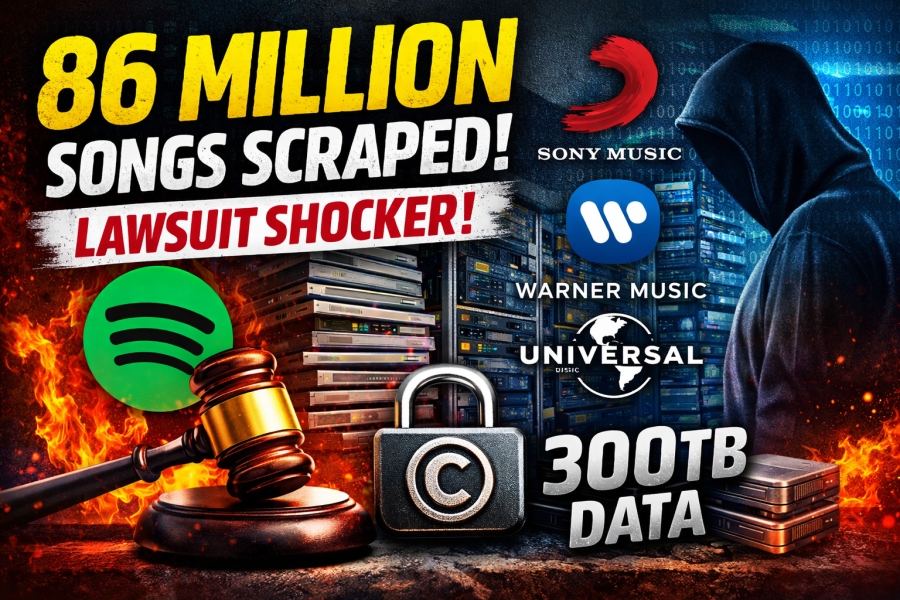
🎶 Spotify, Sony, Warner & UMG Sue Shadow Library After Scraping of 86 Million Tracks
In one of the most dramatic copyright battles of recent years, Spotify and the world’s three biggest record labels — Sony Music Entertainment, Warner Music Group, and Universal Music Group (UMG) — have launched a sweeping lawsuit against the shadow library known as Anna’s Archive after it allegedly scraped around 86 million music files and 300 terabytes of data from Spotify’s platform.
This case has rippled across the music industry, legal communities, and even the world of artificial intelligence — raising urgent questions about copyright enforcement, digital preservation, and the ethics of mass data collection. Let’s break it all down.
📌 What Happened? The Alleged Spotify Data Scrape
At the center of this legal battle is Anna’s Archive, a controversial online “shadow library” originally known for collecting and sharing pirated academic papers, ebooks, and other copyrighted content. In late 2025, the group announced that it had somehow scraped a massive amount of data from Spotify’s platform — including:
-
Metadata for an estimated 256 million tracks, accounting for roughly 99.9% of Spotify’s catalog.
-
Audio files for approximately 86 million songs, which the archive claims represent about 99.6% of all listens on Spotify.
-
The total dataset is said to total nearly 300 terabytes of storage.
Anna’s Archive publicly described this haul as part of a “music preservation archive”, arguing that it would protect cultural works from loss and censorship. But rights holders vehemently disagree.
According to unsealed court filings, Spotify and the labels allege that the scraping was unauthorized, violated Spotify’s terms of service, and included audio that was accessed through “illicit tactics” that allegedly circumvented digital rights management (DRM) protections.
Spotify has stated that it identified and disabled the accounts involved in the scrape, and has worked to implement additional protections against similar attacks.
⚖️ The Lawsuit: Who’s Suing Whom?
In late December 2025, Spotify joined forces with Universal Music Group, Sony Music Entertainment, and Warner Music Group to file a lawsuit in the U.S. District Court for the Southern District of New York. The complaint — initially sealed to prevent Anna’s Archive from moving assets or adapting — alleges:
-
Mass copyright infringement
-
Breach of contract (Spotify’s Terms of Service)
-
Violations of the Digital Millennium Copyright Act (DMCA)
-
Violations of the Computer Fraud and Abuse Act (CFAA)
The plaintiffs argue the scrape was not just large — it was an unprecedented assault on copyrighted digital music meant for unsanctioned dissemination.
Because the operators of Anna’s Archive are anonymous and did not respond to initial notices, the plaintiffs secured a temporary restraining order and, shortly afterward, a preliminary injunction from a federal judge. These orders compelled hosting services like domain registries and Cloudflare to disable access to the site’s major domains, including the .org domain.
This effectively disrupted the archive’s ability to distribute the scraped material — at least for now — and represented a significant early legal victory for the music companies.
📉 Why This Matters to the Music Industry
1. Enormous Scale of Scraped Data
While most piracy cases involve a few thousand or even millions of songs, this scrape allegedly touched tens of millions of tracks — representing virtually every popular song on the platform. And even if the archive covered only “37% of Spotify’s audio files,” those files account for nearly all listening activity on the service.
This scale makes the incident unique in the history of digital music distribution.
2. Copyright Enforcement in the Digital Age
Recording companies and streaming platforms have long battled piracy through takedowns and anti-piracy tech, but this case suggests a new frontier: fights over data scraping at industrial scale.
Unlike individuals sharing a few albums, Anna’s Archive’s actions — if proven correct — involve systematic harvesting enabled by automated systems. The lawsuit invokes serious federal statutes (including the CFAA) designed to protect digital property and server integrity.
3. Potential Impact on AI and Data Use
One of the most talked-about implications is the use of scraped music for AI training.
Music metadata and audio at this scale could theoretically be used to train large-scale generative AI models capable of mimicking artists, producing new music, or analyzing trends — which is exactly why rights holders may be worried. Some industry observers argue that the existence of such a dataset could tempt AI developers.
The dataset includes extensive metadata — including track identifiers (ISRCs), album art, and popularity metrics — that could be deeply valuable for analytics or machine learning purposes.
🛡️ Legal Tactics: Stealth Filing & Domain Takedowns
One of the most striking aspects of the case is how quickly Spotify and the labels moved before public disclosure.
Rather than announcing the lawsuit immediately, the plaintiffs filed the complaint under seal and obtained an emergency restraining order ex parte — that is, without notifying Anna’s Archive first. This tactic was intended to:
-
Prevent the archive from preemptively releasing data upon learning of legal action
-
Keep the defendants from moving infrastructure offshore
-
Force domain registries and hosting services to act before the community could adapt
The result was a rapid suspension of at least one major domain and disruption of core hosting functions.
🧠 Anna’s Archive’s Response & Broader Community Reaction
Anna’s Archive has pushed back, at times claiming that domain suspensions were unrelated to the scrape — a stance that has been widely disputed by legal filings.
The shadow library community — a network of enthusiasts who celebrate open access to knowledge — is divided. Some applaud the preservation rhetoric, while others express concern that legal pressure will eventually collapse Anna’s Archive’s operations entirely.
Supporters argue that large open datasets can empower research and culture, while critics point out that unauthorized copying and redistribution of copyrighted music undermines the rights and revenue streams of artists and rights holders.
🎤 What This Means for Artists & Fans
For Artists
-
Stronger copyright enforcement means better protection of royalties
-
Legal precedent could discourage future unauthorized mass scraping operations
-
Artists may feel more secure that their work isn’t being redistributed in bulk outside authorized channels
For Fans
-
Casual listeners likely won’t notice immediate changes to streaming platforms
-
However, access to unofficial archives and torrents may become more restricted
-
This case underscores the risks associated with downloading or streaming music from unauthorized sources
🔍 Key Legal Questions Still Unresolved
The lawsuit may be only the beginning. Ongoing issues include:
-
Will Anna’s Archive contest the suit or identify its operators?
-
Can copyright law fully address this new form of mass scraping?
-
What penalties might be imposed if infringement is proven?
-
Could other tech platforms face similar scrapes and legal battles?
These questions mark a crucial crossroad for digital rights, cultural preservation, and the future of online music.
📊 Search Trends & What People Are Asking
Trending search queries related to this story include:
-
Spotify data scrape Anna’s Archive lawsuit
-
How many songs were scraped from Spotify
-
Record labels sue pirate library 86 million tracks
-
Is Spotify user data safe after scrape
-
Can scraped music be used to train AI models
This surge in interest highlights the broad public concern around digital rights, corporate lawsuits, and user privacy.
🏁 Final Thoughts
The Spotify vs. Anna’s Archive lawsuit is more than a copyright clash — it’s a modern legal battleground where technology, culture, and law intersect.
Whether you’re an artist, a data scientist, a lawyer, or a music fan, this case illustrates how digital content is increasingly at the center of complex disputes that can shape the future of content distribution and ownership online.
Expect this story to evolve rapidly — especially as courts, technologists, and the public weigh the balance between open access and intellectual property protection.
