


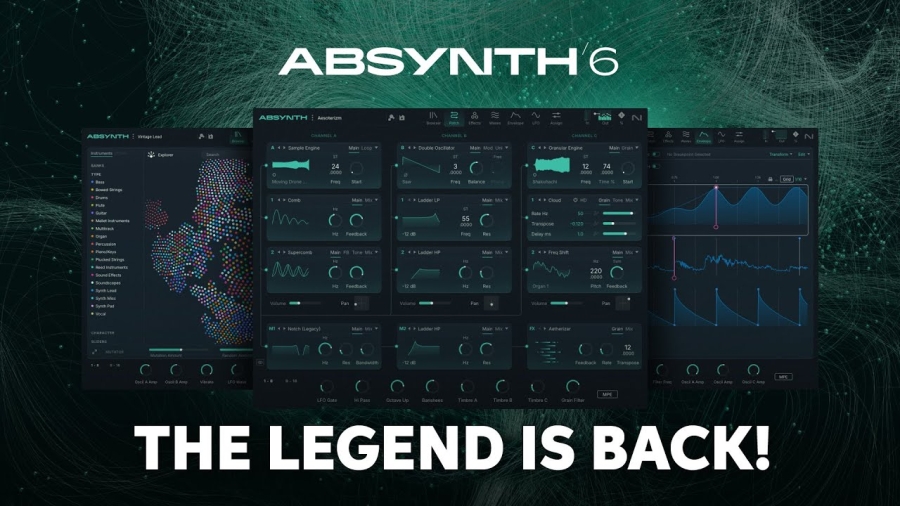
Absynth 6 — The Dreamy Return of a Soundscape Legend
If you grew up hunting for otherworldly pads, plucky evolving textures, and synth sounds that felt like they came from another planet, Absynth has likely been on your "desert-island" shortlist for decades. After a period of quiet and a headline-making discontinuation, Native Instruments has resurrected that uniquely cinematic instrument — now reborn as Absynth 6. This isn’t just a nostalgia reissue: NI and the original developers have overhauled the engine, interface, and performance features while keeping the signature sonic DNA intact.
Why the return matters
Absynth was always more than a polysynth — it was a hybrid laboratory. The original versions fused subtractive, granular, and FM elements with an experimental "mutation" approach to patch generation and a semi-modular architecture that encouraged exploration. That voice — the eerie, evolving textures you can instantly recognise — has influenced countless film, ambient, and electronic producers for 20+ years. Bringing Absynth back matters because there aren’t many modern synths that combine modular-style patching, granular timbres, and a deep modulation ecosystem in a single instrument with that much personality.
What’s new in Absynth 6 (the headline features)
Absynth 6 modernises the original concept in ways that make it much more usable for today’s producers while opening new sonic doors:
-
Hybrid engine refinements — The core still blends granular, FM, wavetable, and subtractive synthesis, but with a rebuilt engine that increases resolution and expands modulation possibilities. That means old patches translate well but can also be pushed much further.
-
Modernised UI & navigation — One of the big complaints about earlier Absynth versions was the UI. Absynth 6 introduces a cleaner, contemporary interface plus a new preset navigation system that leans on AI-style sorting and visual sound previews so you can find textures faster without losing the joy of discovery.
-
MPE & expression — MPE (MIDI Polyphonic Expression) and polyphonic aftertouch support arrive for expressive performance control, which unlocks new ways to shape evolving pads, morphing leads, and responsive ambiences in real time.
-
New filters & effects — The update adds freshly redesigned filters (including a ladder-notch mode that developer Brian Clevinger singled out) and an expanded suite of effects geared toward space, movement, and texture. These aren’t cosmetic: they change the harmonic behaviour and character of Absynth in a way that’s meaningful for sound designers.
-
Point-cloud visualiser & preset browsing — A novel point-cloud style visualisation gives you a spatial sense of presets and how they relate, letting you visually explore sound families rather than scrolling through a list. It’s a playful idea that helps bridge intuitive browsing with serious sound design.
These changes show NI didn’t just dust off an old codebase — they rethought workflow and playability for 2025 while keeping the experimental heart intact.
How it sounds — the character and use cases
If you come to Absynth 6 expecting raw analog brawn, you’ll be partially surprised — and happily so. Absynth has always favoured texture, motion, and spectral complexity over brick-wall analog emulation. In practice that means:
-
Pads that breathe — Absynth is a go-to for evolving pads that avoid steady loops. Its granular and wavetable combo produces motion that sounds organic and cinematic. Great for scoring, ambient, and experimental pop.
-
Weird leads & plucks — By mixing FM and spectral processing, Absynth yields leads and plucks with metallic, bell-like qualities but with evolving tails that keep them interesting across a track.
-
Atmospheres and sound design — The Mutation feature and deep modulation routing make it ideal for creating textures, risers, and movement layers for film and games. The new filters and effects broaden this use even more.
Early hands-on impressions from journalists and sound designers call Absynth 6 “weird in the best way” — a polysynth that rewards exploration and deep patch work rather than simply providing instant one-knob presets. That makes it an excellent tool for producers who enjoy digging under the hood.
Compatibility, system notes, and pricing
Native Instruments has made Absynth 6 available as a download with a retail price in the neighbourhood of €199 / £179 / $199, while owners of previous Absynth versions (2–5) can upgrade at reduced pricing (commonly around €99 for eligible owners). It’s available through the NI store and authorised resellers. Make sure your system meets NI’s general compatibility expectations (macOS and Windows compatibility statements are on NI’s support pages), and check Native Access for updates and installation details.
A few practical things to note: read the compatibility page if you’re running ARM Macs or older legacy OS versions — plugin support across system updates can be a sticking point for heavyweight synths with large sample/granular engines. Also watch for loyalty/upgrade windows if you own older Absynth versions — NI typically offer time-limited upgrade pricing for registered users.
The development story — who made the comeback happen
Absynth’s return isn’t purely a corporate decision — it’s a human story. Brian Clevinger, the original developer, worked closely with NI on Absynth 6’s revival. In interviews, he’s described the process as emotional: bringing a long-lived project back involved balancing respect for the original instrument and a desire to modernise UI, playability, and performance features. Notably, NI involved prominent sound designers in curating presets, making this release feel both historical and collaborative. That lineage helps explain why Absynth 6 sounds like a proper continuation rather than a re-skinned impostor.
Where Absynth 6 sits in 2025’s synth landscape
The synth market in 2025 is crowded: there are highly polished wavetable monsters, modular plugin ecosystems, and lots of analogue emulations. Absynth 6 occupies a unique niche — it’s not trying to be a Swiss army knife for classic analog tones; instead, it’s a creative sound-design engine. Its hybrid toolkit (granular + FM + wavetable + subtractive with semi-modular routing) places it alongside instruments aimed at texture and cinematic scoring rather than simple lead/bass duty. That positioning makes it especially interesting for media composers, ambient artists, and producers who want less predictable, more evolving elements in their productions. Early reviewers say it’s the “biggest update in Absynth history,” because it moves the synth from a legacy toolbox into a living, modern instrument.
Hands-on tips and a quick workflow guide
If you pick Absynth 6 up, here are some practical tips to quickly get results:
-
Start with mutations — Use the Mutation feature to generate wild starting points, then pull back parameters you like. It’s a fast path to discovering complex timbres.
-
Use the point-cloud browser — Let the visual preset mapping nudge you toward families of sounds rather than hunting through names. It helps spark creative patch morphs.
-
Exploit MPE — If you have an MPE controller, map aftertouch and slide to spectral parameters for expressive performance—pads and leads come alive.
-
Layer and automate — Pair Absynth’s evolving textures with a dry synth or sample instrument to keep rhythm and clarity while Absynth fills the atmospheric space.
Downsides and real talk
No synth is perfect. Absynth historically had a steep learning curve and a UI that could feel obtuse; NI has improved that, but the depth that makes Absynth powerful also makes it heavy to learn. If you want immediate, plug-and-play pop sounds, Absynth may feel like overkill. Also, plugin compatibility on the newest OS/hardware combinations can be a snag — always check NI’s compatibility notes and community threads if you're on cutting-edge hardware.
Final verdict — who should buy Absynth 6?
Buy Absynth 6 if you:
-
Love deep sound design and evolving textures.
-
Compose for film, games, or ambient music and need organic, moving soundscapes.
-
Want a hybrid synth that rewards exploration rather than one that gives instant “pop” patches.
Maybe hold off if you:
-
Need immediate, classic analog tones without a learning curve.
-
We are running experimental OS/hardware combos until compatibility is confirmed.
Where to learn more and get started
Head to Native Instruments’ product page for full specs, demos, and the exact pricing/upgrade eligibility. Early reviews and hands-on guides (Sound On Sound, CDM, and several synth bloggers) already offer demo walkthroughs and sound tests if you want to hear Absynth 6 in action before buying. There are also tutorial videos popping up showing workflow tips and patch deep dives
