
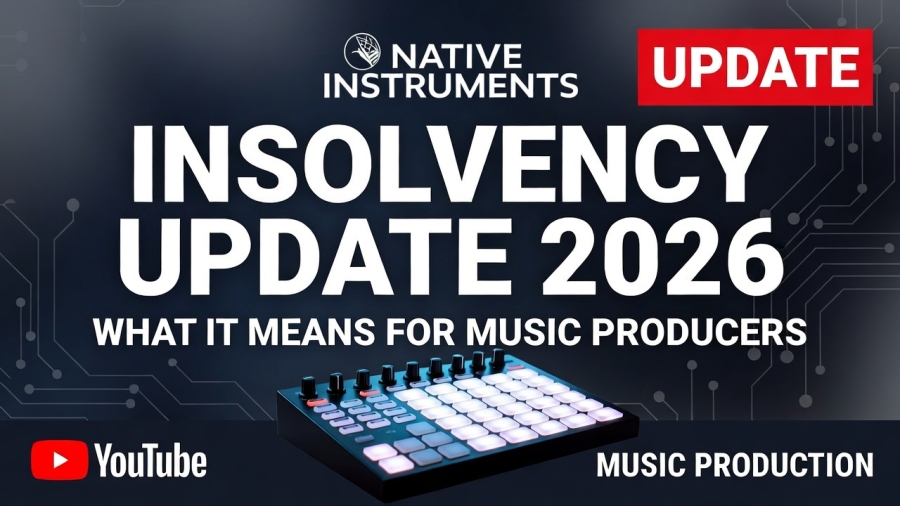
Native Instruments Insolvency Update 2026: What It Means for Music Producers
Introduction
The music production world was shaken earlier this year when Native Instruments confirmed it had entered insolvency proceedings. As one of the most influential companies in modern music production—responsible for industry-standard tools like Kontakt, Maschine, and Traktor—the news sparked widespread concern among producers, DJs, and audio professionals worldwide.
Now, as of March 2026, the situation has evolved significantly. While the headlines may still sound alarming, the reality is more complex—and not necessarily catastrophic.
In this article, we break down everything you need to know about the Native Instruments insolvency situation, what has changed recently, and what it means for your music production workflow moving forward.
What Happened to Native Instruments?
To understand the current situation, we need to briefly revisit how things unfolded.
Earlier in 2026, Native Instruments entered preliminary insolvency proceedings in Germany. This legal process is often misunderstood—it doesn’t mean a company is shutting down. Instead, it allows businesses to restructure their finances under court supervision while continuing operations.
Since then, the company has progressed further into formal insolvency proceedings, marking a new phase in its restructuring efforts.
Key takeaway:
Native Instruments is not bankrupt in the traditional sense—it is restructuring in an attempt to survive.
Native Instruments Is Now Actively Seeking a Buyer
The biggest development in recent weeks is that Native Instruments has officially entered an active mergers and acquisitions (M&A) process.
This means:
-
The company is looking for potential buyers or investors
-
There is reportedly strong interest from multiple parties
-
A sale—either full or partial—is increasingly likely
This could reshape the future of the entire ecosystem.
What could happen?
There are three realistic scenarios:
-
Full acquisition
A larger company acquires Native Instruments entirely and continues operations -
Partial sale
Different divisions are sold separately (more likely) -
Strategic investment
External investors stabilize the company without fully acquiring it
Business Is Still Running (For Now)
Despite the uncertainty, one important fact stands out:
👉 Native Instruments is still fully operational
Users can still:
-
Download and activate products
-
Use plugins and instruments
-
Access customer support
-
Receive updates (though possibly slower)
This includes the entire ecosystem:
-
Kontakt libraries
-
Maschine hardware and software
-
Traktor DJ tools
-
Effects and plugins
For now, your workflow remains unaffected.
Not All Parts of Native Instruments Are Impacted
A crucial detail that many people miss is that only certain parts of the company are involved in insolvency proceedings.
-
The insolvency primarily affects German entities (Native Instruments GmbH)
-
International divisions, particularly in the US, remain more stable
This includes brands like:
-
iZotope
-
Plugin Alliance
These companies operate somewhat independently and are not directly tied to the insolvency process in Germany.
Why this matters:
Even in a worst-case scenario, parts of the ecosystem could continue independently.
Why Did Native Instruments Get Into Trouble?
The insolvency didn’t come out of nowhere. It’s the result of several years of strategic decisions and industry pressure.
1. The Soundwide Merger Strategy
Native Instruments attempted to build a massive audio ecosystem through the Soundwide initiative, bringing together multiple brands under one umbrella.
While ambitious, this strategy:
-
Increased operational complexity
-
Created integration challenges
-
Required significant financial investment
2. Rapid Expansion and Acquisitions
The company acquired or merged with several major players, including iZotope and Plugin Alliance.
While this expanded its reach, it also:
-
Increased financial strain
-
Added overlapping products and teams
-
Slowed down innovation in some areas
3. Industry Competition
The music production space has become more competitive than ever, with companies like:
-
Ableton
-
Image-Line
-
Steinberg
pushing rapid innovation and strong user engagement.
Native Instruments, by comparison, faced criticism for:
-
Slow updates
-
Aging software architecture
-
Lack of clear direction
4. Investor Pressure
Private equity ownership added another layer of complexity. Investors typically expect growth and returns, which can lead to aggressive expansion strategies that don’t always succeed long term.
What This Means for Producers
This is the question everyone is asking:
👉 Should you be worried?
Short answer: Not immediately—but stay informed.
What Happens to Your Plugins and Licenses?
One of the biggest concerns is whether users could lose access to their tools.
Here’s the current reality:
-
Your purchased products are safe for now
-
Offline functionality will continue to work
-
Activation servers are still running
Even in restructuring scenarios, companies typically maintain:
-
License validation systems
-
Download access
-
Core product functionality
Worst-case scenario:
If servers were ever shut down (unlikely in the near term), offline use could still be possible for many products.
The Future of Kontakt, Maschine, and Traktor
Let’s break down the three biggest ecosystems.
Kontakt
Kontakt is the backbone of modern sample-based music production.
-
Used by thousands of developers
-
Powers massive orchestral and cinematic libraries
-
Industry standard for sampling
👉 Highly likely to survive in any acquisition scenario
Maschine
Maschine combines hardware and software for beat-making.
-
Strong user base
-
Unique workflow
-
Less dominant than Kontakt
👉 Could be:
-
Continued under new ownership
-
Repositioned
-
Or potentially spun off
Traktor
Traktor has faced tough competition in recent years.
-
Competes with platforms like Serato and Rekordbox
-
Slower development cycles
👉 More uncertain future compared to Kontakt
What Happens If Native Instruments Gets Sold?
If a buyer steps in, here’s what typically happens:
Positive outcomes:
-
Increased investment
-
Faster updates
-
Improved support
-
Renewed innovation
Potential downsides:
-
Product discontinuation
-
Price changes
-
Ecosystem fragmentation
-
Account migrations
Could Native Instruments Be Split Up?
Yes—and this is one of the most likely outcomes.
For example:
-
iZotope could be sold separately
-
Plugin Alliance could remain independent
-
Core NI products could go to another buyer
This would fundamentally change the “all-in-one ecosystem” vision.
Industry Impact: Why This Matters
Native Instruments is not just another company—it’s a pillar of the music production industry.
Its tools are used in:
-
Film scoring
-
EDM production
-
Hip-hop beatmaking
-
Game audio design
If the company changes direction, it could influence:
-
Plugin standards
-
Sample library ecosystems
-
Production workflows worldwide
Should You Keep Using Native Instruments Products?
Yes—with some awareness.
Reasons to continue:
-
Tools are still industry-standard
-
No immediate risk to functionality
-
Workflow familiarity is valuable
Smart precautions:
-
Keep backups of installers
-
Save project files with rendered audio
-
Avoid relying 100% on cloud-based systems
The Most Likely Outcome
Based on current developments, the most realistic scenario is:
👉 Native Instruments survives—but in a different form
-
A buyer or investor steps in
-
Some restructuring occurs
-
The ecosystem evolves
This is not the end of Native Instruments, but it is likely the end of its current structure.
Final Thoughts
The Native Instruments insolvency situation is serious—but far from hopeless.
The company is:
-
Still operating
-
Actively seeking buyers
-
Supported by strong industry interest
For producers, the key takeaway is simple:
👉 Stay informed, but don’t panic
Your tools aren’t going anywhere overnight. However, the long-term landscape may shift—and being prepared is always the smart move.
