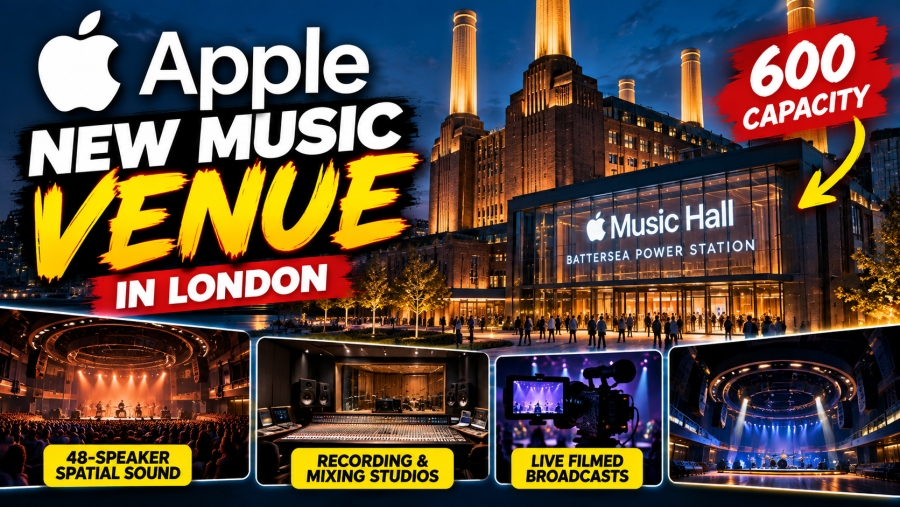
Apple Opens New 600-Capacity Music Venue in London’s Battersea Power Station
Apple is taking its relationship with music beyond streaming, radio and recorded audio with the launch of Apple Music Hall, a new 600-capacity live music venue inside London’s iconic Battersea Power Station.
Designed as an intimate concert space with the production capabilities of a much larger facility, Apple Music Hall combines live performance, Spatial Audio recording, professional mixing, multicamera video production and global livestreaming under one roof.
The venue is scheduled to open on September 28, 2026, marking a significant new chapter in Apple’s long-running involvement with live music. The company says artists will be able to perform for a small audience and leave with a finished Spatial Audio recording, broadcast-ready mix, and multicamera video from the same performance.
Apple Music Hall Brings Live Music to Battersea Power Station
Located inside Battersea Power Station on the River Thames, Apple Music Hall is designed around a simple idea: combine the intimacy of a small concert with the technical infrastructure normally associated with much larger productions.
The venue can accommodate 600 people, allowing artists to perform in an environment where audiences remain physically close to the stage. At the same time, Apple has equipped the room with professional recording, mixing and broadcast technology.
The result is a venue that isn't simply intended to host concerts. It is effectively a live music production facility where a single performance can become an in-person event, an immersive audio recording, a filmed production and a global livestream.
Apple says the space was deliberately designed to close the gap between intimacy and production value.
A 38-Foot Stage Designed for Flexible Performances
At the center of Apple Music Hall is a 38-foot-wide stage that can be configured in different ways.
The traditional setup allows artists to perform toward an audience positioned in front of the stage. However, the room can also be rearranged for an in-the-round configuration, putting the audience around the performer.
That flexibility could make the venue suitable for very different types of performances, from stripped-back singer-songwriter shows to full-band productions requiring a more conventional stage arrangement.
The relatively small capacity is also intentional. Apple says the venue is designed to ensure that every seat feels close to the performer while still providing production infrastructure capable of capturing high-end audio and video.
The 48-Speaker Spatial Audio System Is the Main Attraction
One of the most distinctive technical features of Apple Music Hall is its 48-speaker Spatial Audio system.
Instead of relying on conventional left-and-right speaker positions, the system surrounds the audience with speakers positioned around the room. That allows compatible performances to be presented as immersive Spatial Audio experiences.
For fans inside the venue, this means the sound can be designed to create a more enveloping listening experience.
For Apple, however, the system has an additional purpose: it gives the company a dedicated environment for capturing live performances specifically for Spatial Audio distribution.
Apple says performances can be recorded and mixed in Spatial Audio either live or after the event.
Two Recording and Mixing Studios Behind the Stage
Behind the performance area, Apple Music Hall contains two dedicated recording and mixing studios.
These aren't simply facilities for documenting concerts. Apple describes the hall as a full production environment capable of capturing performances as multitrack recordings and producing Spatial Audio mixes.
That creates an interesting workflow for artists and producers.
Instead of booking a concert venue and then moving the production into another studio for post-production, the performance and recording processes can happen within the same facility.
A live show can therefore become a polished audio production without requiring the artist to recreate the performance in a conventional recording studio.
Apple says performances can be captured and mixed in Spatial Audio either during the show or afterward, giving production teams flexibility over the final result.
Apple Music Hall Is Built for Broadcast Production
Audio isn't the only major production focus.
The venue is hardwired for 16 or more professional cameras, all feeding into a purpose-built broadcast control room.
The system can also incorporate iPhone video capture alongside traditional broadcast cameras.
That means Apple Music Hall has been designed from the beginning with filmed music content in mind.
For an artist, one performance can potentially generate multiple deliverables: the physical concert experience, a multitrack recording, a Spatial Audio mix and a multicamera video production.
Apple says the venue's infrastructure allows artists to walk away from a single show with a finished Spatial Audio recording, broadcast-ready mix and multicamera video.
Live Performances Can Be Streamed Globally
The combination of intimate capacity and broadcast infrastructure becomes particularly important because performances from Apple Music Hall will also be livestreamed globally.
That changes the economics and reach of a 600-person concert.
Normally, a small venue show is experienced primarily by the people who manage to get into the room. Apple's model potentially turns that same event into a global digital performance.
The audience inside Battersea Power Station becomes one part of the experience, while Apple Music users elsewhere can potentially watch and listen remotely.
It also fits directly into Apple's existing emphasis on immersive audio, premium video and exclusive music programming.
Apple Is Also Opening New Apple Music Radio Studios
The venue isn't arriving alone.
Alongside Apple Music Hall, Apple is opening new Apple Music Radio studios at Battersea Power Station.
London-based Apple Music Radio hosts and shows will now broadcast from the Battersea location.
That creates an unusually concentrated music ecosystem: live performances, radio broadcasting, artist interviews, recording, mixing and video production can all take place at the same site.
Apple Music Radio has long been positioned as a place for artist interviews, premieres, conversations and special performances. Moving London's radio operations into the same building as Apple Music Hall creates additional opportunities to connect those activities.
An artist could potentially perform at the venue, participate in an interview, record content and generate material for Apple Music's wider ecosystem without moving between multiple London facilities.
Why Battersea Power Station Makes Sense for Apple
The location itself carries considerable cultural significance.
Battersea Power Station is one of London's most recognizable landmarks, and the building has a longstanding connection to music history. Most famously, its exterior appeared on the cover of Pink Floyd's 1977 album Animals.
Apple Music Hall incorporates architectural elements inspired by the building, including heritage brickwork, fluted arches and bronze balconies.
A large glass wall also connects the interior to the surrounding concourse and views toward the River Thames.
That means the venue is not designed as a generic black-box concert hall. Its visual identity is closely connected to Battersea Power Station's industrial and Art Deco heritage.
Apple Has a Long History With Live Music
Apple Music Hall may be a new physical venue, but Apple's involvement in live music isn't new.
The company previously operated the iTunes Music Festival in London, which ran for a decade and featured major artists including Adele, Elton John, Lady Gaga and One Direction.
The festival eventually ended in 2017.
Apple Music Hall represents a different approach. Instead of taking over existing venues for a large annual festival, Apple now has a permanent facility specifically designed around its music platform.
That gives the company greater control over acoustics, recording, filming, production and distribution.
It also allows Apple to create smaller, more exclusive performances that can subsequently reach audiences around the world through Apple Music.
The Venue Is Designed Around the Modern Music Release
The most interesting aspect of Apple Music Hall may be how closely its design reflects the way music is consumed in 2026.
A concert is no longer necessarily just a concert.
It can become a livestream, an album track, a Spatial Audio experience, a music video, social-media clips, an interview, behind-the-scenes content and promotional material.
Apple Music Hall has been built around that reality.
The venue's recording studios address the audio side. The 48-speaker system addresses immersive listening. The broadcast control room and camera infrastructure address video. Global livestreaming addresses distribution.
All of those components are integrated into one location.
For artists, that could reduce the separation between live performance and recorded content production.
What Does This Mean for Artists and Producers?
From a production perspective, Apple Music Hall could become an interesting destination for artists who want high-quality live recordings without sacrificing the energy of an audience.
Traditional live recording presents several challenges. Engineers have to deal with venue acoustics, crowd noise, microphone placement, monitoring, stage configurations and post-production.
Apple's facility has been designed specifically to manage those requirements.
The presence of dedicated recording and mixing studios means producers can work directly from the venue.
The Spatial Audio system also provides a dedicated environment for immersive productions.
And because the venue supports 16 or more cameras, artists can capture professional video at the same time.
That could be particularly useful for artists releasing live sessions, exclusive performances and premium video content.
A Small Venue With Arena-Level Production Infrastructure
The 600-person capacity is perhaps the most revealing detail about Apple's strategy.
Apple isn't trying to build another giant arena.
Instead, it is creating a space where the audience is small but the production capabilities are large.
That distinction matters.
A 600-capacity room can create a more intimate relationship between performer and audience while Apple's infrastructure allows the resulting performance to be distributed globally.
DJ Mag reported that Apple Music executive Oliver Schusser described the smaller size as intentional, emphasizing that Apple does not want to interfere with existing venues and that the limited capacity is part of the concept.
The model is therefore less about competing with London's established concert venues and more about creating a specialized environment for Apple Music productions.
When Will Apple Music Hall Open?
Apple Music Hall is scheduled to officially open on September 28, 2026.
Apple has not yet announced the complete lineup of opening performances, although the company is inviting fans to follow Apple Music Hall for information about upcoming shows and ticket access.
The venue is expected to host intimate performances that can subsequently be shared with audiences outside London through Apple Music's digital platforms.
Apple Music Hall Could Change the Live Session Format
The launch of Apple Music Hall highlights how quickly the boundaries between concerts, studios and streaming platforms are disappearing.
A traditional concert venue is primarily designed for the audience in the room.
A recording studio is designed primarily for audio production.
A broadcast facility is designed for video distribution.
Apple Music Hall combines elements of all three.
That makes it particularly relevant to the modern music business, where a single artist performance can have value across several formats.
The 48-speaker Spatial Audio system, two recording and mixing studios, 16-plus camera infrastructure and global livestreaming capability all point toward the same goal: turning an intimate live performance into a complete digital music production.
Final Thoughts: Apple Is Building a Music Production Ecosystem
Apple Music Hall is more than a new 600-capacity concert venue in London.
With its 48-speaker Spatial Audio system, 38-foot stage, dedicated recording and mixing studios, multicamera infrastructure and global livestreaming capabilities, it has been designed as an end-to-end music production facility.
The location inside Battersea Power Station also gives the project a strong connection to London's music history, while the adjacent Apple Music Radio studios connect live performance with interviews, broadcasting and artist-led programming.
For fans, the appeal will be intimate concerts and immersive audio experiences.
For artists, the bigger attraction could be the ability to perform one show and leave with multiple forms of professionally produced content.
And for Apple Music, the venue provides another way to connect artists and listeners — both inside London and around the world.
With Apple Music Hall opening on September 28, 2026, the next question is simple: which artists will Apple bring to the stage first?
