


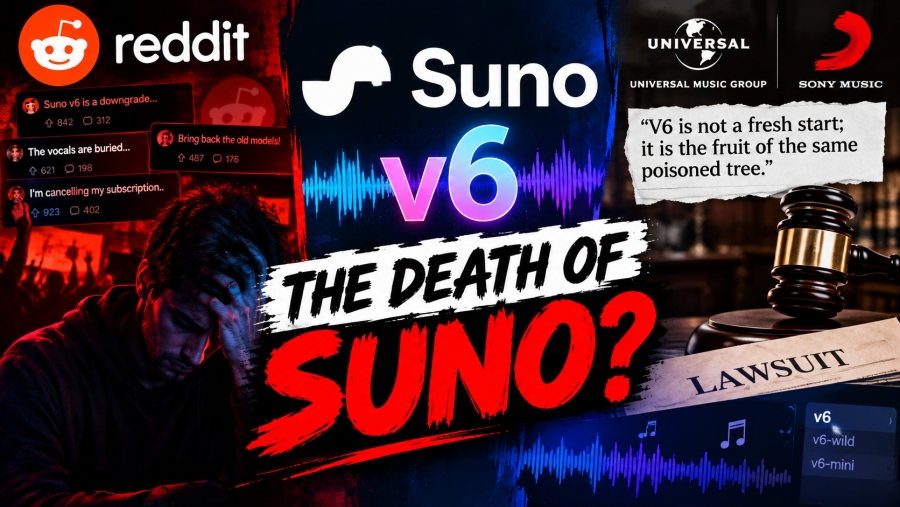
“The Death of Suno”: Reddit Users Turn Against Suno After v6 Model Update
Suno’s latest chapter was supposed to mark a major reset for the AI music platform. Instead, the launch of its v6 music models has triggered an unusual two-sided backlash: some long-time users are criticizing the sound and creative results, while Universal Music Group and Sony Music Entertainment have launched another copyright lawsuit, arguing that the new model remains connected to allegedly infringing training material.
On Reddit, some users have gone as far as describing the situation as “the death of Suno,” with complaints focused on muffled mixes, generic songwriting, buried vocals, and the removal of older models they preferred. Meanwhile, UMG and Sony argue that v6 is not legally separated from Suno’s earlier models.
The labels’ complaint uses an especially pointed phrase: “v6 is not a fresh start; it is the fruit of the same poisoned tree.”
That combination makes the v6 launch one of the most controversial moments yet for Suno — even though the company itself presents the update as a major step toward working with the traditional music industry.
Suno v6 Was Supposed to Be a New Beginning
Suno launched v6 on September 9, 2026, describing it as a new generation of music models developed with industry partners including Warner Music Group, BMG and Believe. The company says v6 is faster, more expressive, and higher quality, with greater control for creators.
The release introduced three related models.
The flagship v6 is aimed at paid Pro and Premier subscribers and is designed to provide reliable, polished results across genres. v6-wild is intended to be more experimental and unpredictable, while v6-mini is the faster model available to everyone.
Suno also introduced a range of creative features around the new models, including natural-language editing, mashups, sampling, audio isolation and the ability to create music from combinations of text, images, video and audio.
On paper, this is a substantial product update.
But there was one major change that immediately affected existing users: Suno said previous models would be retired as v6 rolled out.
That decision has become central to the backlash.
Why Are Suno Users Complaining About v6?
The biggest criticism isn't necessarily about the existence of v6. It is about the way it sounds.
Posts on the SunoAI subreddit describe v6 output as muffled, dull, generic, compressed and less musically interesting than earlier versions. One highly upvoted post said the new model made the author seriously consider cancelling their subscription. Another post titled “Bye bye Suno, I’m cancelling my subscription” received hundreds of upvotes while criticizing the removal of previous models.
Other complaints focus on vocals being pushed too far back in the mix, reduced high-frequency detail and arrangements that users feel are less distinctive.
There are also complaints about prompt adherence. Some users report that v6 doesn't always follow requested BPM, instrumentation, arrangement or genre instructions as reliably as their preferred older models.
That doesn't establish that v6 is objectively worse in every situation. Audio quality and creative usefulness are partly dependent on genre, prompting technique and individual expectations.
However, the volume of negative community feedback is notable because Suno's existing users are among the people most familiar with how the platform has changed from model to model.
The Problem With Removing the Older Suno Models
For many users, the most controversial part of the v6 transition is not simply the new sound.
It's the fact that older models are being retired.
Suno had previously allowed creators to develop workflows around different generations of its technology. Some users preferred particular models for vocals, others for electronic music, rock, experimental production or specific songwriting styles.
Suno announced in August that its previous models would be retired when the new generation launched. The company emphasized that existing songs would remain available in users' libraries and could still be played, shared, remixed or used as the basis for covers.
For users who simply want to create new material with the sound of an older model, however, that distinction isn't necessarily satisfying.
This explains why some Reddit discussions have framed v6 not as an optional upgrade but as a forced change in the creative environment.
In other words, users aren't merely saying “I don't like v6.”
Some are effectively saying “I don't want to lose the tools I was already using.”
Suno Says v6 Was Built With the Music Industry
There's an important piece of context behind the update.
Suno has spent 2026 attempting to move toward deeper relationships with traditional music companies.
In August, Suno announced a major global partnership with BMG, describing the deal as part of the development of a new music model created with the industry.
It then announced a partnership with Believe and TuneCore, saying independent artists could eventually participate in new Suno products and have opportunities to earn money through those experiences.
Warner Music Group was also involved in Suno's broader transition toward licensed industry partnerships.
Suno presented this strategy as a way to create a healthier relationship between generative AI and the music business.
The company says v6 is part of that transformation.
But Sony and Universal Are Not Convinced
The biggest twist came on September 18.
Universal Music Group and Sony Music Entertainment filed a new lawsuit against Suno, accusing the company of continuing to infringe their copyrighted recordings. The new complaint alleges that Suno copied 60,202 sound recordings without authorization.
The lawsuit is particularly significant because it directly addresses v6.
Suno has said v6 was trained from scratch using a new dataset and developed with industry partners. But the labels argue that the development process still relied on outputs and information derived from earlier Suno models.
That is where the phrase “fruit of the same poisoned tree” comes from.
The labels argue that if earlier Suno models were allegedly trained using unauthorized copies of copyrighted recordings, then using outputs or other information generated by those models in developing v6 doesn't eliminate the underlying issue.
This is an allegation in ongoing litigation, not a final court determination.
The “User Creations” Issue Adds Another Layer
The legal dispute became even more complicated on September 22.
Suno said v6 was trained using “interactions including creations and preference signals” from its community.
That statement has attracted attention because the labels' complaint argues that user-generated outputs from previous Suno models could themselves carry information derived from allegedly unauthorized training material.
Music Business Worldwide reported that Suno had previously characterized relevant user data as preference information rather than audio uploaded by users. The company's newer wording specifically referenced user “creations” alongside preference signals.
The distinction could become important in the legal arguments surrounding how v6 was developed.
For now, the competing positions are clear: Suno says the labels' claims are fundamentally flawed, while Sony and Universal argue that v6 remains connected to earlier allegedly infringing models.
Why the Reddit Backlash and Lawsuit Are So Interesting Together
The user backlash and the legal fight come from completely different directions.
Reddit users are primarily talking about creative quality and workflow.
Sony and Universal are talking about copyright, training data and legal liability.
Yet both criticisms challenge the idea that v6 represents a clean new beginning.
For users, the argument is essentially:
The new model doesn't sound as good to me, and I want the old versions back.
For the labels, the argument is:
The new model is still connected to the technology and outputs of models we allege were built using our copyrighted recordings.
Those are fundamentally different disputes, but they have converged at precisely the moment Suno is trying to reposition itself as a more industry-friendly AI music company.
Suno's Industry Strategy Is Still Expanding
Despite the controversy, it would be premature to interpret the backlash as evidence that Suno is actually disappearing.
The company continues to develop its platform and expand partnerships.
Its Believe agreement includes plans for artist participation, distribution opportunities through Believe and TuneCore, watermarking and fingerprinting measures, and download restrictions designed to combat mass distribution.
Suno has also continued updating Studio. On September 17, the company announced improvements to MIDI performance, including faster and more accurate MIDI-to-audio transcription and improved MIDI prompting.
That means the company is still actively building beyond simple text-to-song generation.
The “death of Suno” language should therefore be understood as community rhetoric surrounding the v6 rollout, rather than evidence that Suno has shut down or is necessarily going out of business.
The Download Limits Controversy Also Matters
The v6 backlash didn't arrive in isolation.
Suno announced changes to its download policy shortly before the new models arrived.
Beginning September 3, the company introduced download limits based on subscription tier: free users receive a limited number of trial downloads, Pro users receive 20 downloads per month and Premier users receive 60, while Premier users using Suno Studio are exempt from those limits.
Suno said the restrictions were designed to make mass exporting and abuse more difficult.
But from a user perspective, the timing meant several significant changes were happening simultaneously: new models, retired models, revised download rules and a stronger push toward an industry-partnered ecosystem.
That makes the v6 transition feel considerably bigger than a conventional software update.
What Happens Next for Suno?
The next stage will depend on several things.
First, Suno will need to respond to the user feedback surrounding v6. If enough creators continue reporting problems with sound quality, vocals, prompt adherence or genre performance, future updates could address those concerns.
Second, the legal dispute with Sony and Universal will be closely watched. The new lawsuit adds another major layer to an already complicated copyright battle surrounding AI-generated music.
Third, Suno's partnerships with Warner Music Group, BMG and Believe will provide an important test of whether licensed AI music models can create a sustainable commercial alternative to models trained using disputed datasets.
The company is effectively trying to prove that AI music can become more deeply integrated with the established music industry while maintaining the creative appeal that made platforms such as Suno popular in the first place.
Is This Really “The Death of Suno”?
For now, the answer is more complicated than a Reddit headline.
There is clearly significant dissatisfaction among some Suno users following the v6 rollout. Some users have publicly discussed cancelling subscriptions, while others are asking for older models to return.
At the same time, Suno has launched a major new model family, expanded its industry partnerships, and continued developing its Studio platform.
The legal situation is equally unsettled. Sony and Universal's new lawsuit represents a serious challenge, but the allegations remain part of ongoing litigation rather than established final findings.
What makes the current moment so important is that both sides of Suno's audience are questioning the company's new direction at the same time.
Creators are asking whether v6 delivers the sound and creative freedom they want.
Music companies are asking whether a model built using information derived from previous systems can truly represent a clean break from the past.
And Suno is arguing that v6 represents exactly that: a new generation designed around stronger safeguards and collaboration with the music industry.
Whether v6 ultimately becomes a turning point or simply a controversial transition will depend on what happens next.
For now, however, one thing is undeniable: Suno v6 has turned what was supposed to be a fresh chapter into one of the most closely watched moments in AI music.
