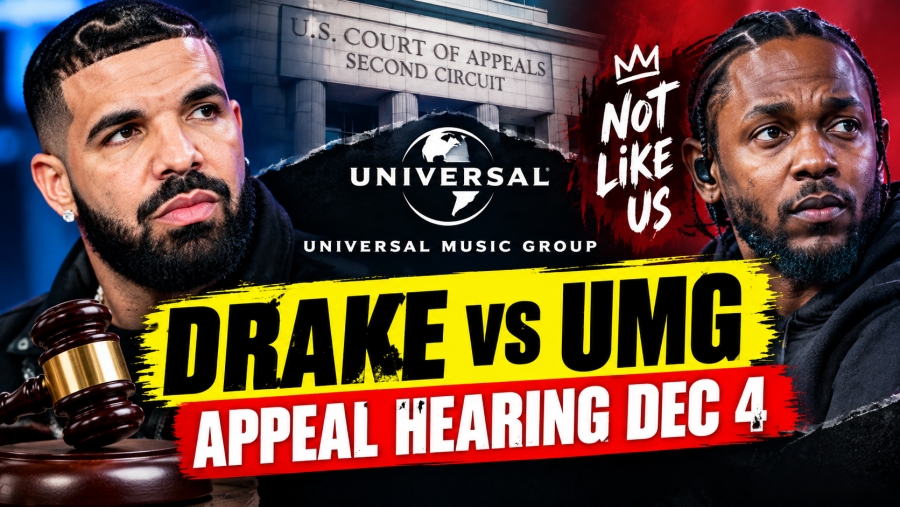
Drake’s UMG Appeal Over Kendrick Lamar’s “Not Like Us” Gets December Hearing Date
Drake’s legal battle with Universal Music Group (UMG) over Kendrick Lamar’s “Not Like Us” is heading back into federal court this December.
The U.S. Court of Appeals for the Second Circuit has scheduled oral arguments for December 4, 2026, giving Drake’s legal team another opportunity to challenge the dismissal of his defamation lawsuit against UMG. A three-judge appellate panel will hear arguments from both sides and determine whether the case should remain dismissed or return to the lower court for further proceedings.
The lawsuit stems from one of the most closely watched rap battles of recent years, but Drake’s legal action targets UMG Recordings rather than Kendrick Lamar himself. Drake alleges that UMG knowingly released and promoted “Not Like Us” despite what he says were false and defamatory allegations about him.
UMG has denied wrongdoing and argues that the song must be understood in the context of a highly publicized rap battle, where exaggeration, insults and provocative artistic expression are expected.
With the December hearing approaching, the case could become an important legal discussion about defamation, rap lyrics, artistic expression, record-label responsibility and the boundaries between promotional music content and factual claims.
What Is the Drake vs. UMG Lawsuit About?
Drake, whose legal name is Aubrey Drake Graham, filed his lawsuit against UMG in January 2025, following the explosive 2024 feud between him and Kendrick Lamar.
The lawsuit alleged that UMG defamed Drake by releasing and promoting Lamar’s “Not Like Us,” which contains serious accusations directed at Drake.
Importantly, Kendrick Lamar was not named as a defendant in Drake’s lawsuit. Instead, the case focused on UMG and its role in distributing, marketing and promoting the song.
Drake's complaint also included claims involving harassment and New York's General Business Law. The case was ultimately narrowed by the court's dismissal of the claims.
The dispute placed a major record label in an unusual position: UMG had commercial relationships with both Drake and Lamar while the two artists were publicly attacking each other through music.
Drake argued that the label's promotion of the track went beyond simply allowing an artist to release a diss record.
UMG rejected that characterization and argued that the song's lyrics should be understood as part of a rap battle rather than as conventional factual reporting.
The 2024 Kendrick Lamar and Drake Feud
The legal dispute cannot be separated from the extraordinary public attention surrounding the 2024 Drake-Kendrick Lamar feud.
Over a period of roughly two weeks, the two artists released a series of diss tracks that escalated rapidly. The exchanges included personal accusations, insults and references to each artist's career and personal life.
“Not Like Us,” released by Lamar in May 2024, became the biggest commercial success to emerge from the battle.
The song went far beyond the traditional audience for rap beefs. It became a major mainstream hit, reached No. 1 on the Billboard Hot 100 and later won five Grammy Awards, including Record of the Year and Song of the Year. Lamar subsequently performed it during his Super Bowl halftime show.
That commercial success is relevant to Drake's legal argument because his lawsuit concerns not merely the existence of the diss track, but also the scale of UMG's alleged promotion of it.
The more widely the song was distributed and promoted, Drake's lawyers argue, the greater the alleged impact of the statements contained within it.
Why Did the Lower Court Dismiss Drake’s Case?
In October 2025, U.S. District Judge Jeannette Vargas dismissed Drake's lawsuit.
The court concluded that the statements Drake challenged in “Not Like Us” constituted nonactionable opinion rather than statements of fact that could support a defamation claim.
The court considered the lyrics within the broader context of the Drake-Lamar feud.
Judge Vargas noted that the dispute involved a series of diss tracks featuring increasingly aggressive rhetoric, accusations and imagery. In that setting, the court concluded that a reasonable listener would understand “Not Like Us” as part of an ongoing artistic and musical confrontation rather than as a conventional factual account about Drake.
That distinction between fact and opinion is at the heart of the appeal.
Defamation law generally requires a false statement of fact rather than protected opinion. The question in this case is therefore not simply whether lyrics are offensive or damaging, but whether the challenged statements could reasonably be understood as factual assertions.
Drake Is Challenging the Dismissal
Drake appealed the district court's decision and has argued that the lower court applied an overly broad rule to rap music.
His legal team filed a substantial opening brief with the Second Circuit in January 2026. According to Music Business Worldwide, Drake's lawyers argued that the district court had effectively created what they described as a “dangerous categorical rule” for diss tracks.
The argument does not necessarily claim that all lyrics in a diss track are factual statements.
Instead, Drake's lawyers contend that artistic context should not automatically prevent potentially defamatory statements from being actionable simply because they appear in a rap song.
They have also challenged how the lower court evaluated the allegations at the motion-to-dismiss stage.
In an April 2026 reply brief, Drake's attorneys argued that the district court improperly relied on material outside the complaint and made factual determinations that they believe should not have been resolved at that stage of the litigation.
The Second Circuit will now consider those arguments.
What Is UMG’s Argument?
UMG is asking the appeals court to uphold the original dismissal.
The label's legal position is that “Not Like Us” must be interpreted in its proper artistic and cultural context.
UMG's response brief emphasized that diss tracks are inherently confrontational forms of artistic expression and argued that listeners understand them differently from statements made in a news report, corporate announcement or other factual communication.
The label has also highlighted the sequence of events that preceded “Not Like Us.”
UMG's appellate arguments point to the broader exchange between Drake and Lamar and, in particular, Drake's own diss tracks. UMG has argued that the lyrics should be viewed within that reciprocal musical confrontation rather than isolated from the material that preceded them.
That contextual argument was central to Judge Vargas's original decision and will remain an important issue before the appeals court.
Why the December 4 Hearing Matters
The December 4 hearing is significant because it represents the next major step in the appellate process.
The case has already gone through extensive written briefing. Drake submitted his opening arguments, UMG filed its response, and Drake subsequently filed a reply. Outside organizations and legal scholars have also submitted amicus briefs supporting UMG's position.
At oral argument, the attorneys will have the opportunity to answer questions directly from the three-judge panel.
Appellate hearings can focus heavily on specific legal questions raised by the judges. The December proceeding therefore gives both sides an opportunity to explain why the district court's interpretation of defamation law should either be upheld or reversed.
The panel will not necessarily issue a decision on the day of the hearing.
Instead, the judges will consider the arguments and issue a written ruling at a later date. The timing of that decision has not been announced.
Could the Lawsuit Be Revived?
The central question for the Second Circuit is whether Drake's lawsuit should continue.
If the appeals court agrees with the lower court, the dismissal would remain in place.
If the judges determine that the district court made a legal error, they could reverse the dismissal and send the case back for further proceedings.
That would not necessarily mean Drake had won the underlying defamation case.
Rather, it would allow the litigation to continue in the lower court, where additional legal and factual questions could be addressed.
The appeals court could also issue a more limited ruling concerning particular aspects of the district court's decision.
As of September 2026, there is therefore no final appellate ruling on Drake's claims.
The Bigger Question: Can Rap Lyrics Be Defamatory?
The case has attracted attention well beyond Drake and UMG because it raises questions about how courts should interpret artistic expression.
Rap has traditionally relied on exaggeration, fictionalization, boasts, threats and hyperbole. Diss tracks in particular are designed to provoke and entertain.
But that does not automatically answer every legal question.
The difficult issue is how a court distinguishes between artistic rhetoric and potentially actionable factual claims.
Drake's position is that the context of a rap battle should not create an automatic exemption from defamation law.
UMG's position is that removing lyrics from their artistic context could expose musicians and labels to liability for language that audiences understand as part of a performative exchange.
The Second Circuit's ruling could therefore receive attention from artists, record companies, publishers, lawyers and free-expression advocates.
What Could the Case Mean for Record Labels?
The lawsuit also raises questions about how much responsibility a record label carries for music it distributes and promotes.
UMG is not accused of writing the lyrics to “Not Like Us.” Drake's case instead focuses on the company's role in releasing and promoting the recording.
That distinction matters for the broader music business.
Record labels routinely market songs containing controversial lyrics. They also make promotional decisions based on commercial performance, audience engagement and cultural momentum.
If a court were to establish broader circumstances under which labels could face liability for promoting disputed statements contained in songs, that could affect how companies approach marketing and risk management.
At the same time, the existing legal framework surrounding defamation and artistic expression remains relevant. The Second Circuit will be deciding the particular legal questions presented by Drake's appeal rather than issuing a general ruling on every controversial lyric released by a record label.
The Role of “Not Like Us” in Modern Music Culture
Whatever happens legally, “Not Like Us” has already become an unusually important example of how quickly a diss track can move from hip-hop culture into mainstream entertainment.
The song became a global commercial success, won major industry awards and became part of one of the biggest live television performances of 2025.
That trajectory also makes the lawsuit unusual.
A traditional diss track might circulate primarily within a genre's audience. “Not Like Us” became a mainstream cultural event, meaning its lyrics reached listeners who may have had little familiarity with the conventions of battle rap.
That difference in audience is relevant to the broader discussion about how listeners interpret provocative artistic language.
What Happens After December 4?
Once oral arguments conclude, the three-judge panel will consider the case and eventually issue its decision.
There is no announced date for the ruling.
The possible outcomes include affirming the district court's dismissal, reversing the decision and allowing the lawsuit to proceed, or issuing another form of ruling that sends particular issues back to the lower court.
The December hearing therefore does not represent the end of the legal process in every scenario.
Instead, it is the next major checkpoint in a case that has already moved from a highly publicized rap feud into a federal appellate dispute.
Why Music Professionals Are Watching the Case
For artists, producers, managers and labels, the Drake-UMG case is worth following because it sits at the intersection of music, copyright-adjacent business issues, defamation law, promotion and artistic expression.
Artists regularly make provocative statements through songs. Labels regularly distribute and promote that material.
The case asks how those activities interact with legal protections when statements made through music are alleged to cause reputational harm.
It also illustrates the importance of context.
The same sentence can potentially be interpreted differently depending on whether it appears in a news article, an interview, a social-media post, a fictional work or a diss track.
The Second Circuit's analysis could provide additional guidance on how federal courts should approach those distinctions.
Final Thoughts
Drake's appeal against Universal Music Group is scheduled to reach the U.S. Court of Appeals for the Second Circuit on December 4, 2026, when a three-judge panel will hear oral arguments concerning the dismissal of his lawsuit over Kendrick Lamar's “Not Like Us.”
The underlying dispute is about more than one rap song.
At its center is a legal question about whether statements made in an aggressive artistic context can nevertheless be treated as actionable factual claims, and how much responsibility a record label has for promoting those statements.
The district court previously ruled that the challenged lyrics were nonactionable opinion when considered within the context of the Drake-Lamar feud. Drake's appeal argues that the decision went too far, while UMG maintains that the dismissal should stand.
The Second Circuit's eventual ruling will determine the next stage of this particular case. It could also provide further insight into how courts approach the boundary between rap's tradition of provocative expression and modern defamation law.
For now, the music industry will be watching December 4.
