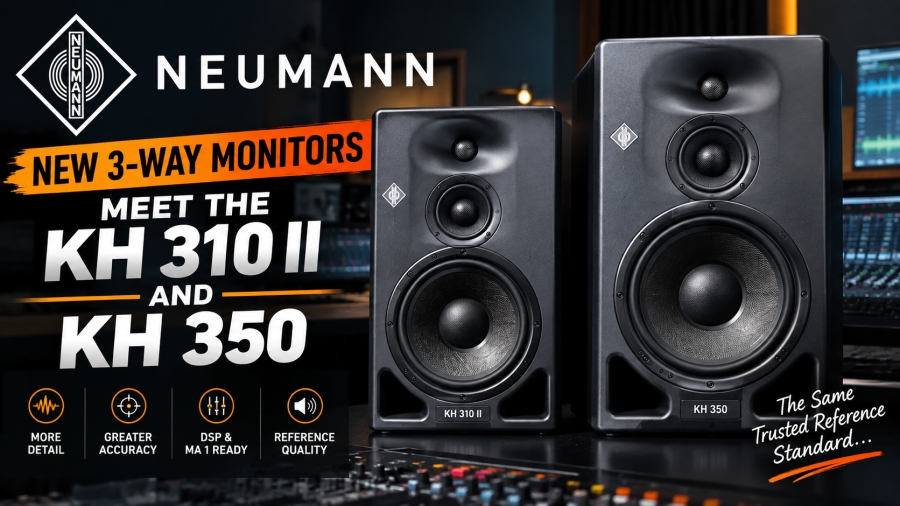
Neumann Expands Its Range of 3-Way Monitors: Meet the KH 310 II and KH 350
Neumann is expanding its acclaimed KH range with two new three-way studio monitors designed to give engineers, producers and critical listeners more choice without compromising the reference-quality monitoring philosophy the brand is known for.
The Neumann KH 310 II and Neumann KH 350 occupy different positions in the company’s monitoring lineup, but share a common goal: accurate, consistent and highly detailed reproduction that helps users make better production decisions.
Neumann describes the new models as offering “the same trusted reference standard while allowing users to choose the monitoring concept that best supports their workflow.” The KH 310 II focuses on compact, controlled nearfield monitoring, while the larger KH 350 brings greater low-frequency authority, higher output and more scale to larger rooms and longer listening distances.
For producers, mixing engineers, mastering engineers, broadcasters and post-production professionals, the introduction gives the Neumann KH family an even broader range of three-way monitoring options.
Neumann KH 310 II and KH 350: A New Chapter for the KH Range
The KH 310 has long been regarded as one of Neumann’s key reference monitors. Rather than completely reinventing that design, Neumann has taken its established concept and updated it with modern DSP, new electronics and improved acoustic performance.
The KH 310 II is the successor to the original KH 310 and retains its sealed-cabinet design, compact footprint and dedicated three-way architecture. Neumann says the new model preserves the familiar KH 310 tonal balance while improving virtually every measurable aspect of performance.
The KH 350, meanwhile, takes a different approach. It is a larger three-way monitor with a bass-reflex cabinet, designed for applications where greater low-frequency extension, headroom and scale are priorities.
That distinction is important. Rather than positioning one model as simply “better” than the other, Neumann is giving professionals two different monitoring philosophies.
Why Three-Way Studio Monitors Matter
A three-way studio monitor separates the frequency spectrum between three dedicated drivers: a woofer for low frequencies, a midrange driver for the critical center of the spectrum and a tweeter for high frequencies.
That dedicated midrange section is particularly important for professional monitoring. Vocals, guitars, keyboards, snare drums, strings and many of the elements that determine the character of a mix live heavily in the midrange.
Neumann explains that three-way monitoring can provide improved separation, detail and mixing accuracy because each driver has a more focused job.
The KH 310 II and KH 350 both use an 8.25-inch woofer, 3-inch midrange driver and 1-inch tweeter. Both are also tri-amplified, with dedicated amplification for their individual frequency sections.
For critical mixing and mastering, this architecture can make it easier to hear subtle changes in vocal balance, compression, EQ, ambience and instrument placement.
Neumann KH 310 II: The Reference, Refined
The KH 310 II is arguably the most direct evolution of the two new models.
Designed as a compact three-way nearfield monitor, it retains the sealed cabinet geometry of its predecessor. Neumann says that geometry was already optimized for neutral directivity, low diffraction and accurate imaging, which is why the company chose to retain the basic form rather than redesign the enclosure from scratch.
The biggest changes happen inside.
The KH 310 II introduces an integrated DSP platform, compatibility with Neumann’s MA 1 Automatic Monitor Alignment system and digital connectivity. Its maximum SPL is also increased by 5 dB compared with the original model.
Neumann lists a total amplification capacity of 525 watts, compared with 290 watts for the previous KH 310. The updated monitor also delivers lower harmonic and intermodulation distortion, improved directivity and tighter production tolerances.
The result is intended to be more than simply a louder KH 310.
The redesigned woofer offers improved high-excursion performance, while DSP processing helps achieve improved linearity. Neumann specifies frequency-response linearity of ±0.6 dB for the KH 310 II and a frequency response of 29 Hz to 21 kHz within ±6 dB. Maximum SPL is rated at 121.4 dB at one metre.
A Monitor Designed for Precision and Control
The KH 310 II is particularly interesting for engineers who work relatively close to their monitors.
Neumann recommends a listening distance of around 1 to 2.5 metres, making the monitor well suited to professional project studios, mixing rooms and smaller control rooms. Its feasible listening distance is listed as 0.75 to 6 metres.
The sealed enclosure also reflects a deliberate design philosophy.
Instead of chasing maximum bass extension through a ported cabinet, the KH 310 II prioritizes controlled low frequencies and transient precision. This can be particularly useful when making detailed mixing decisions where bass timing and low-end definition matter as much as sheer quantity.
For engineers already familiar with the original KH 310, the new model therefore represents an upgrade rather than a radical change in philosophy.
Neumann KH 350: Full-Range Authority
The KH 350 takes the three-way concept into a larger format.
While it shares the same basic driver configuration as the KH 310 II, the KH 350 uses a bass-reflex cabinet designed to deliver greater low-frequency extension and a larger sense of scale.
Its stated frequency response reaches down to 27 Hz, compared with 29 Hz for the KH 310 II. Maximum SPL is rated at 122.6 dB at one metre.
Those numbers only tell part of the story.
The KH 350 is intended for users who need more authority from their main monitors. That could include music producers working with bass-heavy genres, film and television mixers, immersive audio engineers or studios with larger listening environments.
Neumann recommends the KH 350 for listening distances around 3 metres and beyond, with a recommended range of 1.2 to 3 metres and a feasible listening distance extending from 1 to 9 metres.
That makes the KH 350 a more natural fit for midfield applications than the compact KH 310 II.
KH 310 II vs KH 350: Which Monitor Is Right for You?
The biggest difference between the two new Neumann studio monitors isn't simply size.
It is the intended workflow.
The KH 310 II is designed around analytical listening, tight low-end control and nearfield precision. It makes sense for engineers who work in relatively compact rooms and want a highly detailed reference monitor that doesn't dominate the listening environment.
The KH 350 is aimed at users who need more scale and low-frequency authority. Its bass-reflex design, extended response and higher output make it better suited to larger rooms, longer listening distances and productions where powerful low-frequency reproduction is essential.
In simple terms:
- KH 310 II: compact, controlled and analytical.
- KH 350: larger, more powerful and full-range.
- Both: three-way, tri-amplified monitoring with Neumann's reference-focused design philosophy.
That choice is central to the new range.
Instead of forcing every professional studio into the same monitoring approach, Neumann is allowing engineers to choose the speaker that better matches their room, distance and production requirements.
DSP and Neumann MA 1 Integration
One of the most important developments in the KH 310 II is the move toward deeper DSP integration.
The monitor is compatible with Neumann's MA 1 Automatic Monitor Alignment system, which can be used to measure and align compatible Neumann monitoring systems to the listening environment.
That matters because even an extremely accurate studio monitor can be affected by the room around it.
Reflections, standing waves, speaker placement and room dimensions can all influence what reaches the engineer's ears. Room correction does not eliminate the need for good acoustic treatment, but it provides another layer of control over the monitoring chain.
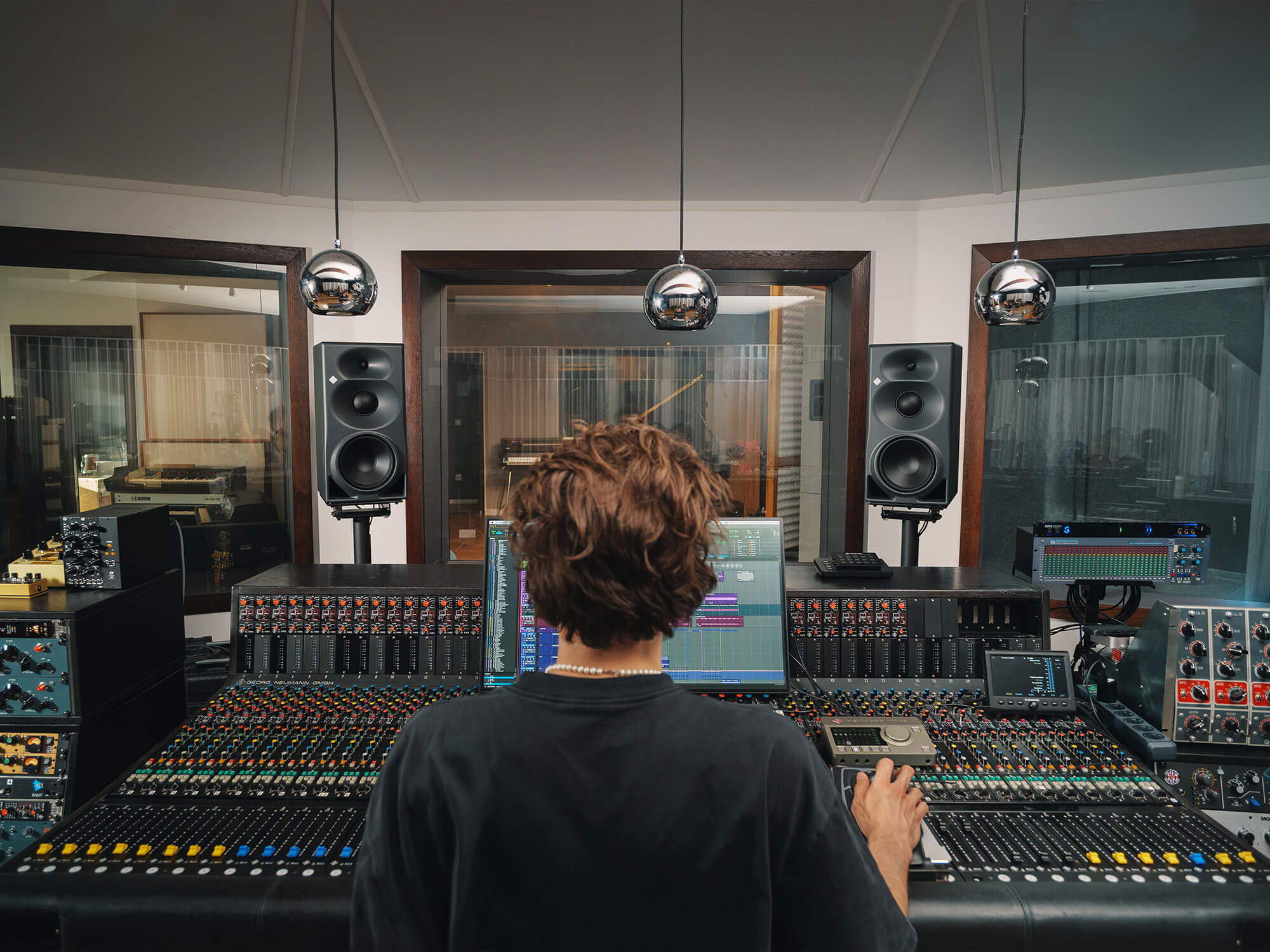
The KH 350 also includes integrated MA 1 room-correction capabilities, reinforcing Neumann's approach of treating the monitor, room and calibration system as parts of a larger ecosystem.
A Consistent Monitoring Ecosystem
Neumann's strategy extends beyond individual speakers.
The company has been expanding the KH ecosystem with DSP-controlled subwoofers designed for stereo, surround and immersive monitoring systems. Its current range includes models such as the KH 805 II, KH 810 II and KH 870 II.
That gives studios the possibility of building a monitoring system gradually.
A producer might begin with a pair of three-way monitors, then introduce a subwoofer or expand into a multichannel immersive configuration as the studio's requirements evolve.
The attraction is consistency.
If the monitoring chain maintains a familiar sonic reference from stereo mixing through immersive production, engineers can spend less time adapting to different monitoring systems and more time concentrating on the material.
Who Should Consider the KH 310 II?
The KH 310 II is particularly compelling for professional mixing and mastering engineers who value midrange detail and controlled bass.
It is also an attractive option for producers who have grown beyond smaller two-way monitors but don't have the room or listening distance required for a larger midfield system.
Its compact dimensions—253 x 383 x 292 mm—make it considerably easier to integrate into smaller control rooms than a large-format monitor.
For engineers working primarily on vocals, acoustic music, electronic production, pop, rock or detailed post-production work, the dedicated midrange driver can be especially valuable.
The improved output and DSP capabilities also mean that the KH 310 II is not simply a cosmetic refresh of the original model.
Who Should Consider the KH 350?
The KH 350 is aimed at a different kind of studio.
Its larger cabinet measures 649 x 474 x 399 mm, and the monitor is intended to provide more authority in larger spaces.
That makes it a natural candidate for commercial recording studios, larger mixing rooms, post-production facilities and immersive audio environments.
It could also appeal to producers who simply want their main monitoring system to reproduce substantial low-end information without immediately adding a subwoofer.
For bass-heavy productions, film soundtracks and immersive formats, having greater headroom and low-frequency extension can be particularly useful.
The Bigger Picture for Neumann Studio Monitors
The introduction of the KH 310 II and KH 350 shows that the future of professional monitoring isn't necessarily about choosing between traditional analog design and modern digital technology.
Instead, Neumann is combining both.
The KH 310 II keeps the proven physical architecture of its predecessor while adding DSP, digital connectivity, improved amplification and redesigned acoustic components.
The KH 350 takes the same three-way reference philosophy and applies it to a larger, bass-reflex platform designed around scale and authority.
That approach also reflects a broader trend in professional studio monitoring: engineers increasingly expect speakers to integrate with room calibration, digital workflows and expandable monitoring ecosystems rather than functioning as isolated boxes.
Neumann KH 310 II and KH 350: Two Different Routes to Reference Monitoring
With the KH 310 II and KH 350, Neumann is expanding its three-way monitor range without abandoning the characteristics that made the KH series attractive to professional users in the first place.
The KH 310 II is the precision-focused option: compact, sealed, highly controlled and built for critical nearfield listening.
The KH 350 is the full-range alternative: larger, more powerful and designed to deliver greater low-frequency authority and scale.
Neither is simply a replacement for the other.
Instead, the two monitors give studios a choice based on room size, listening distance, workflow and the type of material being produced.
And that is perhaps the most important part of Neumann's latest announcement. The goal isn't simply to make monitoring louder or add more technology. It is to provide engineers with a trustworthy reference that fits the way they actually work.
For professionals who rely on their monitors to make decisions about every detail of a production, that flexibility could be just as important as the specifications themselves.
