


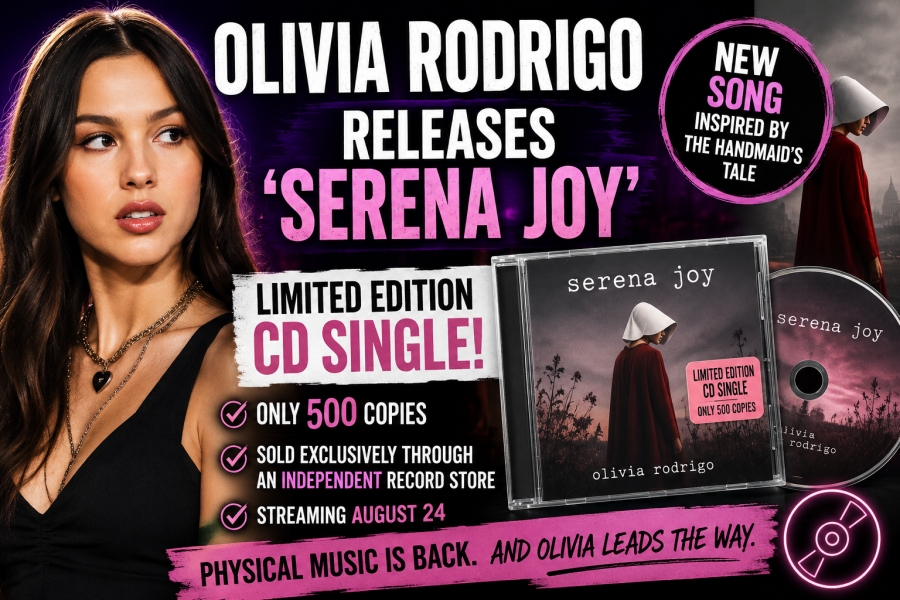
Olivia Rodrigo Releases “Serena Joy” as a Limited-Edition CD Single
Olivia Rodrigo has surprised fans with the release of “Serena Joy,” a previously unreleased song inspired by The Handmaid’s Tale, but the way she released it may be even more significant than the song itself.
Rather than immediately putting the track on Spotify, Apple Music and other streaming platforms, Rodrigo first made “Serena Joy” available as an extremely limited-edition CD single through an independent record store in California.
Only 500 physical copies were produced, and the CDs were sold exclusively through Analog Record Shop in Tustin, California, ahead of Rodrigo’s upcoming Daisy Chain Fields festival. The limited run reportedly sold out, turning the CD into an instant collector’s item before the song’s wider digital release.
The move is particularly interesting because it arrives during a surprising revival of physical music. CDs, once considered an outdated format, are increasingly attracting younger listeners who value physical ownership, collectible releases and the experience of having something tangible connected to their favorite artists.
Rodrigo’s “Serena Joy” release therefore represents more than a new song. It is an example of how major pop artists are finding new ways to combine streaming, physical music, independent record stores, limited editions and fan culture.
What Is Olivia Rodrigo’s “Serena Joy”?
“Serena Joy” is a previously unreleased Olivia Rodrigo song named after Serena Joy Waterford, a character from Margaret Atwood’s The Handmaid’s Tale.
The song arrives as a politically charged piece of music focused on themes surrounding women's rights, complacency and resistance. Its title references a character associated with the oppressive society depicted in The Handmaid’s Tale, giving the track a clear connection to one of contemporary literature’s most recognizable stories about authoritarianism and reproductive rights.
The timing of the release is also significant.
Rodrigo is preparing for Daisy Chain Fields, a women-led music festival scheduled for August 29 in Irvine, California. The event is connected to women's rights and reproductive-rights organizations, making “Serena Joy” a natural thematic companion to the festival.
The song is being treated as a non-album track rather than a conventional new album lead single. Its initial physical-only release has consequently created a sense of exclusivity around the track.
Only 500 Copies of “Serena Joy” Were Made
The most remarkable detail about the release is its tiny production run.
Rodrigo released just 500 CD copies of “Serena Joy” through Analog Record Shop in Tustin. The store was selected in connection with her upcoming Daisy Chain Fields event, giving local fans an opportunity to obtain the song physically before its general digital release.
According to reports, the limited-edition CDs sold out.
That means the physical version was essentially transformed into a collectible from the moment it went on sale.
For comparison, a major pop single can potentially generate millions of streams in its first few days. Rodrigo instead created scarcity by making only a few hundred physical copies available.
That is a very different approach to music distribution.
Rather than asking fans to compete for streams, the release encouraged them to compete for ownership.
When Will “Serena Joy” Be Available on Streaming Services?
Fans who missed the limited CD release do not have to wait indefinitely.
“Serena Joy” is scheduled to receive its wider digital release on August 24, 2026, meaning the physical-only window is deliberately short.
That strategy is important.
Rodrigo is not rejecting streaming. Instead, she is using physical media to create an exclusive first stage of the release before making the song broadly accessible.
The approach effectively creates two audiences:
One group gets the rare physical edition.
The much larger audience gets the song digitally.
This allows the artist to benefit from the excitement of scarcity without permanently restricting access to the music.
Why Is Olivia Rodrigo Releasing a CD Single in 2026?
At first glance, releasing a CD single in 2026 might seem strange.
Streaming is overwhelmingly important to the modern music business, and listeners can access songs instantly through platforms around the world.
But physical music has developed a new role.
Instead of being the primary way people listen to music, CDs, vinyl records and cassettes increasingly function as collectibles, merchandise and fan experiences.
That distinction is crucial.
A listener may stream an album hundreds of times but still purchase a physical edition because they want something tangible associated with the artist.
Rodrigo's “Serena Joy” release takes that concept to an extreme.
There is no large-scale physical album campaign here. There are only 500 copies of one song.
That scarcity gives the CD value beyond its function as a way of playing music.
CDs Are Making a Comeback Among Younger Listeners
The “Serena Joy” release comes at an interesting moment for CDs.
Recent reporting indicates that CD sales have been growing in 2026, with younger consumers helping drive renewed interest in the format. The Guardian recently reported that CD sales increased significantly this year while searches for CD players also surged, suggesting that physical music is becoming part of a broader retro-technology trend.
The appeal is not necessarily nostalgia.
Many younger listeners did not grow up buying CDs.
Instead, they are discovering physical formats for the first time.
For some, CDs are relatively affordable compared with vinyl. They are compact, easy to collect and offer artwork, packaging and a physical connection to music without the higher prices often associated with vinyl records.
That makes CDs particularly interesting as a bridge between physical and digital music culture.
Why Physical Music Matters to Gen Z
The resurgence of physical music reflects a broader change in how younger consumers think about entertainment.
Streaming offers convenience, but it can also make music feel temporary.
A playlist can disappear. An artist can change a song's availability. A streaming subscription can be canceled. Algorithms determine much of what listeners discover.
A physical CD is different.
Once purchased, it belongs to the listener.
That sense of ownership is one reason physical music has become attractive to younger audiences. Industry observers have also linked the trend to a desire for more intentional and tactile ways of experiencing music.
For artists, that creates an opportunity.
A CD does not necessarily have to compete with streaming.
It can complement it.
Olivia Rodrigo and the Independent Record Store Connection
Another important aspect of the “Serena Joy” release is where the CDs were sold.
Rather than distributing the single through a major retail chain, Rodrigo chose Analog Record Shop, an independent store in Tustin, California.
That decision gives the release a stronger community and grassroots dimension.
Independent record stores have long served as important gathering places for music fans. They offer an experience that online streaming platforms cannot replicate: browsing physical releases, speaking with music enthusiasts and discovering music in a tangible environment.
By connecting “Serena Joy” with an independent record store, Rodrigo also helped generate foot traffic and attention for a type of music retailer that has had to reinvent itself during the streaming era.
The release therefore benefits both the artist and the physical music ecosystem.
A Smart Marketing Strategy for the Streaming Era
From a marketing perspective, the “Serena Joy” campaign is remarkably efficient.
Imagine announcing a normal digital single.
The song appears on streaming platforms, fans listen to it and the promotional cycle begins.
Rodrigo's strategy created something different.
First came the mystery surrounding an unreleased song.
Then came the announcement of a physical release.
Then came the realization that only 500 copies existed.
Fans rushed to the independent store.
The copies sold out.
News outlets reported on the unusual strategy.
Social media amplified the scarcity.
And only afterward does the song arrive on streaming platforms for the mass audience.
The physical release effectively became its own marketing event.
Scarcity Creates a Stronger Fan Connection
Limited-edition music releases are nothing new, but the strategy works particularly well in the streaming era because digital music is inherently abundant.
Most songs are instantly available.
A fan can search for an artist and find thousands of tracks within seconds.
Scarcity therefore becomes valuable.
A 500-copy CD creates a completely different emotional response from a standard digital single.
Fans who purchased one can say they own something that only a tiny number of other people possess.
That turns a simple CD into a piece of pop-culture memorabilia.
For an artist like Olivia Rodrigo, whose fan base includes a large number of highly engaged younger listeners, that kind of collectible can be extremely powerful.
The “Serena Joy” Release Connects Music and Activism
The song's physical-release strategy is only one part of the story.
“Serena Joy” is also closely connected to Rodrigo's activism and the upcoming Daisy Chain Fields festival.
The festival is scheduled for August 29 in Irvine and features a women-led lineup including artists such as Mitski, Garbage and Stevie Nicks. Its proceeds are set to benefit organizations including Planned Parenthood and the Center for Reproductive Rights.
That context gives the song additional meaning.
The title's reference to The Handmaid's Tale is not random. It places the track within a broader conversation about women's rights and political power.
Music has frequently served as a vehicle for activism, and Rodrigo's decision to connect a new song to a cause-based festival demonstrates how contemporary pop releases can function as cultural statements as well as commercial products.
What This Means for the Music Industry
The “Serena Joy” release could become a useful example of where physical music is heading.
The future probably isn't a return to the 1990s, when CDs were the dominant format and almost every major album was expected to generate substantial physical sales.
Instead, physical music is becoming premium and experiential.
Artists can use limited CDs and vinyl records to reward their most dedicated fans.
They can create special artwork, alternate versions, bonus tracks and exclusive packaging.
They can partner with independent record stores.
And they can generate headlines by making a physical release available before a song reaches streaming services.
The product is no longer simply the music.
It is the experience of owning a piece of the release.
Olivia Rodrigo Shows That CDs Are Not Dead
It would be premature to say that CDs have returned to their former dominance.
Streaming remains the central way most listeners consume music.
But Rodrigo's release demonstrates that physical music does not need to dominate the market to be commercially and culturally relevant.
A format can decline as a mass-market product while simultaneously becoming more valuable as a collectible.
That may be exactly what is happening with CDs.
Recent reporting has highlighted growing CD sales and renewed interest among younger consumers, while artists including Rodrigo and other major pop acts are using physical editions to deepen fan engagement.
The CD is no longer simply a container for music.
For many fans, it is merchandise, memorabilia and proof of fandom.
What Fans Can Expect Next
The 500 physical copies of “Serena Joy” are already generating collector interest, but the bigger moment will arrive when the song reaches streaming services on August 24.
That will finally allow Rodrigo's broader audience to hear the track.
It also means the initial scarcity will disappear.
The song will transition from a highly exclusive physical artifact into a widely accessible digital release.
That contrast is precisely what makes the campaign so interesting.
Rodrigo has created a short period in which the physical version is genuinely special before opening the song to everyone.
The Bigger Picture: Music Is Becoming Both Digital and Physical
The story of “Serena Joy” ultimately reflects the strange and increasingly diverse nature of the modern music industry.
Streaming has made music more accessible than ever.
At the same time, fans are showing renewed interest in physical formats.
Artists are responding by giving each format a different purpose.
Streaming provides accessibility.
Vinyl provides premium collectibility.
CDs provide affordable physical ownership.
Limited editions provide scarcity.
And independent record stores provide community.
Olivia Rodrigo's “Serena Joy” combines all of those elements into a single release strategy.
Final Thoughts
Olivia Rodrigo's decision to release “Serena Joy” as a limited-edition CD single is one of the more intriguing music-industry stories of August 2026.
Only 500 copies were produced, and they were sold through Analog Record Shop in Tustin, California, ahead of Rodrigo's Daisy Chain Fields festival. The limited edition reportedly sold out, while the song is scheduled to become available digitally on August 24.
The move is especially notable because it arrives during a renewed interest in CDs among younger music fans.
Rather than treating physical music as an outdated technology, Rodrigo has turned the CD into a limited collectible and fan experience.
That may be the real lesson here.
The future of music is not necessarily going to be entirely digital or entirely physical.
Instead, the industry may increasingly use both.
Streaming will remain the easiest way to hear a song, while limited physical releases can give fans something they cannot get from an algorithm: ownership, scarcity and a tangible connection to the artist.
With “Serena Joy,” Olivia Rodrigo has demonstrated how an old format can be given a new purpose.
And in an industry built around constant technological change, sometimes the most interesting innovation is simply finding a new reason to make something physical again.
