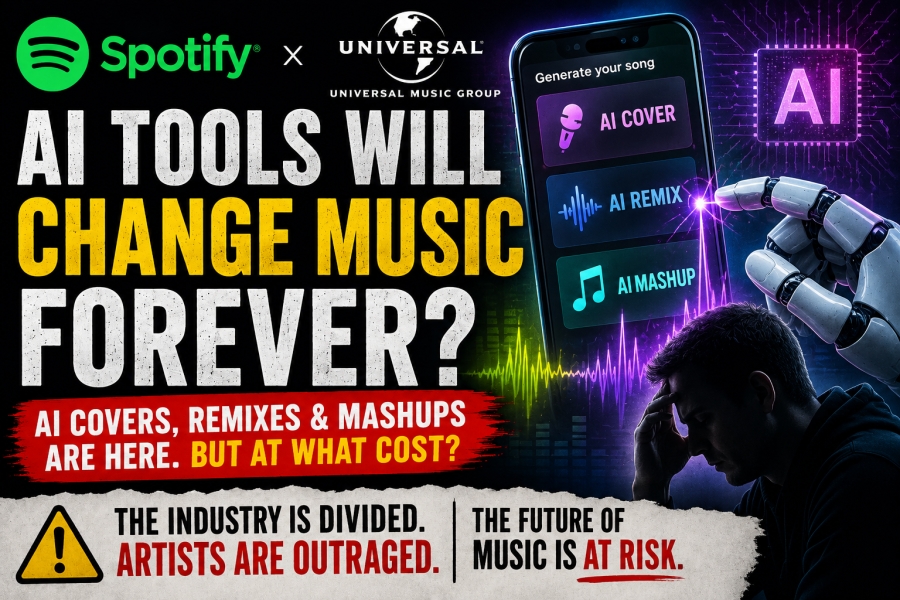
Spotify and Universal Music Group Launch AI Music Tools: The Beginning of a Dangerous New Era for Human Creativity?
The music industry entered a controversial new chapter this morning after Spotify officially announced a licensing agreement with Universal Music Group that will allow the streaming giant to launch user-facing generative AI music tools for paying subscribers.
According to reports, the new feature will enable users to generate AI-powered “covers,” remixes, mashups, and alternate versions of songs from participating UMG artists directly inside Spotify’s ecosystem. The feature will reportedly be offered as a paid add-on service.
The announcement immediately sparked intense debate across the music industry, with artists, producers, songwriters, and fans questioning whether the short-term financial opportunities of AI-generated music are worth the potentially devastating long-term consequences for human creativity.
While Spotify is presenting the move as a groundbreaking innovation capable of unlocking new revenue streams for creators, critics argue that this may instead represent one of the clearest signs yet that major corporations are prioritizing artificial intelligence and monetization over authentic human artistry.
For many within the industry, the controversy extends beyond Spotify itself. The participation of Universal Music Group — one of the world’s three major record labels — is being viewed by some as a historic turning point in the relationship between AI and the commercial music business.
Spotify Officially Embraces User-Facing Generative AI
This announcement is especially significant because it marks the first major example of a streaming platform openly integrating user-facing generative AI music tools directly into its service.
While AI-generated music has already been circulating across the internet for several years, most major streaming companies had previously approached the technology cautiously due to legal, ethical, and artistic concerns.
Now, Spotify appears ready to move aggressively into the AI music era.
The company’s new tools will reportedly allow users to:
- Generate AI-powered covers of existing songs
- Create remixes and mashups
- Modify tracks using generative AI systems
- Experiment with alternate song versions
- Interact with music in new AI-assisted ways
The tools will initially focus on music owned or controlled by participating UMG artists under the licensing agreement.
Spotify argues that these AI features could create entirely new forms of fan engagement while also generating additional revenue opportunities for artists, labels, and the platform itself.
However, the announcement has already triggered backlash from critics who believe the move may accelerate the devaluation of human-made music.
Universal Music Group’s Role Sparks Industry Outrage
Much of the criticism surrounding the announcement has been directed toward Universal Music Group itself.
As one of the “Big Three” record labels alongside Sony Music Entertainment and Warner Music Group, UMG holds enormous influence over the global music industry.
Because of this, many observers view the partnership as far more than a simple licensing deal.
For critics, the agreement represents the first major label openly embracing a future where AI-generated reinterpretations of artist work become normalized inside mainstream streaming platforms.
This has led some musicians and fans to accuse UMG of prioritizing corporate profits over artistic integrity.
The core concern is simple: once audiences become comfortable consuming AI-generated covers, remixes, and alternate versions of songs, the floodgates may open for a much larger wave of AI-generated music content.
Critics fear this could permanently alter how audiences value human-created art.
The Fear of AI Music Saturation
One of the biggest concerns surrounding Spotify’s new AI initiative is the potential saturation of the music marketplace.
The streaming industry already suffers from oversaturation problems. Thousands of songs are uploaded to streaming services every single day, making discovery increasingly difficult for independent artists.
Now imagine a future where millions of AI-generated variations of songs flood streaming platforms.
Industry critics fear users could soon generate endless versions of tracks, including:
- AI-generated vocal covers
- Genre-swapped remixes
- Artificial mashups
- Synthetic collaborations
- Alternate arrangements
- Machine-generated reinterpretations
While this may initially seem entertaining or innovative, many artists worry that it could gradually dilute the emotional value of music itself.
Music has historically been rooted in human experience, storytelling, vulnerability, emotion, and artistic identity. Critics argue that AI-generated reinterpretations risk turning music into disposable algorithmic content optimized for engagement rather than genuine creative expression.
Spotify Says AI Could Create New Revenue Streams
Spotify is positioning the new feature as an economic opportunity for creators.
According to the company’s messaging, allowing fans to interact with songs through AI tools could generate additional monetization pathways for participating artists and rights holders.
Possible revenue models may include:
- Paid AI remix generation
- Premium AI cover features
- Licensing splits
- Fan-created remix marketplaces
- Subscription upgrades
- AI music customization tools
Spotify believes that interactive AI-driven music experiences may become a major part of the future streaming economy.
From a business perspective, the strategy makes sense.
Streaming companies are constantly searching for new ways to increase user engagement, subscription retention, and platform revenue. AI-powered personalization tools could potentially keep listeners inside the Spotify ecosystem for longer periods of time.
However, critics argue that monetization alone should not justify reshaping the foundations of artistic culture.
The Ethical Questions Surrounding AI Music
The Spotify-UMG announcement raises major ethical questions about the future of creativity.
Many artists are asking:
- What happens when AI-generated content becomes indistinguishable from human-made music?
- Will listeners still value authentic artistic creation?
- Could AI-generated content replace working musicians?
- Who truly owns AI-generated derivative works?
- How should royalties be distributed?
- What happens to artistic identity in an AI-dominated marketplace?
These questions are becoming increasingly urgent as AI systems rapidly improve.
Modern generative AI can already:
- Replicate vocal styles
- Mimic production aesthetics
- Compose melodies
- Generate lyrics
- Create instrumentals
- Simulate artist performances
The technology is evolving faster than many legal and ethical frameworks can adapt.
The Long-Term Risks for Human Artists
Critics of Spotify’s AI move argue that the long-term consequences could be severe for human creators.
If audiences become increasingly comfortable consuming AI-generated music, independent artists may face even greater challenges standing out in an already overcrowded industry.
Some fear the industry could evolve toward a future where:
- Algorithms prioritize machine-generated content
- AI-generated music floods playlists
- Listener attention fragments further
- Human artistry becomes devalued
- Labels focus more on scalable AI content
- Creativity becomes increasingly automated
This concern is especially serious for smaller musicians who already struggle with low streaming payouts and discoverability issues.
Unlike major corporations, independent artists often rely heavily on emotional connection and authenticity to build fanbases. If AI-generated music dominates streaming environments, maintaining those connections may become increasingly difficult.
AI Music Is Already Changing Listener Behavior
The rise of AI-generated music is no longer theoretical.
Over the past several years, AI-created songs and voice-cloned recordings have repeatedly gone viral online. Some fake songs featuring AI-generated celebrity vocals have accumulated millions of plays before being removed.
This demonstrates a critical reality:
Audiences are already willing to engage with AI-generated music content.
Spotify’s decision could accelerate this behavior significantly by bringing AI generation tools directly into mainstream streaming culture.
If users begin casually generating alternate versions of songs for entertainment, the cultural perception of music may shift from something created by artists into something endlessly customizable by algorithms.
That transformation could fundamentally alter how music is consumed and valued.
The Difference Between Creative Tools and Creative Replacement
Supporters of AI music technology often argue that these tools are simply creative enhancements rather than replacements for human artistry.
And to some extent, that argument has merit.
Technology has always influenced music production. From synthesizers and autotune to digital audio workstations and sampling culture, innovation has continuously reshaped music creation.
However, critics argue Spotify’s new AI tools cross into a different category entirely.
Instead of helping artists create music, these systems allow users to generate derivative reinterpretations of existing songs themselves.
That distinction matters.
Many musicians fear that turning music into endlessly remixable AI content could weaken the relationship between artists and their original creations.
The Streaming Industry’s AI Arms Race
Spotify’s announcement may also trigger wider industry competition.
If Spotify successfully monetizes AI-generated music experiences, competitors like Apple Music, Amazon Music, and YouTube may eventually pursue similar strategies.
This could lead to a full-scale AI arms race across streaming platforms.
Companies may compete to offer:
- More advanced remixing tools
- AI-generated vocal transformations
- Interactive song editing
- Personalized music generation
- Virtual artist collaborations
The result could dramatically reshape the economics and culture of streaming.
Fans Are Divided Over the Announcement
Online reactions to the Spotify and UMG partnership have been deeply divided.
Some users are excited about the creative possibilities and technological innovation.
Supporters argue:
- AI remixing could be fun and interactive
- Fans may become more creatively engaged
- Artists could earn additional revenue
- Music experiences may become more personalized
- Innovation should not be feared automatically
However, critics argue the long-term risks outweigh the short-term novelty.
Many fear the music industry may be sacrificing artistic authenticity for corporate profit and technological hype.
The Future of Music May Be Changing Forever
Whether people support or oppose Spotify’s AI initiative, one reality is becoming impossible to ignore:
The music industry is rapidly entering the generative AI era.
This moment may eventually be remembered as one of the most important turning points in modern music history — the moment when major streaming platforms and record labels openly embraced AI-generated reinterpretations of human art.
The long-term consequences remain uncertain.
What is clear, however, is that the decisions being made today could shape the future relationship between technology, creativity, artists, and audiences for decades to come.
Final Thoughts
Spotify and Universal Music Group’s new AI music partnership has ignited one of the biggest debates the modern music industry has faced in years.
On one side, supporters see innovation, monetization opportunities, and the evolution of fan interaction. On the other, critics see the potential beginning of large-scale artistic devaluation driven by algorithms and corporate profit motives.
As generative AI continues advancing, the music industry faces an increasingly difficult challenge: finding a balance between technological innovation and preserving the emotional authenticity that makes human-created music meaningful in the first place.
The fear for many artists is not simply that AI will change music.
It is that the industry may eventually stop valuing the humans behind it.
