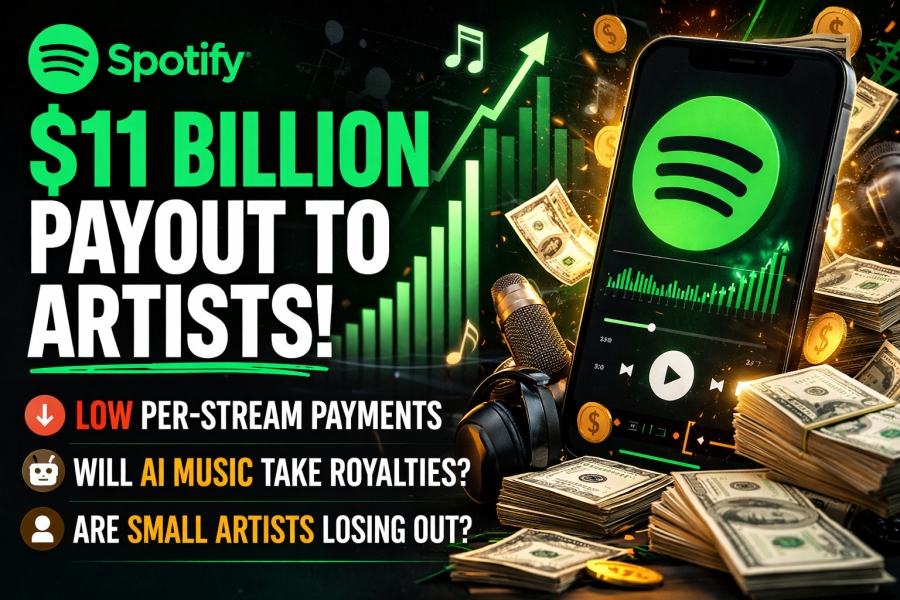
Spotify’s $11 Billion Payout to Artists: What It Means for Musicians in 2026
The music streaming era has fundamentally reshaped how artists earn money from their work. At the center of this transformation is Spotify, the world’s largest music streaming platform.
In early 2026, the company announced that it paid more than $11 billion to the music industry in 2025, marking the largest annual payout from any music retailer in history.
At first glance, the number appears to signal a thriving digital music economy. But behind the headline figure lies a heated debate across the industry. Many musicians, producers, and independent labels argue that despite record payouts, individual artists still struggle to earn sustainable income from streaming.
With the rise of AI-generated music, massive catalog uploads, and algorithm-driven discovery, the economics of streaming are once again under scrutiny.
So what does Spotify’s $11 billion payout actually mean for artists—and is the streaming model really working?
Spotify’s Record-Breaking $11 Billion Payout
Spotify revealed its record payout as part of its annual Loud & Clear report, which aims to increase transparency around how streaming royalties work.
According to the company, Spotify paid over $11 billion to the music industry in 2025, surpassing the previous year’s record and bringing total lifetime payouts close to $70 billion.
The company says this makes it the highest-paying retailer in the music industry, exceeding what physical stores, digital download platforms, and other streaming services contribute annually.
Spotify also highlighted several notable trends in its report:
-
Over 13,800 artists earned more than $100,000 annually from Spotify streams.
-
Roughly half of all royalties went to independent artists and labels.
-
Global streaming continues to grow as Spotify expands into more markets.
From Spotify’s perspective, the data proves that streaming has revived the music business after the piracy crisis of the early 2000s.
And in many ways, that claim has merit.
Streaming Helped Save the Music Industry
Two decades ago, the music industry was struggling.
During the late 1990s and early 2000s, digital piracy platforms like Napster caused record sales to collapse. Revenue from physical albums plummeted as consumers downloaded music illegally.
Streaming services changed that trajectory.
Platforms like Spotify introduced a subscription model that made music accessible, affordable, and legal. Instead of purchasing albums individually, listeners could access millions of songs for a monthly fee.
The result was a major industry rebound.
Today, streaming accounts for the largest share of global music revenue, and platforms like Spotify now reach hundreds of millions of listeners worldwide.
Spotify alone reportedly has over 751 million users globally, including around 290 million paying subscribers.
This massive scale is what makes billion-dollar royalty payouts possible.
But scale does not necessarily translate into fair distribution.
How Spotify Actually Pays Artists
One of the biggest misconceptions about streaming royalties is the idea that Spotify pays a fixed amount per stream.
In reality, the platform uses a pro-rata revenue-sharing model.
Here’s how it works:
-
Spotify collects revenue from subscriptions and advertising.
-
Around 70% of that revenue goes to rights holders, including labels, publishers, and distributors.
-
Royalties are distributed based on stream share—how much of the total listening each artist receives.
So if an artist’s songs represent 1% of all streams, they receive 1% of the total royalty pool for that period.
Because of this system, there is no universal per-stream payment rate.
However, industry estimates suggest that artists typically earn between $0.003 and $0.005 per stream on average.
To put that into perspective:
-
10,000 streams: roughly $30–$50
-
100,000 streams: roughly $300–$500
-
1 million streams: roughly $3,000–$5,000
And that money is usually split among labels, publishers, distributors, and collaborators before the artist receives their share.
This is where much of the criticism begins.
Why Many Artists Still Struggle Financially
Despite billions flowing through streaming platforms, many musicians say the economics remain unsustainable.
There are several reasons for this.
1. Extremely Low Per-Stream Earnings
While millions of streams sound impressive, the revenue generated from them can still be modest.
For example, an artist might need hundreds of thousands—or even millions—of streams per month just to earn a living wage.
This has led many musicians to argue that streaming platforms undervalue recorded music.
Comparisons with other streaming services have also fueled criticism. Some industry analyses suggest platforms like Apple Music may pay higher average royalties per stream than Spotify.
However, Spotify counters that its massive user base generates more total revenue overall.
2. Revenue Is Concentrated Among Superstars
Another criticism centers on the distribution of streaming income.
The pro-rata payout model tends to favor artists with the highest streaming numbers.
Global superstars dominate listening on platforms like Spotify, meaning they receive a large portion of the royalty pool.
Even though thousands of artists earn significant money on Spotify, most musicians still earn relatively small amounts from streaming alone.
This has created what some analysts call a “winner-takes-most” streaming economy.
3. The Explosion of New Music
Streaming platforms have also dramatically increased the number of artists releasing music.
Today, tens of thousands of tracks are uploaded every day.
This abundance of content means:
-
More competition for listeners
-
Shorter attention spans for songs
-
Smaller revenue shares for individual artists
In other words, the streaming economy is growing—but it’s also becoming more crowded.
The AI Music Factor
One of the newest challenges facing the streaming economy is AI-generated music.
Artificial intelligence tools can now generate songs automatically, sometimes producing thousands of tracks in a short period of time.
Some industry insiders worry that AI music could flood streaming platforms, diluting the royalty pool and making it even harder for human artists to earn money.
Streaming platforms are already responding to this concern.
Spotify has begun introducing policies designed to combat AI-generated music spam, which can involve automated uploads intended to exploit royalty systems.
As AI music tools continue to evolve, the industry will likely face difficult questions about:
-
Copyright ownership
-
AI training data
-
Revenue distribution
The outcome of these debates could shape the future of streaming economics.
Independent Artists Are Growing, But Slowly
One positive trend highlighted in Spotify’s data is the growth of independent artists.
According to the company, roughly half of all Spotify royalties now go to independent artists and labels rather than major record companies.
This reflects a broader shift in the music industry.
Digital distribution platforms have made it easier than ever for musicians to release music without signing traditional record deals.
Many independent artists are now building careers through:
-
Streaming revenue
-
Social media audiences
-
Direct-to-fan marketing
-
Touring and merchandise
Spotify also claims its discovery tools and editorial playlists have helped launch thousands of new artist careers.
However, critics argue that independent artists still face major challenges gaining visibility in an algorithm-driven ecosystem.
Streaming Is Only One Piece of the Puzzle
Another important point in the streaming debate is that recorded music is only one revenue stream for artists.
Many musicians rely on multiple income sources, including:
-
Live performances
-
Merchandise sales
-
Brand partnerships
-
Sync licensing
-
Patreon-style fan support
Streaming platforms themselves are also expanding into new areas.
Spotify has developed features like concert discovery tools and ticket sales integrations, which have helped generate billions in live music revenue.
These features suggest that the future of music income may depend on integrated digital ecosystems, rather than streaming royalties alone.
The Future of Streaming Economics
As streaming continues to dominate music consumption, the debate around artist compensation is unlikely to disappear.
Several potential changes could reshape the system in the coming years.
User-Centric Royalty Models
Some experts propose switching from the current pro-rata model to a user-centric system, where each subscriber’s fee is distributed only among the artists they listen to.
AI Regulation
Governments and industry groups are beginning to explore regulations for AI-generated music, including copyright protections and licensing frameworks.
Higher Subscription Prices
Streaming platforms have already begun raising subscription prices in some markets, which could increase the royalty pool.
New Monetization Tools
Platforms are experimenting with fan subscriptions, tipping, and exclusive content, which may provide additional revenue streams for artists.
Conclusion
Spotify’s $11 billion payout to the music industry represents a historic milestone for the streaming era.
It reflects the enormous scale of modern music consumption and the growing financial power of digital platforms.
However, the number also highlights a deeper debate about how that money is distributed.
While top artists are earning millions and streaming has revived industry revenues, many musicians still struggle to generate meaningful income from their recordings.
With the rise of AI music, algorithm-driven discovery, and an ever-growing flood of new releases, the economics of streaming are entering a new phase of evolution.
The big question now is whether the next decade of music streaming will deliver a system that works not only for platforms and superstars—but for the entire creative ecosystem.
