


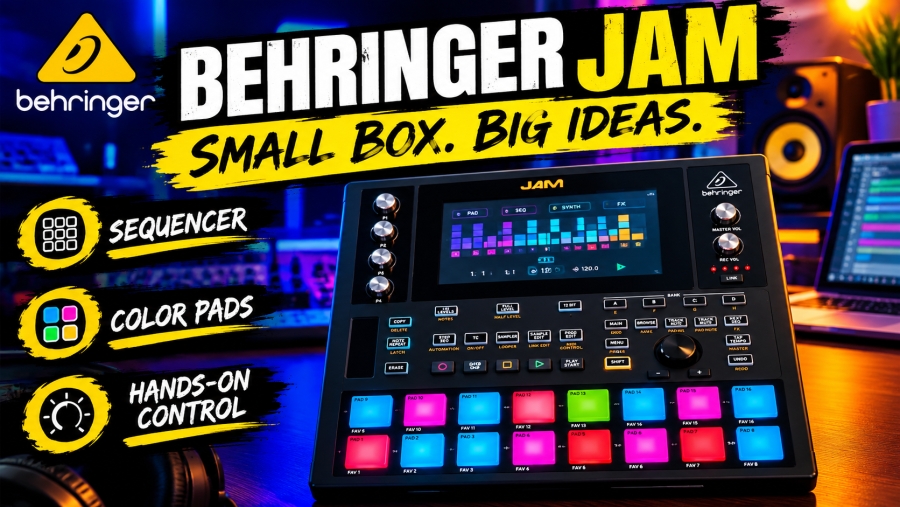
Behringer Jam and Jam Play: Compact MIDI Controllers Bring New Creative Possibilities to Music Producers
Behringer has officially unveiled two new compact MIDI controller keyboards and sequencers, Jam and Jam Play, giving electronic musicians and music producers new options for creating melodies, programming sequences and performing musical ideas without needing a large studio setup.
Announced in October 2026 and covered by MusicRadar on October 9, the two devices build on the concept behind Behringer’s Swing MIDI keyboard and sequencer. Both feature 32 velocity- and aftertouch-sensitive keys, a 64-step sequencer, chord-playing capabilities, an arpeggiator, and multiple connectivity options for integrating hardware synthesizers, modular equipment, and computer-based music production.
The biggest difference is that Jam Play also includes built-in instrument sounds and drum kits, allowing musicians to create and perform music without relying on a computer or external synthesizer.
For producers who value portability, hands-on control, and spontaneous experimentation, the new devices could offer an interesting alternative to traditional MIDI keyboards. Here is everything you need to know about Behringer Jam and Jam Play, their features, creative applications, and what they could mean for modern music production.
What Are Behringer Jam and Jam Play?
Jam and Jam Play are compact 32-key MIDI controller keyboards designed to combine keyboard performance with sequencing and electronic music production.
Rather than focusing exclusively on playing notes into a digital audio workstation (DAW), both instruments integrate tools for building musical patterns, triggering arpeggios, and controlling external hardware.
The result is a more performance-oriented approach to MIDI control. Producers can play a phrase, program a sequence, experiment with chords, and manipulate musical parameters using physical controls rather than relying entirely on a mouse and computer screen.
According to Behringer’s product information, both models feature velocity-sensitive keys with channel aftertouch, a four-channel 64-step sequencer, chord and arpeggiator modes, assignable rotary controls, pitch and modulation touch strips, and transport buttons.
The instruments also support USB and conventional MIDI connections, alongside CV/gate and analogue synchronization connections for compatible hardware.
Their compact format makes them suitable for desktop studios, portable production setups and hardware-based electronic music rigs.
Behringer Jam vs Jam Play: What Is the Difference?
Although the two products share much of their core functionality, they are aimed at slightly different workflows.
Behringer Jam is primarily a MIDI controller and sequencer. It is designed to control software instruments, external synthesizers, drum machines and other compatible MIDI equipment. Musicians who already own virtual instruments or hardware synthesizers may appreciate its straightforward controller-focused approach.
Behringer Jam Play builds on that concept by adding an onboard sound engine. The official product page lists 128 instrument voices, 10 drum kits and built-in effects. It also includes an OLED display for navigating presets and parameters, plus a dedicated audio output.
That means Jam Play can operate as a more self-contained music-making instrument. Users can connect headphones and begin experimenting with sounds and sequences without first opening a DAW.
The distinction is important when choosing between the models. Jam is potentially attractive for producers who already have a collection of software and hardware instruments, while Jam Play offers a more independent setup for songwriting, sketching and portable performance.
32 Keys With Velocity and Aftertouch
Both instruments use a 32-key keyboard, providing two and a half octaves of playing range in a relatively compact footprint.
For many electronic music producers, this is a practical compromise between portability and expressive performance. A 32-key keyboard can accommodate bass lines, chord progressions, lead melodies and arpeggiated patterns without occupying the space required by a full-size keyboard.
Velocity sensitivity allows the instrument to respond to how forcefully a key is played. Depending on the receiving sound engine, this can control volume, filter movement, attack or other parameters.
Channel aftertouch adds another layer of expression by allowing pressure applied after a key is pressed to influence compatible instruments. Producers can use it to introduce vibrato, filter modulation or changes in timbre without needing a separate modulation wheel for every gesture.
These features are particularly useful for expressive synth leads, evolving pads and performance-oriented electronic music.
The keyboard is not intended to replace a full-size piano action for every player. Instead, its compact design prioritizes portability and hands-on control.
A 64-Step Sequencer for Building Musical Ideas
One of the most important features shared by Jam and Jam Play is the 64-step, four-channel polyphonic sequencer.
A step sequencer lets musicians arrange notes into repeating patterns. Rather than recording a complete performance in one take, users can enter individual notes, adjust their timing and build loops that can be modified during playback.
Behringer lists rest, tie and legato note-entry options, alongside ratcheting, swing and randomized gate functions.
These capabilities can be useful for creating rhythmic variations, repeating bass patterns and evolving melodic sequences. Ratcheting can divide a step into multiple note repetitions, while swing changes the rhythmic feel. Gate randomization introduces variation in note lengths.
The four-channel structure also allows different musical parts to be organized into separate sequences, making it easier to combine elements such as bass, chords, melody and percussion.
For electronic music producers, this type of workflow can encourage experimentation. A simple pattern can become the foundation for an entire arrangement as notes, rhythms and performance variations are added.
The sequencer can also provide a useful starting point for musicians who prefer building ideas through repetition rather than recording long performances immediately.
Chord Play Mode Makes Complex Harmony More Accessible
Both devices include a Chord Play mode capable of storing chords with up to 16 notes, according to Behringer.
This feature can help musicians trigger complex harmonic structures from a compact keyboard setup. Instead of playing every note of a large chord individually, users can recall a stored voicing and perform it as part of a progression.
For beginners, chord storage can make harmonic experimentation more accessible. More experienced producers may use it to explore dense pads, cinematic textures, layered synth arrangements and unusual voicings.
Chord triggering can also be useful during live performances, where a musician may need to operate several musical parts while maintaining a consistent rhythmic pattern.
The feature does not replace an understanding of harmony, but it can reduce the physical demands of playing complex chords and make it easier to experiment with different arrangements.
An Arpeggiator for Electronic Music Production
An onboard arpeggiator is another key feature shared by Jam and Jam Play.
Arpeggiators automatically play the individual notes of a held chord according to a selected pattern. Depending on the instrument and settings, they can generate ascending, descending, alternating and other rhythmic movements.
Behringer lists eight arpeggiator styles, with support for up to eight simultaneous notes per step.
This opens up several creative possibilities. A sustained chord can become a rhythmic synth pattern, a simple bass note can develop into a repeating melodic figure, and a short chord progression can provide the basis for a driving electronic arrangement.
Arpeggiators are especially useful in genres such as techno, house, synthwave, ambient, trance and experimental electronic music, although they can be applied to almost any style.
Combined with the 64-step sequencer, the arpeggiator gives producers multiple ways to develop musical material without manually entering every note.
Jam Play Adds 128 Instrument Sounds and 10 Drum Kits
The defining feature of Jam Play is its integrated sound engine.
Behringer lists 128 instrument voices, 10 drum kits and built-in effects. The instrument also has a small OLED display for selecting presets and navigating parameters, along with a dedicated audio output.
This gives Jam Play a significant advantage for musicians who want to work without a computer. A user can power up the instrument, select a sound, program a sequence and begin developing an idea immediately.
The built-in sounds also make it useful for travel, songwriting sessions away from the studio and quick musical sketches between larger production sessions.
The inclusion of drum kits allows users to explore rhythmic arrangements alongside melodic and harmonic parts. Combined with the sequencer, this can help create the foundations of a complete electronic track.
However, the listed number of sounds does not automatically determine their quality or versatility. Producers should evaluate the available timbres, editing capabilities and overall sound character when deciding whether Jam Play can replace any existing instruments.
Four Assignable Controls and Touch Strips
Both Jam and Jam Play include four assignable rotary controls, alongside dedicated pitch and modulation touch strips.
Assignable controls allow users to adjust selected parameters on compatible instruments or software. Depending on the MIDI configuration, these could include filter cutoff, resonance, envelope settings, effects levels or other sound-shaping controls.
The advantage is immediacy. Instead of opening a plugin interface and searching for a particular parameter, a producer can map a control and adjust it physically while playing.
The pitch and modulation touch strips provide another way to introduce expressive movement into a performance.
For electronic musicians, this can make a difference when performing leads, shaping transitions or adding motion to otherwise static sounds. Physical controls can also encourage experimentation because changes can be made quickly while a sequence continues playing.
Jam Play’s OLED display adds a further layer of feedback, particularly when selecting presets or navigating its onboard functions.
Connectivity for MIDI, Modular and Hardware Synthesizers
Modern music studios often combine computer software with external synthesizers, drum machines, samplers and modular equipment. Jam and Jam Play are designed to fit into these hybrid environments.
Behringer lists USB connectivity, five-pin MIDI In and Out, CV/gate outputs, analogue sync connections and a sustain-pedal input. The devices also feature two USB-C connections, according to published product information.
USB and conventional MIDI connections allow the keyboards to communicate with compatible computer software and external instruments. CV/gate connections provide a way to control compatible modular synthesizers and other analog equipment, while analogue sync can help coordinate timing with supported devices.
This flexibility could make the products useful in a variety of setups, from a laptop-based bedroom studio to a hardware-focused performance rig.
Compatibility and routing should still be checked before purchase, particularly when integrating older equipment or complex modular systems.
How Jam and Jam Play Could Fit Into a DAW Workflow
Although both devices offer sequencing capabilities, they can also serve as controllers within a computer-based production environment.
A producer might use Jam to play notes into Ableton Live, FL Studio, Logic Pro or another compatible DAW, then use its sequencing and performance controls to generate musical ideas.
The hardware sequencer can be especially useful during the early stages of production. Instead of drawing notes directly into a piano roll, users can experiment with rhythms and melodies using physical keys and controls.
Once a pattern is working, MIDI can be recorded into the DAW for further editing, arrangement and sound design. The exact workflow will depend on the host software, MIDI routing and the functions supported by each application.
Jam Play offers an additional option: users can begin with its built-in sounds and later decide whether to recreate or replace those parts with software instruments.
This combination of immediate hardware interaction and detailed DAW editing can be appealing to producers who want the spontaneity of an instrument without giving up the precision of modern production software.
Who Should Consider Buying Behringer Jam or Jam Play?
Jam may be worth considering for musicians who already own virtual instruments or external synthesizers and want a compact controller with sequencing and performance features.
Jam Play may be more appealing to beginners, traveling musicians and hardware enthusiasts who want an instrument capable of producing sound without relying on a computer.
Both could suit electronic music producers interested in techno, house, ambient, synthwave, soundtrack composition and experimental music.
They may also appeal to musicians who struggle to begin projects in a large DAW environment. A compact keyboard with an integrated sequencer can provide a more immediate way to capture musical ideas before moving into a full arrangement.
The best choice depends on whether the buyer values a controller-focused instrument or an integrated sound source. Before purchasing, it is worth comparing the available sounds, physical layout, connectivity, software compatibility and overall cost with competing products.
Pricing and Availability: What Buyers Should Know
Behringer has published product pages for both Jam and Jam Play, but pricing and availability information has varied across retailers.
At the time of the October 2026 announcement, UK retailer Andertons listed Jam at approximately £89, while European retailer Thomann listed Jam and Jam Play for preorder at approximately €99 and €179, respectively, according to reporting by MusicRadar.
These figures should be treated as retailer listings rather than a universal final price. Regional taxes, shipping, stock levels and launch arrangements may affect what customers actually pay.
Prospective buyers should check the official Behringer product listings and their preferred local retailer for current pricing, delivery estimates and warranty information.
Final Thoughts: Compact Controllers for Spontaneous Music Creation
Behringer Jam and Jam Play bring together compact keyboards, expressive controls, sequencing, chord triggering and arpeggiation in a format designed for modern electronic music production.
The shared 64-step sequencer, velocity- and aftertouch-sensitive keys, assignable controls and broad connectivity give both devices potential value for producers who want more hands-on interaction with their instruments.
Jam focuses on controlling external hardware and software, while Jam Play adds 128 instrument voices, 10 drum kits, effects and an audio output for a more self-contained setup.
Neither device will automatically replace a complete studio or a full-size performance keyboard. Their appeal lies in providing a compact and accessible way to capture ideas, create patterns and control other instruments.
For producers who value immediacy and experimentation, the new models offer another approach to the relationship between hardware and software. Ultimately, their success will depend on how well their controls, sounds and sequencing functions translate into real creative workflows.
