


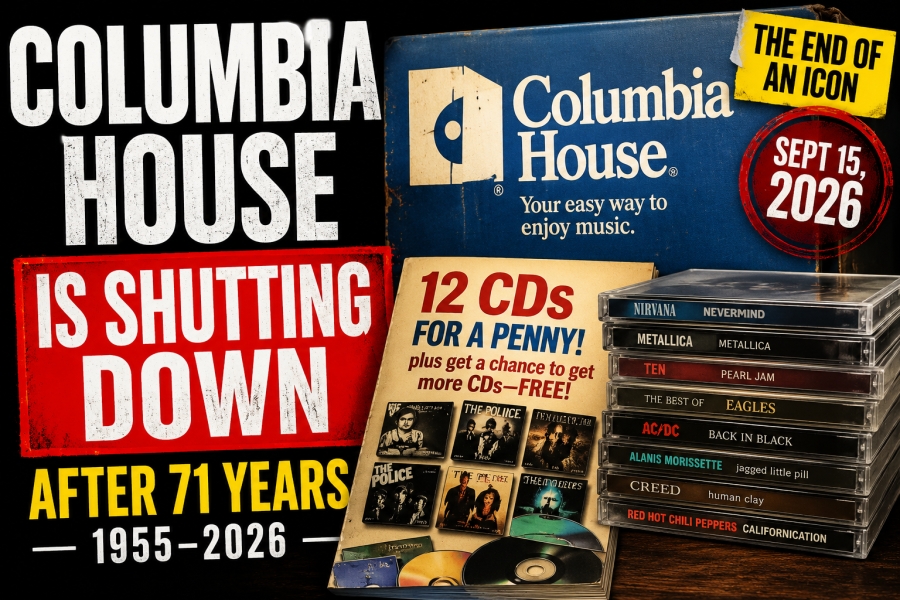
Columbia House Is Shutting Down After 71 Years: The End of an American Music Institution
For generations of music fans, few names were as familiar as Columbia House. Before streaming, digital downloads, smartphones and even widespread online shopping, the mail-order music club offered Americans a remarkably simple proposition: choose your favorite albums, send in a tiny payment, and wait for a package of records, tapes or CDs to arrive at your door.
Now, after 71 years, Columbia House is coming to an end.
The company has announced that it will stop accepting new orders after September 15, 2026, marking the final chapter of a business that helped shape how millions of Americans discovered and purchased music. Although the original music club had already disappeared years ago, the Columbia House brand survived as a smaller mail-order media business. Its upcoming closure represents the end of one of the last surviving links to the pre-digital music marketplace.
The story of Columbia House is more than nostalgia. Its rise, transformation and eventual decline mirror the enormous changes that have reshaped the music industry over the past seven decades.
What Is Columbia House?
Columbia House began in 1955 as the Columbia Record Club, a mail-order service launched by Columbia Records, then owned by CBS. The concept was straightforward: instead of requiring consumers to visit a record store, Columbia House could bring music directly to their homes.
That model was particularly useful at a time when record stores were not equally accessible to everyone. The service helped connect music labels with consumers in suburban and rural areas while giving listeners an increasingly convenient way to build personal record collections.
As music technology changed, Columbia House changed with it.
The company moved from vinyl records into other physical formats, including tapes and CDs. Its ability to adapt to new formats was one reason the brand remained relevant for so many decades.
But Columbia House eventually became famous for something beyond convenience: its aggressive promotional offers.
The Famous “12 CDs for a Penny” Deal
For many consumers, the words “12 CDs for a penny” immediately bring back memories of Columbia House.
The company's advertisements promised customers a large number of albums for an almost unbelievably low introductory price. Similar promotions appeared for records and cassette tapes during earlier eras.
There was, of course, a catch.
Customers who accepted the introductory offer generally became members of the club and agreed to purchase additional titles at regular prices over a specified period. Columbia House also became associated with negative-option billing, in which customers could receive selections unless they actively declined them.
For some customers, the system was an affordable way to build a substantial music collection. For others, it became a source of frustration because of unwanted shipments, membership obligations and the difficulty of canceling.
Nevertheless, the promotional model became an important part of American pop culture.
Columbia House wasn't simply selling albums. It was selling the idea that an enormous music collection could arrive at your home through the mail.
How Big Did Columbia House Become?
At its peak, Columbia House was a major force in the American entertainment business.
The company reportedly reached approximately 16 million members during its most successful period in the mid-1990s. By 1996, it was generating around $1.4 billion in annual revenue, demonstrating just how powerful the physical-media business had become before the internet transformed entertainment consumption.
Those numbers are difficult to imagine in today's streaming economy.
A consumer in the 1990s might spend significant amounts of money every month building a personal CD collection. Each album represented a physical object that had to be manufactured, packaged, shipped and stored.
For record labels and retailers, this created multiple revenue opportunities.
For consumers, it created a completely different relationship with music. Owning an album meant physically possessing it.
Columbia House and the Golden Age of Physical Music
The success of Columbia House was closely tied to the golden age of physical music.
During the 1970s and 1980s, vinyl records and cassette tapes dominated music consumption. Then CDs arrived and rapidly transformed the market.
Compact discs offered consumers improved durability, portability and digital audio quality. They also became highly profitable products for record companies.
Columbia House benefited from that transition.
The company could use the same basic mail-order concept while changing the format being delivered. A customer who once ordered vinyl could eventually order cassette tapes and then CDs without fundamentally changing the purchasing experience.
That flexibility helped the company survive several technological transitions.
But the digital revolution would be different.
The Internet Changed Everything
Columbia House's eventual decline cannot be separated from the rise of the internet.
In the late 1990s and early 2000s, music consumers gained new ways to discover, purchase and obtain music without relying on mail-order catalogs.
The emergence of Napster demonstrated that music could be distributed digitally. Apple's iTunes later established a legal mainstream model for buying individual digital tracks and albums.
Suddenly, consumers no longer needed to wait for an album to arrive in the mail.
Music could be downloaded almost immediately.
That change fundamentally challenged the physical distribution model on which Columbia House had been built.
The shift accelerated again with subscription streaming services. Instead of buying individual albums, listeners could access enormous catalogs through monthly subscriptions or advertising-supported platforms.
The consumer's relationship with music had changed from ownership to access.
When Did Columbia House Stop Selling Music?
Although the Columbia House name remained recognizable, the company's original music-club business eventually disappeared.
The music club closed in 2010, with the company subsequently concentrating on physical home entertainment products such as DVDs and Blu-rays.
That transition was itself symbolic.
The company that had once helped Americans build CD collections was now attempting to survive by selling another form of physical media.
For a while, that strategy allowed Columbia House to remain in business even as music consumption rapidly moved online.
However, DVDs and Blu-rays eventually faced many of the same pressures that had damaged physical music sales.
Streaming video services reduced the need for consumers to purchase or rent physical movies, just as music streaming had reduced the need to purchase CDs.
The Failed Vinyl Comeback
Interestingly, Columbia House did recognize that physical media could potentially make a comeback.
After the company's parent company entered bankruptcy proceedings in 2015, new ownership explored a possible revival of Columbia House as a vinyl-focused service. The idea was connected to the renewed interest in vinyl records among younger consumers and collectors.
Vinyl had indeed begun experiencing a remarkable revival.
But the planned Columbia House vinyl relaunch never materialized as originally envisioned.
That missed opportunity is another fascinating part of the company's history. Columbia House had survived the transition from vinyl to cassette to CD, but it ultimately could not recreate its former relevance in a market where physical music had become a niche rather than the dominant format.
Why Is Columbia House Finally Closing in 2026?
The current closure is the final stage of a much longer decline.
Columbia House has survived as a much smaller mail-order media operation, but the business environment that originally made the company successful no longer exists.
Consumers can now access enormous entertainment catalogs instantly through digital platforms. Amazon and other online retailers can deliver physical products much more efficiently than traditional mail-order clubs. Meanwhile, younger consumers have grown up in an environment where streaming is the default way to listen to music.
The company's website has announced that new orders will no longer be accepted after September 15, 2026. Customers can still purchase books using credits or credit cards, according to current reports, but the company's broader mail-order operation is coming to an end.
What Columbia House's Closure Means for the Music Industry
The end of Columbia House is significant because it represents more than the closure of one company.
It is a reminder of how radically the music business has changed.
In 1955, physical distribution was essential. Music companies manufactured records and needed reliable ways to put those records into consumers' hands.
By the 1990s, Columbia House represented the enormous commercial power of physical albums.
By the 2000s, digital downloads were disrupting that model.
By the 2010s, streaming was beginning to dominate.
And by 2026, a company whose identity was built around mailing physical entertainment to consumers has reached the end of its journey.
The transformation illustrates one of the music industry's most important long-term trends: technology repeatedly changes not only how music sounds, but how music is sold.
From Owning Albums to Streaming Everything
Perhaps the most meaningful part of the Columbia House story is the change in consumer behavior.
A Columbia House customer in the 1980s or 1990s might carefully browse a catalog, select several albums and wait days for a package to arrive.
The physical albums would become part of a personal collection.
Today, a listener can open a streaming application and search for virtually any artist within seconds.
Instead of asking, “Which albums should I buy?”, listeners often ask, “What do I want to hear right now?”
That difference has enormous implications for artists and the music industry.
Streaming has made music more accessible than ever, but it has also changed how artists earn money, how albums are marketed and how listeners discover new releases.
The Columbia House model was built around selling units.
The modern streaming model is built around engagement and recurring access.
Why the Columbia House Story Still Matters
It would be easy to dismiss Columbia House as an outdated relic.
But its history offers valuable lessons for today's music industry.
Every dominant business model eventually faces disruption.
Vinyl once represented the future. Then cassette tapes changed the way people carried music. CDs became the premium format. Digital downloads challenged physical ownership. Streaming then transformed the entire concept of purchasing music.
Columbia House successfully adapted several times, but eventually the changes became too significant for its original business model to survive.
The same lesson applies to today's music companies.
Streaming may dominate the market now, but the industry will continue to evolve. Artificial intelligence, new distribution technologies, changing copyright rules and emerging forms of music consumption could eventually create another major transformation.
Could Columbia House Become a Collectors' Brand?
Although the company is closing, Columbia House's cultural legacy is unlikely to disappear.
Its advertisements, catalogs, promotional offers and famous “12 CDs for a penny” slogan remain deeply embedded in the memories of multiple generations.
The broader resurgence of vinyl and physical music also demonstrates that consumers have not completely abandoned physical formats.
Instead, physical music has become more specialized.
Collectors buy vinyl because they value artwork, packaging, ownership and the experience of playing a physical record. Limited-edition releases and deluxe box sets can command premium prices even in an industry dominated by streaming.
That means the cultural idea behind Columbia House could continue to exist even if the company itself does not.
The End of an Era
Columbia House's closure on September 15, 2026, is ultimately the end of an extraordinary journey.
Founded in 1955 as a record club, the company grew into a cultural phenomenon that reached millions of members and generated billions of dollars in annual revenue at its peak. It survived the transition from vinyl to cassette tapes to CDs and later attempted to remain relevant through DVDs and other physical media.
But the rise of digital downloads and streaming changed the economics of entertainment forever.
Today, the idea of receiving a package of albums through the mail feels almost impossibly slow compared with instant digital access.
And that is precisely why Columbia House's final closure is so symbolic.
It isn't simply the end of a mail-order company.
It is the closing chapter of a business model that helped define how generations of Americans bought music.
For anyone who remembers flipping through a Columbia House catalog, circling albums, mailing in an order and waiting for that first package to arrive, the company's shutdown is a reminder of just how far the music industry has traveled.
From 12 CDs for a penny to millions of songs available at the tap of a screen, the journey of Columbia House mirrors the extraordinary evolution of music consumption itself.
After 71 years, the mailbox is finally quiet.
