


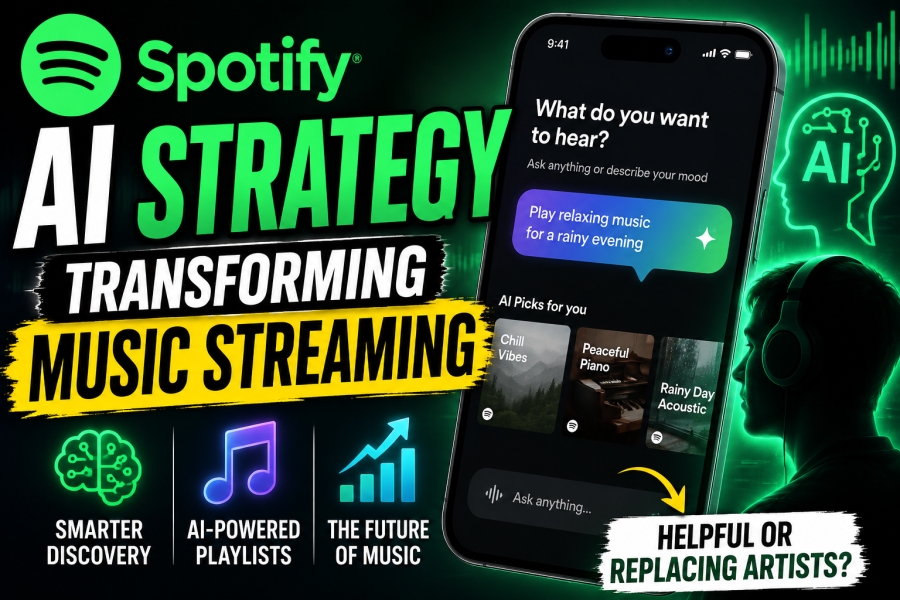
Spotify's AI Strategy in 2026: How Artificial Intelligence Is Changing Music Discovery, Artist Success, and the Future of Streaming
Artificial intelligence has become one of the biggest forces shaping the music industry, and Spotify is at the center of this transformation. As the world's leading music streaming platform continues expanding its AI-powered features, listeners are discovering music in entirely new ways while artists and industry professionals debate what these changes mean for the future.
From conversational music discovery to increasingly sophisticated recommendation algorithms, Spotify's investment in artificial intelligence aims to make finding the perfect song easier than ever. However, these innovations also raise important questions. Will AI improve the listening experience without sacrificing human creativity? Can independent artists still compete in an algorithm-driven ecosystem? And what role will human curators play as AI becomes smarter?
In this article, we'll explore Spotify's evolving AI strategy, how it benefits listeners, the challenges facing artists, and what the future of music streaming may look like.
Spotify's Growing Investment in Artificial Intelligence
Artificial intelligence has quietly powered Spotify for years. Every personalized playlist, song recommendation, and artist suggestion has relied on machine learning to understand user preferences.
Today, Spotify is taking AI much further.
Recent developments include conversational music discovery, where users can describe the type of music they're looking for in natural language rather than searching by artist or genre. Instead of typing "rock playlist," users can ask for something like:
-
Songs similar to early 2000s indie rock
-
Relaxing jazz for studying
-
Upbeat music for a morning workout
-
Emotional acoustic songs for rainy days
This conversational approach mirrors the growing popularity of AI assistants across many digital platforms and represents a significant shift in how people interact with streaming services.
Rather than expecting users to know exactly what they want, Spotify's AI attempts to understand moods, activities, emotions, and preferences through natural conversation.
How AI Recommendation Algorithms Continue to Improve
Spotify's recommendation engine has long been considered one of the most sophisticated in the streaming industry.
Modern AI systems analyze thousands of listening signals, including:
-
Listening history
-
Songs skipped
-
Songs replayed
-
Time of day
-
Playlist additions
-
Favorite genres
-
Device usage
-
Listening duration
-
Regional trends
Instead of recommending music based solely on genre, Spotify's AI creates highly personalized listening experiences unique to every user.
For example, two listeners who enjoy pop music may receive completely different recommendations because their broader listening habits reveal different tastes.
One listener may also enjoy electronic dance music, while another frequently listens to indie folk. AI recognizes these subtle differences and adapts recommendations accordingly.
As these algorithms improve, discovering new artists becomes easier and more personalized than ever before.
Conversational Music Discovery Could Change Everything
One of Spotify's most exciting developments is conversational AI.
Traditional music searches require users to know what they're looking for.
AI changes that experience completely.
Imagine saying:
"Play relaxing music that feels like watching the sunset on the beach."
Or:
"Find songs with powerful female vocals similar to Adele but less mainstream."
Instead of searching by keyword alone, AI interprets meaning, mood, context, and musical characteristics.
This represents a major evolution in music discovery because people often know how they want to feel but struggle to describe music using conventional categories.
Natural language search removes that barrier.
As AI becomes increasingly accurate, users may spend less time searching and more time listening.
The Benefits of AI for Music Listeners
For everyday listeners, Spotify's AI offers several advantages.
Better Personalization
Recommendations become more accurate over time as AI learns listening habits.
Instead of generic playlists, users receive suggestions tailored specifically to their preferences.
Faster Music Discovery
Finding new artists traditionally required browsing playlists or relying on recommendations from friends.
AI dramatically shortens that process.
Listeners can discover emerging artists within seconds.
Mood-Based Listening
Many users don't search for specific songs.
Instead, they search for experiences.
Whether exercising, studying, relaxing, or commuting, AI helps build playlists around activities and emotions rather than artist names.
Reduced Search Friction
Conversational AI eliminates the need to remember song titles or artist names.
Users simply describe what they want.
This creates a smoother and more intuitive experience.
Will AI Replace Human Music Curators?
One of the biggest debates surrounding Spotify's AI expansion concerns the future of human curation.
For years, editorial playlists created by music experts have played an important role in helping artists gain exposure.
Playlists such as "New Music Friday" or genre-specific collections are carefully assembled by experienced curators who understand musical trends and cultural moments.
AI now performs many similar tasks automatically.
This raises an important question:
Can algorithms replace human taste?
The answer is likely more complex than a simple yes or no.
Human curators understand storytelling, cultural relevance, and emotional context in ways that AI still struggles to replicate.
Algorithms excel at analyzing data, but they cannot fully understand why a particular song resonates with society during a specific moment.
Rather than replacing curators entirely, AI will likely become a powerful tool that supports human decision-making.
The future may involve collaboration rather than competition.
Independent Artists Face New Opportunities and New Challenges
Spotify's AI ecosystem creates both exciting opportunities and significant concerns for independent musicians.
Greater Discoverability
In theory, AI can help unknown artists reach audiences that genuinely enjoy their music.
Rather than relying solely on record labels, talented musicians can be matched with listeners based on listening behavior.
This levels the playing field to some extent.
Increased Competition
However, AI also introduces enormous competition.
Every day, thousands of new songs are uploaded to streaming platforms.
As AI becomes more efficient at generating music, the volume of available content could increase dramatically.
Independent artists may find it harder to stand out in an increasingly crowded marketplace.
Algorithm Dependence
Many musicians already worry about becoming overly dependent on recommendation algorithms.
Small changes to Spotify's ranking systems could significantly affect streams, revenue, and audience growth.
Artists have little visibility into how these systems operate, making algorithm updates both influential and unpredictable.
Could AI-Generated Music Flood Streaming Platforms?
One of the industry's greatest concerns is the rapid growth of AI-generated music.
Today's AI tools can produce instrumental tracks, lyrics, melodies, and even realistic vocal performances.
As these technologies improve, millions of AI-generated songs could be uploaded to streaming services.
This raises several important questions.
How will Spotify distinguish between human-created and AI-generated music?
Should AI-generated songs compete directly with human artists?
Will listeners care whether music was created by a person or an algorithm?
Some industry experts argue that AI democratizes music creation by giving more people access to creative tools.
Others worry that an overwhelming amount of synthetic music could make genuine artistic expression harder to discover.
The challenge for Spotify will be balancing innovation with authenticity.
Artist Compensation Remains a Major Concern
Spotify's AI strategy intersects with an ongoing debate about artist compensation.
Many musicians already believe streaming royalties do not adequately reflect the value of their work.
If AI-generated music becomes widespread, concerns may grow even further.
Questions include:
-
Will AI-created tracks receive royalty payments?
-
How should copyright apply to AI-generated songs?
-
Who owns music created with artificial intelligence?
-
Could AI reduce opportunities for professional musicians?
These issues remain unresolved across much of the music industry.
Governments, record labels, technology companies, and artists continue discussing how copyright and royalty systems should evolve alongside AI.
The Evolution of Music Recommendation Algorithms
Spotify's recommendation system is becoming increasingly sophisticated.
Future AI models may consider factors beyond listening history, including:
-
Current mood
-
Voice interactions
-
Fitness activities
-
Weather conditions
-
Travel habits
-
Smart home devices
-
Social interactions
-
Live event preferences
Imagine opening Spotify after finishing a workout.
Instead of manually choosing music, AI automatically recommends recovery playlists based on your recent activity.
Or during a rainy evening, Spotify could suggest mellow acoustic songs that match your environment.
These contextual recommendations could redefine personalized entertainment.
Privacy Considerations in AI-Powered Music Streaming
As AI becomes smarter, it also requires more data.
Spotify already analyzes listening habits to personalize recommendations.
Future AI features may rely on additional contextual information to deliver even better suggestions.
While many users appreciate personalization, others remain concerned about privacy and transparency.
Streaming platforms will need to clearly explain how user data is collected, stored, and used.
Building trust will become increasingly important as AI systems become more sophisticated.
The Future of AI and Human Creativity
Artificial intelligence is unlikely to replace musicians altogether.
Instead, it is becoming another creative tool.
Many artists already use AI for brainstorming lyrics, generating melodies, improving production workflows, and experimenting with new sounds.
Throughout history, technology has repeatedly changed music production.
From synthesizers and drum machines to digital audio workstations, each innovation initially sparked concerns before eventually becoming part of mainstream music creation.
AI may follow a similar path.
Rather than replacing creativity, it may enhance it.
The musicians who learn to combine human imagination with AI tools could unlock entirely new forms of artistic expression.
What Spotify's AI Strategy Means for the Music Industry
Spotify's expanding AI strategy represents more than a technological upgrade.
It signals a broader shift in how music is created, discovered, recommended, and consumed.
Listeners will enjoy increasingly personalized experiences.
Independent artists may gain new discovery opportunities while facing greater competition.
Human curators will likely work alongside AI instead of disappearing altogether.
Meanwhile, debates around copyright, artist compensation, transparency, and AI-generated music will continue shaping industry policy for years to come.
The companies that succeed will be those that strike the right balance between innovation and fairness.
Final Thoughts
Spotify's AI-powered future offers enormous possibilities. Smarter recommendations, conversational music discovery, and highly personalized listening experiences have the potential to make streaming more engaging than ever before.
Yet these innovations also bring complex challenges. Independent artists need fair opportunities to be discovered, human creativity must continue to be valued, and streaming platforms will need transparent policies regarding AI-generated content and royalties.
The future of music will likely be neither fully human nor fully artificial. Instead, it will be a collaboration where technology enhances creativity without replacing the artists who inspire it.
As Spotify continues refining its AI capabilities, one thing is certain: the relationship between listeners, musicians, and streaming platforms is entering a new era. Those who understand and adapt to these changes will be best positioned to thrive in the rapidly evolving music industry.
