


MUSIC INDUSTRY LAUNCHES AI LABELS FOR SONGS: A NEW ERA OF TRANSPARENCY IN MUSIC CREATION
THE MUSIC INDUSTRY TAKES A MAJOR STEP TOWARD AI TRANSPARENCY
Artificial intelligence has become one of the most transformative forces in modern music production. From AI-powered songwriting tools and vocal synthesis to automated mastering and music generation platforms, technology is changing how music is created, distributed, and consumed.
Now, the music industry is taking a significant step toward greater transparency. Several of the world's leading music organizations have announced a new industry-wide initiative designed to help listeners understand whether the music they are hearing was created by humans, artificial intelligence, or a combination of both.
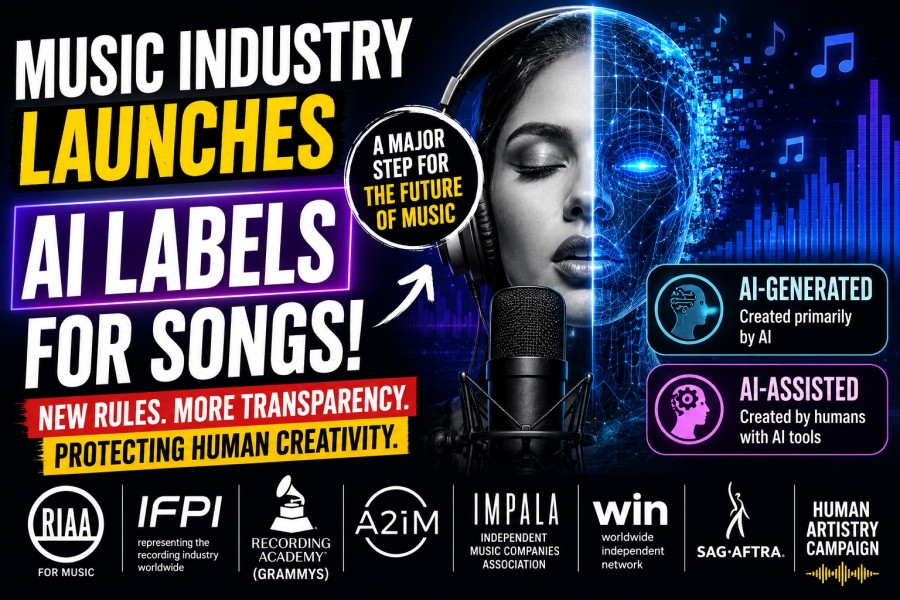
The initiative introduces standardized labels that identify AI-generated and AI-assisted music, creating a clearer distinction between songs created primarily by artificial intelligence and those made by human artists using AI tools as part of their creative process.
The announcement marks one of the most important developments in the ongoing conversation surrounding artificial intelligence and music, with potential implications for artists, record labels, streaming platforms, rights holders, and listeners worldwide.
WHAT ARE THE NEW AI MUSIC LABELS?
At the center of the initiative are two standardized labels designed to provide transparency across the music ecosystem.
AI-GENERATED
The AI-Generated label applies to music where the core creative elements are created primarily by artificial intelligence.
This may include:
-
AI-generated vocals
-
AI-created melodies
-
AI-composed instrumental arrangements
-
AI-generated lyrics
-
Fully automated music production
In these cases, artificial intelligence plays the primary creative role in producing the final musical work.
AI-ASSISTED
The AI-Assisted label applies to music that is primarily created by humans but incorporates AI tools during the production process.
Examples include:
-
AI-assisted mixing and mastering
-
AI-powered audio restoration
-
AI-generated sound design elements
-
AI-assisted songwriting suggestions
-
Vocal enhancement tools
Under this classification, human creators remain responsible for the artistic direction and creative decisions while leveraging AI technology to improve workflow and efficiency.
The distinction is intended to help listeners understand the role artificial intelligence played in the creation of a song without discouraging innovation.
WHY THE MUSIC INDUSTRY INTRODUCED AI LABELS
The rapid rise of AI-generated music has created both excitement and concern throughout the industry.
In recent years, AI platforms have enabled users to generate complete songs within minutes. These systems can imitate musical styles, create realistic vocals, generate lyrics, and even produce tracks that sound remarkably similar to commercially released music.
While many creators view these tools as valuable resources, others worry about their impact on artistic authenticity, copyright protection, and the future of human creativity.
The introduction of AI labels aims to address several key challenges.
IMPROVING TRANSPARENCY
One of the biggest concerns among listeners is the inability to determine how a song was created.
Many consumers believe they have a right to know whether the music they are hearing was performed by a human artist or generated by artificial intelligence.
The new labels provide that transparency.
SUPPORTING HUMAN CREATIVITY
The initiative also seeks to protect and celebrate human artistic contributions.
Organizations behind the labeling system emphasize that technology should support creativity rather than replace it.
By clearly identifying human-created music, the industry hopes to preserve recognition for artists, songwriters, musicians, and producers.
BUILDING TRUST WITH LISTENERS
Transparency can strengthen trust between artists and audiences.
As AI-generated content becomes increasingly sophisticated, many listeners want reassurance that they understand what they are consuming.
The new labels help provide that clarity.
WHICH ORGANIZATIONS ARE SUPPORTING THE INITIATIVE?
The initiative has received support from many of the most influential organizations in the global music business.
Participants include:
-
Recording Industry Association of America (RIAA)
-
International Federation of the Phonographic Industry (IFPI)
-
Recording Academy (Grammys)
-
American Association of Independent Music (A2IM)
-
IMPALA
-
Worldwide Independent Network (WIN)
-
SAG-AFTRA
-
Human Artistry Campaign
The involvement of these organizations demonstrates broad industry consensus regarding the importance of transparency in the age of artificial intelligence.
Rather than leaving individual platforms to create their own standards, the industry is attempting to establish a unified framework that can be adopted globally.
HOW AI IS CHANGING THE MUSIC INDUSTRY
Artificial intelligence is already influencing nearly every stage of music production.
SONGWRITING
AI tools can generate lyric ideas, chord progressions, melodies, and song structures within seconds.
Many artists use these systems as brainstorming tools during the creative process.
MUSIC PRODUCTION
Modern AI software can assist with:
-
Beat creation
-
Arrangement suggestions
-
Audio editing
-
Mixing
-
Mastering
These tools help creators work faster and often reduce production costs.
VOCAL SYNTHESIS
One of the most controversial developments involves AI-generated vocals.
Advanced voice models can replicate human singing voices with remarkable accuracy, raising concerns regarding artist consent, copyright ownership, and identity protection.
CONTENT CREATION
Social media creators are increasingly using AI-generated music for videos, podcasts, advertisements, and marketing campaigns.
As adoption grows, transparency becomes increasingly important.
WHAT THIS MEANS FOR STREAMING PLATFORMS
Streaming services are expected to play a crucial role in implementing the new labeling system.
Platforms such as Spotify, Apple Music, YouTube Music, Amazon Music, and others may eventually display AI-related information directly alongside tracks.
Potential implementations could include:
-
Song metadata labels
-
Artist profile disclosures
-
Search filters
-
Playlist categorization
-
Recommendation system adjustments
For streaming companies, transparency may become an essential feature as listeners demand more information about the content they consume.
The initiative could also help combat deceptive uploads and unauthorized AI-generated content.
THE BENEFITS OF AI LABELING FOR ARTISTS
Many artists have expressed concern about how AI-generated content could impact their careers.
The new labeling system offers several advantages.
RECOGNITION OF HUMAN WORK
Artists who invest years developing their craft want their contributions recognized.
Clear labeling helps distinguish authentic performances from fully automated creations.
PROTECTION OF CREATIVE IDENTITY
AI-generated voice clones and unauthorized imitations have become major concerns.
Greater transparency may help reduce confusion and prevent misuse of artist identities.
FAIR COMPETITION
Many creators argue that listeners should be able to distinguish between songs created through traditional artistic processes and those generated largely by algorithms.
The labeling system supports a more informed marketplace.
THE CHALLENGES OF IMPLEMENTING AI LABELS
While the initiative has received widespread support, implementation may not be straightforward.
DEFINING AI INVOLVEMENT
One major challenge is determining exactly how much AI usage qualifies a song as AI-Generated or AI-Assisted.
Modern music production often involves multiple software tools, many of which already use machine learning technologies.
Establishing clear thresholds may prove difficult.
GLOBAL STANDARDIZATION
Music is distributed internationally across numerous platforms and territories.
Ensuring consistent adoption across the global music industry will require ongoing collaboration.
ENFORCEMENT
Verifying the accuracy of AI labels may become another challenge.
The industry may need systems capable of auditing submissions and detecting undisclosed AI-generated content.
HOW LISTENERS ARE RESPONDING
Public reaction to the initiative has been largely positive.
Many listeners support greater transparency and appreciate having additional information about how music is created.
Others argue that the quality of music matters more than the tools used to create it.
Regardless of differing opinions, most industry observers agree that transparency benefits consumers by providing context without limiting artistic freedom.
The labeling initiative allows listeners to make informed decisions while preserving creative choice.
THE FUTURE OF AI AND MUSIC
Artificial intelligence is unlikely to disappear from the music industry.
In fact, experts expect AI adoption to continue accelerating in the coming years.
Future developments may include:
-
More advanced songwriting systems
-
Real-time AI collaboration tools
-
Personalized music generation
-
AI-powered live performances
-
Enhanced production automation
As these technologies evolve, transparency will become increasingly important.
The introduction of AI labels represents an early attempt to establish standards before AI-generated music becomes even more widespread.
WHY THIS MOMENT MATTERS
The launch of industry-wide AI labels represents more than a technical update.
It reflects a broader effort to balance innovation with accountability.
The music industry recognizes the enormous potential of artificial intelligence while also acknowledging the importance of protecting human creativity.
By introducing AI-Generated and AI-Assisted labels, organizations are sending a clear message: technology can coexist with artistic expression, but transparency must remain a priority.
This approach allows creators to embrace new tools while ensuring audiences understand how music is being made.
FINAL THOUGHTS
The music industry's decision to introduce standardized AI labels marks a historic moment in the evolution of music creation.
As artificial intelligence becomes increasingly integrated into songwriting, production, and distribution, listeners, artists, and industry professionals need greater transparency than ever before.
The introduction of the AI-Generated and AI-Assisted labels provides a practical solution that balances innovation with consumer awareness.
For artists, it offers recognition and protection. For listeners, it delivers clarity. For streaming platforms, it creates an opportunity to build trust. And for the industry as a whole, it establishes a foundation for navigating the future of music in the age of artificial intelligence.
While challenges remain, one thing is clear: the conversation around AI in music is no longer about whether artificial intelligence will play a role in the industry. The focus has shifted toward how it can be used responsibly, transparently, and ethically.
As AI technology continues to evolve, these new labels may become one of the most important tools for maintaining trust between creators and audiences, ensuring that the future of music remains both innovative and authentic.
