Discovering Zebralette 3: u-he's Free Synth Revolutionizing Sound Design
In the ever-evolving world of music production, few things excite producers, sound designers, and hobbyists quite like a powerful, free tool that punches above its weight. Enter Zebralette 3, the latest iteration of u-he's beloved free synthesizer, released just a couple of weeks ago on December 10, 2025. This single-oscillator powerhouse, derived directly from the flagship Zebra 3 synthesizer, is not just a teaser—it's a fully functional instrument capable of crafting intricate, evolving sounds that rival paid plugins. And the best part? It's completely free, with no strings attached, no demo limitations, and no need for a serial number. In this blog post, we'll dive deep into what makes Zebralette 3 a must-download, exploring its history, features, updates, and why it's poised to become a staple in digital audio workstations (DAWs) worldwide.
A Brief History of u-he and the Zebra Legacy
To appreciate Zebralette 3, we need to step back and look at u-he, the German software company founded by Urs Heckmann in 2001. u-he has built a reputation for creating high-quality virtual instruments and effects that blend analog warmth with digital precision. Their lineup includes classics like Diva, Hive, and Repro, but the Zebra series stands out as a modular synthesis icon.
The original Zebra, launched in 2004, was groundbreaking for its flexible oscillator design, allowing users to morph between waveforms in ways that went beyond traditional subtractive synthesis. Zebralette, introduced as a free companion in 2012, stripped Zebra down to its essence: one oscillator with basic modulation and effects. It was designed as both an entry point for beginners and a creative tool for pros, with presets transferable to the full Zebra. Over the years, Zebralette evolved through updates, but version 3 marks a quantum leap, aligning it with the newly released Zebra 3 (which entered public beta on the same day).
Zebra 3 itself has been highly anticipated, with development spanning years. It introduces advanced spectral synthesis, spline-based editing, and a modular architecture that lets users build complex patches from scratch. Zebralette 3 extracts the core oscillator from this beast, embedding it in a streamlined environment. This isn't just a rehash—it's a fresh take, optimized for low CPU usage and modern workflows, making it accessible even on modest setups.
What Makes Zebralette 3 Stand Out?
At its heart, Zebralette 3 is a spectral synthesizer with a single oscillator, but don't let that fool you. This oscillator is a chameleon, capable of wavetable-like morphing, additive synthesis, and waveform manipulation that can yield everything from punchy basses to ethereal pads. The audio engine switches seamlessly between traditional wave rendering and additive modes, supporting up to 1024 harmonics in Curve Spectrum mode for logarithmic scaling across about 10 octaves.
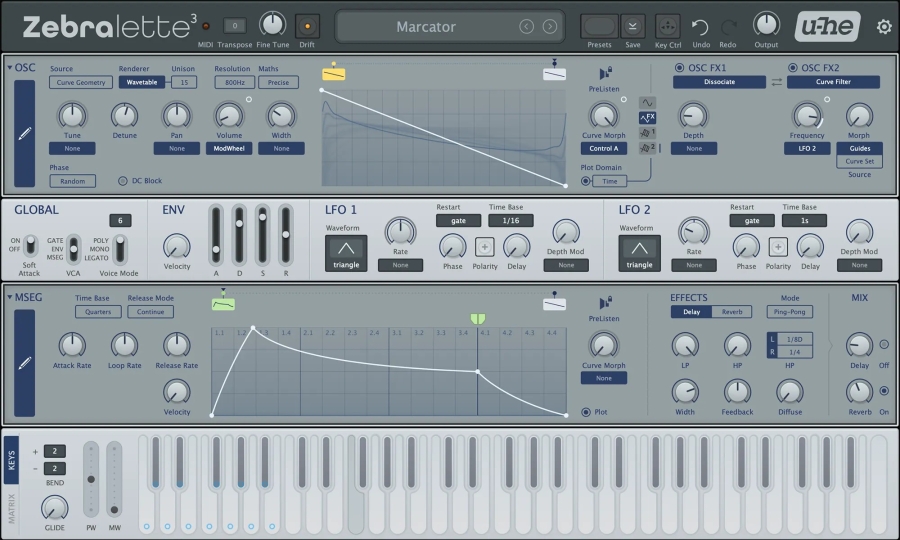
The interface is clean and intuitive, perfect for newcomers while offering depth for experts. The main view centers on the Oscillator Editor, where you can draw and sculpt waveforms using spline curves, Bézier handles, freehand tools, and warping functions like Scale, Multiply, Warp, and Rotate. This draws inspiration from vector graphics software, allowing precise control over the orange trace that visualizes the waveform in real-time or spectrum mode (time vs. frequency). Morphing between up to 16 curves adds dynamism, turning static sounds into evolving textures.
To visualize this, here's a screenshot of the Zebralette 3 interface in action:
Complementing the oscillator are two serial FX blocks for mangling, which include options such as filters, formants, phase distortion, spectral decay (where harmonics fade at different rates for plucked or atmospheric effects), warping, windowing, and animation. These aren't afterthoughts—they're integral to shaping the raw oscillator output into usable tones.
Modulation is where Zebralette 3 shines. It includes a classic ADSR envelope with velocity sensitivity, but the star is the MSEG (Multi-Stage Envelope Generator). This flexible editor lets you draw dynamic curves with up to seven morphable MSEGs, complete with looping, grid snapping for rhythmic patterns (X-axis) or pitch sequencing (Y-axis in 12/24 steps), and spline tools for smooth accelerations or arcs. Two LFOs provide additional movement: one global, one per voice, with multiple waveforms, tempo sync, and phase control.
The modulation matrix offers six slots for routing sources (like LFOs, MSEG, velocity, modwheel) to destinations, with modifiers such as quantization, sample & hold, or slew limiting. You can even modulate the modulation depth, adding layers of complexity without overwhelming the user.
On the effects side, global delay (syncable, stereo, or ping-pong) and reverb (from short ambiences to vast halls) add polish. These are simple but effective, ensuring your sounds sit well in a mix without needing external plugins.
What's New in Zebralette 3?
Building on its predecessors, Zebralette 3 introduces several game-changers. The spline-based editing in both the Oscillator and MSEG editors allows for smoother, more organic shapes—think Bézier curves for fluid transitions that were clunky in older versions. Morphing capabilities have expanded, with up to 16 curves in the oscillator and seven in the MSEG, enabling cinematic evolutions ideal for film scores or ambient music.
The audio engine now supports additive synthesis alongside wavetable export in .WAV format, bridging gaps with other synths like Serum or Vital. CPU efficiency has been drastically improved, making it run lighter than ever—perfect for stacking multiple instances in a project. u-he also uses Zebralette 3 as a testbed for their new License Card system, hinting at future innovations.
Reviews highlight these updates as transformative. Synthtopia notes the "dynamic toolbox from vector graphic apps" for waveform mangling, while Bedroom Producers Blog praises the presets for their nuance, covering polysynths, pads, percussion, and organs with subtle movement. Demo tracks like "Oddvar – Stripes" (a deep house piece using only Zebralette 3 sounds) and "Hyboid – Rowlf’s Daydream" (fluffy jazz rock) showcase its versatility.
System Requirements and Compatibility
Zebralette 3 is designed for broad accessibility. It runs on macOS 10.10+, Windows 7+, and Linux (glibc 2.28+), with CPU requirements starting at Intel Nehalem or AMD Bulldozer (Apple M1 supported). You'll need about 50-125 MB of disk space and a display of at least 1280x1024 pixels. Formats include CLAP, AUv2, VST3, and AAX (Pro Tools 10.3.7+), ensuring compatibility with most DAWs like Ableton Live, Logic Pro, FL Studio, or Reaper. Linux support is beta, with community assistance via forums.
No standalone version—it's a plugin only, so integrate it into your host software. MIDI learn and host automation make it seamless for live performance or studio work.
Getting Started: Download and Installation
Downloading Zebralette 3 couldn't be simpler. Head to the u-he website's freeware section and grab the installer for your platform—no registration required. Installation is straightforward: run the setup, scan for plugins in your DAW, and you're ready. u-he provides a user guide PDF and demo videos to get you up to speed.
Once loaded, explore the factory presets (though not quantified, they're diverse and inspiring). Start with basic waveforms, then experiment with morphing and FX to create custom patches. Tip: Use the oscilloscope view to visualize changes in real-time—it's a great learning tool.
Sound Design Possibilities and Tips
Zebralette 3 excels in spectral and evolving sounds. For basslines, use spectral decay for punchy attacks; for pads, morph between curves with MSEG for breathing textures. Sci-fi effects? Phase distortion and warping deliver alien vibes.
Stack instances for polyphony beyond the built-in 16 voices, or layer with other synths. Export curves as wavetables to feed into compatible plugins. Beginners: Stick to the ADSR and LFOs first; pros: Dive into the mod matrix for intricate routings.
Compared to other free synths like Vital or Surge XT, Zebralette 3 offers unique spectral tools without the bloat. Vital is great for wavetables, but Zebralette's additive mode and spline editing provide a different flavor—more organic, less grid-based.
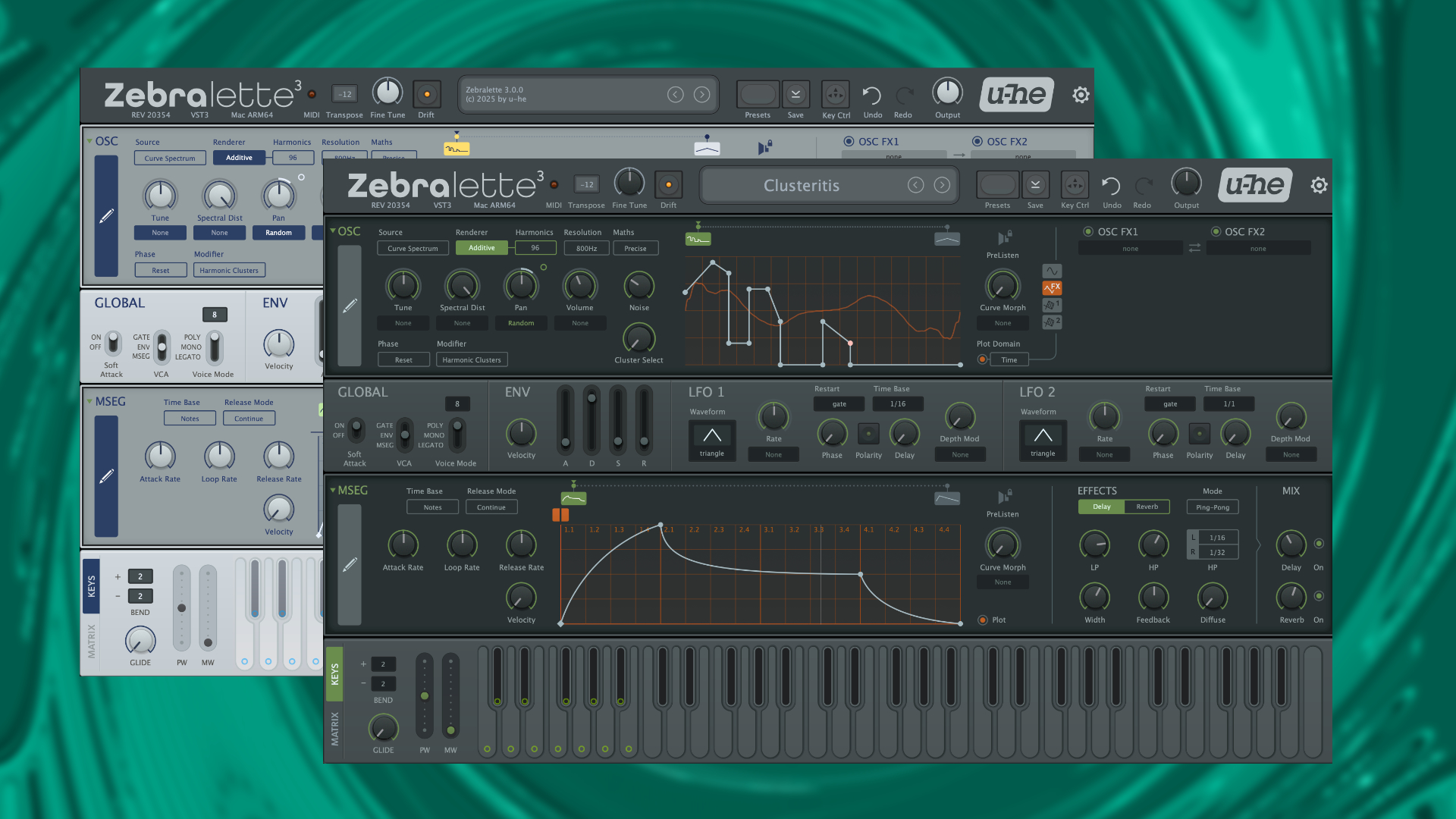
Here's another look at the interface to inspire your setup:
Why Zebralette 3 is a Game-Changer for Freeware
In a market flooded with freemium models, Zebralette 3's outright free status is refreshing. It democratizes high-end synthesis, letting aspiring producers experiment without barriers. For Zebra 3 owners, it's an extra oscillator; for everyone else, it's a standalone gem.
Community feedback is glowing—users call it a "fantastic Christmas gift," praising its depth and efficiency. As music tech advances, tools like this keep creativity alive.
Conclusion: Download and Unleash Your Creativity
Zebralette 3 isn't just free—it's a testament to u-he's commitment to innovation. Whether you're crafting deep house, jazz rock, or experimental soundscapes, this synth delivers. Released amid the holiday season, it's the perfect gift to yourself. Head over to u-he.com, download it, and start exploring. Who knows? Your next hit might start with a single, spectral oscillator.
