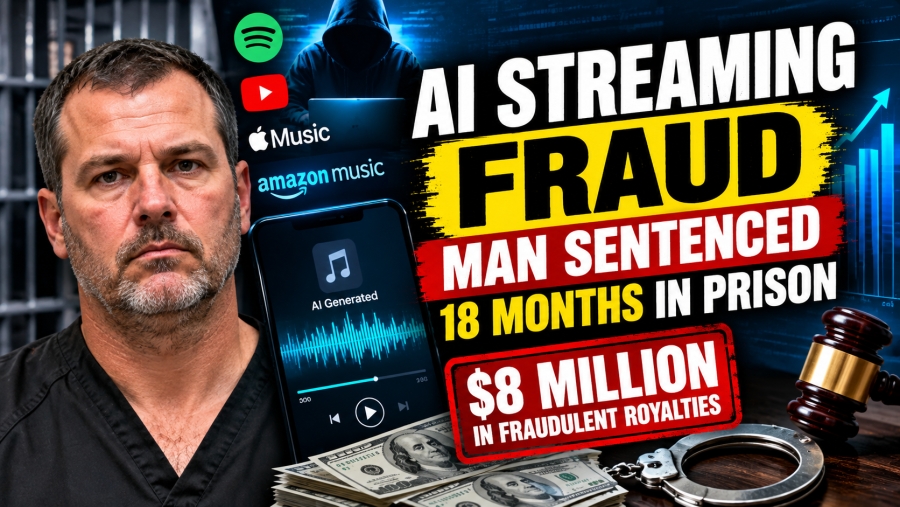
AI Music Streaming Fraud: Michael Smith Sentenced to 18 Months in Prison for $8 Million Royalty Scam
A major music-industry fraud case has reached a landmark conclusion. Michael Smith, a 54-year-old musician and business owner from North Carolina, has been sentenced to 18 months in federal prison for manipulating music-streaming platforms with AI-generated songs and automated bots, obtaining more than $8 million in fraudulent royalty payments.
The sentence, handed down on October 6, 2026, follows a scheme that operated between 2017 and 2024. According to the U.S. Department of Justice (DOJ), Smith created thousands of fraudulent streaming accounts, used automated software to play tracks he controlled and generated hundreds of thousands of songs with artificial intelligence to sustain the operation.
Smith was also ordered to forfeit $8,091,843.64 and will serve two years of supervised release after his prison term.
The case is significant because it demonstrates how AI music generation and automated streaming can be combined to exploit royalty systems. However, the distinction is crucial: creating music with AI is not, by itself, the crime described in this case. The fraud involved deliberately manufacturing fake streams to obtain royalty payments.
Who Is Michael Smith, and What Happened?
Michael Smith is a North Carolina musician and business owner who admitted to participating in a scheme designed to defraud streaming platforms and musicians.
According to the DOJ, Smith's operation ran from 2017 through 2024 and involved music services including Spotify, Apple Music, Amazon Music and YouTube Music. Rather than relying on genuine listeners to discover his recordings, he used fraudulent accounts and automated software to manufacture plays.
The resulting streaming numbers generated royalties that would ordinarily be distributed based on legitimate listening activity.
Smith pleaded guilty on March 19, 2026, to one count of conspiracy to commit wire fraud. On October 6, U.S. District Judge John G. Koeltl sentenced him to 18 months in prison.
Prosecutors had sought a substantially longer sentence, arguing that the scale of the scheme warranted stronger punishment and would otherwise risk sending a weak message to potential offenders.
The court's decision closes a significant chapter in a case that illustrates the growing challenges facing digital music distribution, streaming analytics and royalty accounting.
Source: U.S. Department of Justice.
How the AI Music Streaming Fraud Worked
The operation combined three principal activities: creating fraudulent accounts, generating or acquiring large volumes of music, and repeatedly streaming those recordings through automated systems.
According to the DOJ, Smith first established thousands of fake accounts on major streaming services. He then used software to make those accounts play music he controlled, collecting royalties generated by the artificial activity.
AI music generation helped supply the operation with enough tracks to sustain the scheme. Instead of manually producing every recording, Smith used technology to generate hundreds of thousands of songs.
This large catalogue allowed the operation to distribute streams across many recordings instead of concentrating suspicious activity on a small number of tracks.
The objective was not simply to publish AI-generated music. It was to create the false appearance that real listeners were repeatedly choosing those songs.
Streaming platforms use anti-fraud systems to detect unusual patterns, including suspicious account activity and artificial listening behaviour. According to prosecutors, Smith spread activity across thousands of recordings to make the scheme more difficult to detect.
The operation ultimately generated billions of fraudulent plays, according to court records.
More Than $8 Million in Fraudulent Royalties
The financial scale of the scheme is one of the reasons the case has attracted international attention.
The DOJ says Smith fraudulently obtained more than $8 million in royalties through the artificial streams. The court ordered him to forfeit $8,091,843.64, reflecting the proceeds associated with the scheme.
A particularly striking example involved YouTube Music in April 2023. According to the DOJ, Smith's bot accounts generated 80.9 million streams of his AI-generated music through family-plan accounts during that month.
For comparison, Taylor Swift's entire catalogue received 9.3 million streams on YouTube Music from family-plan streams during the same period, according to the government's figures.
The comparison illustrates the extraordinary volume of artificial activity alleged in the case. It does not mean Smith's music had a larger genuine audience than Swift's; the streams were generated by accounts controlled for the purpose of fraud.
The case also shows why raw streaming numbers can be misleading without context. A high play count is not necessarily evidence of genuine popularity, and platforms must distinguish real audience engagement from manipulated activity.
Why Streaming Fraud Hurts Real Artists
Music-streaming royalties are distributed according to contractual arrangements and each service's payment model. Under a pro-rata system, revenue is generally allocated based on a track's share of eligible listening activity during a particular period.
When fraudulent accounts create millions of artificial plays, they can distort the data used to calculate those shares.
That means money may go to recordings listeners never genuinely consumed, potentially reducing the share allocated to legitimate artists and rights holders.
For independent musicians, the impact can be particularly concerning. Smaller artists often depend on streaming income alongside live performances, merchandise, licensing and other revenue sources. Even modest royalty payments can matter when a career is built gradually over many releases.
Streaming fraud also undermines trust in platform statistics. Artists use play counts to evaluate releases, plan marketing campaigns and demonstrate audience demand to labels, promoters and potential partners.
If those numbers are manipulated, the consequences extend beyond royalty payments. Fraud can distort performance data, undermine confidence in discovery systems and make it harder to identify genuine audience behaviour.
The DOJ described Smith's scheme as diverting money from musicians and songwriters whose work was legitimately streamed by real consumers.
Is AI-Generated Music Illegal? No—But Fraud Is Different
One of the most important lessons from this case is the need to separate AI music creation from fraudulent monetization.
AI music tools can help users generate melodies, harmonies, instrumentals, vocals and complete compositions. Artists may use these systems for experimentation, songwriting, sound design or production workflows.
Whether a particular AI-generated recording can be distributed commercially depends on several factors, including the tool's terms, applicable copyright law, the rights associated with source material and any relevant contractual obligations.
But using AI to create music does not automatically constitute a criminal offence.
Smith's conviction concerned a different activity: conspiracy to commit wire fraud. He used automated accounts to simulate listening activity and obtain payments under false pretences.
In other words, the central issue was the deliberate manipulation of streaming systems, not simply the use of an AI music generator.
This distinction matters as debates about generative music become increasingly polarized. Copyright questions, artist-consent disputes and concerns about training data are important issues, but they are not identical to streaming fraud.
A legally distributed AI-generated track that attracts genuine listeners is fundamentally different from a recording uploaded and played by bots to manufacture royalty income.
Why AI Makes Streaming Fraud Easier to Scale
The case highlights how generative technology can reduce the effort required to produce large amounts of audio.
Before modern AI music systems became widely accessible, creating hundreds of thousands of distinct tracks would have required enormous amounts of time, labour or purchased content. Generative tools can make it easier to produce a large catalogue rapidly.
A large catalogue can then be uploaded to distribution platforms, subject to each distributor's policies and applicable rights requirements.
When combined with automated accounts, the ability to produce vast quantities of audio creates new challenges for streaming services. Fraudsters can attempt to spread activity across many tracks, accounts and services rather than relying on one obviously suspicious recording.
However, generating large amounts of music does not guarantee revenue. Legitimate streaming income depends on actual consumption and the applicable royalty arrangements. The Smith case shows that the financial outcome came from artificial listening, not simply from publishing many songs.
For platforms, the challenge is to identify fraudulent behaviour without unfairly penalizing legitimate artists who release music frequently or experiment with AI-assisted production.
How Streaming Platforms Can Respond
The case puts renewed focus on the technology and policies streaming services use to identify suspicious activity.
Potential indicators of fraud include repeated playback patterns, networks of connected accounts, abnormal listening volumes, suspicious payment details and activity inconsistent with ordinary human behaviour.
No single signal necessarily proves fraud. Legitimate listeners can replay songs, and promotional campaigns can produce unusual spikes in activity. Platforms therefore need multiple forms of evidence and proportionate enforcement procedures.
Possible responses include withholding royalties associated with fraudulent streams, removing manipulated plays from reporting systems, suspending accounts and distributors, and referring serious cases to law enforcement.
Streaming services and distributors can also improve transparency for artists whose music is flagged. Clear explanations and effective appeal mechanisms can help reduce the risk that legitimate recordings are mistakenly removed or have royalties withheld.
The challenge is particularly urgent as AI tools make it easier to generate music and automated systems make it easier to manufacture engagement.
What the Sentence Means for Independent Artists and Producers
For independent artists, producers and small labels, the case is a reminder that streaming success must be built on genuine audience engagement.
Artificially inflating play counts can jeopardize accounts, royalties and distribution relationships. Depending on the circumstances, deliberate manipulation can also create legal exposure.
Artists should be cautious about services promising guaranteed streams, rapid playlist growth or unusually high play counts for a fixed payment. Some promotional services operate legitimately, but offers involving fake listeners, automated accounts or undisclosed manipulation can put a release at risk.
Safer approaches include targeted advertising, collaborations, editorial pitching, short-form video campaigns, email lists, live performances and direct engagement with listeners.
Producers working with AI tools should also keep records of their workflows, review commercial-use terms and make sure they have the necessary rights to distribute their recordings.
The key principle is straightforward: use technology to make and promote music, not to deceive platforms about who is listening.
Could This Case Change the Music Industry?
Smith's sentence is a notable warning for anyone considering large-scale streaming manipulation. It is among the first prominent federal criminal cases in the United States to connect AI-generated music with a major streaming-royalty fraud scheme.
The 18-month prison term, combined with the forfeiture order and supervised release, demonstrates that authorities can pursue serious consequences when artificial streams are used to defraud platforms and rights holders.
The case may also encourage streaming services, distributors and rights organizations to strengthen fraud detection and improve how they investigate suspicious activity.
However, it does not settle every debate surrounding AI music. Questions about copyright, training data, vocal imitation, licensing and ownership remain separate legal and policy issues.
Nor does one criminal case establish that every AI-generated catalogue is suspicious. The appropriate focus is on evidence of misconduct, rather than treating the technology itself as proof of wrongdoing.
For the industry, the long-term challenge will be to protect royalty systems while allowing legitimate creators to use new tools and reach audiences.
Final Thoughts: AI Music Is Not the Crime—Manipulating Streams Is
Michael Smith's 18-month prison sentence marks an important moment in the fight against streaming fraud. According to the U.S. Department of Justice, his scheme used thousands of fraudulent accounts and hundreds of thousands of AI-generated songs to produce billions of artificial streams and obtain more than $8 million in royalties.
The court also ordered him to forfeit $8,091,843.64 and imposed two years of supervised release.
The wider lesson is not that AI-generated music should be banned. It is that streaming platforms and royalty systems must be protected against deliberate manipulation, regardless of how the underlying tracks were created.
For musicians, the case reinforces the importance of building audiences through legitimate listening. For platforms, it highlights the need for stronger fraud prevention. And for the wider music industry, it shows why the growth of generative AI must be accompanied by accountability and transparent distribution practices.
As AI music tools become more accessible, the distinction between creative innovation and financial fraud will remain essential. The future of AI music depends not only on what technology can create, but also on whether the systems distributing and monetizing that music can be trusted.
